DEF 14A
false0001671584DEF 14A00016715842023-01-012023-12-310001671584ecd:NonPeoNeoMemberecd:ChngInFrValAsOfVstngDtOfPrrYrEqtyAwrdsVstdInCvrdYrMember2023-01-012023-12-310001671584ecd:ChngInFrValAsOfVstngDtOfPrrYrEqtyAwrdsVstdInCvrdYrMemberecd:PeoMember2023-01-012023-12-310001671584ecd:NonPeoNeoMemberecd:ChngInFrValOfOutsdngAndUnvstdEqtyAwrdsGrntdInPrrYrsMember2023-01-012023-12-310001671584ecd:NonPeoNeoMemberecd:EqtyAwrdsInSummryCompstnTblForAplblYrMember2023-01-012023-12-310001671584ecd:YrEndFrValOfEqtyAwrdsGrntdInCvrdYrOutsdngAndUnvstdMemberecd:PeoMember2025-01-012025-12-3100016715842025-01-012025-12-310001671584ecd:ChngInFrValAsOfVstngDtOfPrrYrEqtyAwrdsVstdInCvrdYrMemberecd:PeoMember2024-01-012024-12-310001671584ecd:ChngInFrValOfOutsdngAndUnvstdEqtyAwrdsGrntdInPrrYrsMemberecd:PeoMember2023-01-012023-12-310001671584ecd:ChngInFrValOfOutsdngAndUnvstdEqtyAwrdsGrntdInPrrYrsMemberecd:PeoMember2025-01-012025-12-310001671584ecd:ChngInFrValOfOutsdngAndUnvstdEqtyAwrdsGrntdInPrrYrsMemberecd:PeoMember2024-01-012024-12-310001671584ecd:EqtyAwrdsInSummryCompstnTblForAplblYrMemberecd:PeoMember2024-01-012024-12-310001671584ecd:YrEndFrValOfEqtyAwrdsGrntdInCvrdYrOutsdngAndUnvstdMemberecd:PeoMember2024-01-012024-12-310001671584ecd:NonPeoNeoMemberecd:YrEndFrValOfEqtyAwrdsGrntdInCvrdYrOutsdngAndUnvstdMember2023-01-012023-12-310001671584ecd:EqtyAwrdsInSummryCompstnTblForAplblYrMemberecd:PeoMember2025-01-012025-12-310001671584ecd:EqtyAwrdsInSummryCompstnTblForAplblYrMemberecd:PeoMember2023-01-012023-12-310001671584ecd:NonPeoNeoMemberecd:YrEndFrValOfEqtyAwrdsGrntdInCvrdYrOutsdngAndUnvstdMember2024-01-012024-12-310001671584ecd:NonPeoNeoMemberecd:EqtyAwrdsInSummryCompstnTblForAplblYrMember2025-01-012025-12-310001671584ecd:YrEndFrValOfEqtyAwrdsGrntdInCvrdYrOutsdngAndUnvstdMemberecd:PeoMember2023-01-012023-12-310001671584ecd:NonPeoNeoMemberecd:YrEndFrValOfEqtyAwrdsGrntdInCvrdYrOutsdngAndUnvstdMember2025-01-012025-12-3100016715842024-01-012024-12-310001671584ecd:NonPeoNeoMemberecd:EqtyAwrdsInSummryCompstnTblForAplblYrMember2024-01-012024-12-31iso4217:USD
UNITED STATES
SECURITIES AND EXCHANGE COMMISSION
Washington, DC 20549
SCHEDULE 14A
Proxy Statement Pursuant to Section 14(a) of the Securities Exchange Act of 1934
(Amendment No.__)
|
|
|
|
|
Filed by the Registrant |
☒ |
|
Filed by a Party other than the Registrant |
☐ |
Check the appropriate box:
|
|
|
☐ |
|
Preliminary Proxy Statement |
|
|
|
☐ |
|
Confidential, for Use of the Commission Only (as permitted by Rule 14a-6(e)(2)) |
|
|
|
☒ |
|
Definitive Proxy Statement |
|
|
|
☐ |
|
Definitive Additional Materials |
|
|
|
☐ |
|
Soliciting Material Pursuant to § 240.14a-12 |
Aptevo Therapeutics Inc.
(Name of Registrant as Specified In Its Charter)
(Name of Person(s) Filing Proxy Statement if Other Than the Registrant)
Payment of Filing Fee (Check all boxes that apply)
|
|
|
☒ |
|
No fee required. |
|
|
|
☐ |
|
Fee paid previously with preliminary materials. |
|
|
|
☐ |
|
Fee computed on table in exhibit required by Item 25(b) per Exchange Act Rules 14a-6(i)(1) and 0-11. |
APTEVO THERAPEUTICS INC.
2401 4th Avenue, Suite 1050
Seattle, Washington 98121
NOTICE OF ANNUAL MEETING OF STOCKHOLDERS
To Be Held On August 21, 2026
Dear Aptevo Stockholder:
You are cordially invited to virtually attend the 2026 annual meeting of stockholders (the “Annual Meeting”) of Aptevo Therapeutics Inc., a Delaware corporation (the “Company”). The meeting will be held on August 21, 2026 at 10 a.m. Pacific Time. To facilitate stockholder participation and save costs, the Annual Meeting will be held in a virtual meeting format only at www.virtualshareholdermeeting.com/APVO2026. The meeting will be held for the following purposes:
1. To elect two nominees to serve on the Company’s Board of Directors (the “Board”) to hold office until the 2029 Annual Meeting of Stockholders and until their respective successors are duly elected and qualified (“Proposal 1” or the “Director Election Proposal”).
2. To ratify the selection of Baker Tilly US, LLP as the Company’s independent registered public accounting firm for the year ending December 31, 2026 (“Proposal 2” or the “Auditor Ratification Proposal”).
3. To approve, on a non-binding advisory basis, the compensation paid to the Company’s named executive officers in 2025, as disclosed in the proxy statement (“Proposal 3” or the “Say-on-Pay Proposal”).
4. To approve the Aptevo Therapeutics Inc. Fourth Amended and Restated 2018 Stock Incentive Plan (“Proposal 4” or the “Stock Incentive Plan Proposal”).
5. To conduct any other business properly brought before the Annual Meeting.
These items of business are more fully described in the proxy statement accompanying this Notice (the “Proxy Statement”).
The record date for the Annual Meeting is July 23, 2026. Only stockholders of record at the close of business on that date may vote on the proposals being presented at the Annual Meeting or any adjournment, postponement, rescheduling, or continuation thereof.
Important Notice Regarding the Availability of Proxy Materials for the Stockholders’ Meeting to Be Held Virtually on August 21, 2026 at 10 a.m. Pacific Time at www.virtualshareholdermeeting.com/APVO2026.
The Proxy Statement and Annual Report to stockholders are available at www.proxyvote.com.
By Order of the Board of Directors
/s/ SoYoung Kwon
SVP, General Counsel, Business Development and Corporate Affairs
Seattle, WA
July 31, 2026
You are cordially invited to virtually attend the meeting. Whether or not you expect to virtually attend the meeting, please complete, date, sign and return a proxy card (if you received one), or vote over the telephone or the internet as instructed in these materials, as promptly as possible in order to ensure your representation at the meeting. Even if you have voted by proxy, you may still vote if you virtually attend the meeting.
APTEVO THERAPEUTICS INC.
2401 4th Avenue, Suite 1050
Seattle, Washington 98121
FOR THE 2026 ANNUAL MEETING OF STOCKHOLDERS
To be held on August 21, 2026
QUESTIONS AND ANSWERS ABOUT THESE PROXY MATERIALS AND VOTING
When is this Proxy Statement and accompanying proxy card (“Proxy Card”) first being mailed to stockholders?
This Proxy Statement and Proxy Card are first being mailed on or about July 31, 2026 to stockholders of record of Aptevo Therapeutics Inc. (sometimes referred to as the “Company,” “Aptevo,” “we,” “us” or “our”) entitled to vote on the proposals being presented at the Annual Meeting.
How do I attend the Annual Meeting?
In order to facilitate stockholder participation and save costs, the meeting will be held virtually on August 21, 2026 at 10 a.m. Pacific Time. There will not be a physical meeting. We have worked to offer the same participation opportunities as if you attended the Annual Meeting in person and hope the virtual format will allow more stockholders to participate by removing any barriers caused by travel requirements. You may attend the Annual Meeting virtually, including voting and submitting questions, at www.virtualshareholdermeeting.com/APVO2026 by entering the 16-digit control number included on the Notice of the Annual Meeting of Stockholders (“Notice”) or your proxy card (if you received a printed copy of the proxy materials). You should ensure you have a strong internet connection wherever you intend to participate in the Annual Meeting. We encourage you to access the Annual Meeting before it begins. Virtual check-in will begin at 9:30 a.m. Pacific Time on the date of the Annual Meeting.
Our virtual meeting provider, Broadridge Financial Solutions, Inc. (“Broadridge”), facilitates stockholders’ opportunity to ask questions before and during the meeting. The Annual Meeting site will provide stockholders with information regarding (i) time guidelines for their questions, rules around what types of questions are allowed, and rules for how questions and comments will be recognized and disclosed to meeting participants; and (ii) procedures for posting appropriate questions received during the meeting and our answers on our website as soon as is practical after the meeting. Once you are logged into the Annual Meeting, you will be able to submit your questions directly to the Company. Our virtual meeting will be governed by our rules of conduct and procedures will be posted at www.virtualshareholdermeeting.com/APVO2026 in advance of the Annual Meeting.
You may obtain instructions for how to access the Annual Meeting virtually at www.virtualshareholdermeeting.com/APVO2026. If you encounter any difficulties accessing the virtual meeting during the check-in or meeting time or need support in addressing technical and logistical issues related to accessing the virtual meeting platform, a technical assistance phone number will be made available on the virtual meeting registration page at www.virtualshareholdermeeting.com/APVO2026, 30 minutes prior to the start of the meeting.
Who can vote at the Annual Meeting?
Only stockholders of record at the close of business on July 23, 2026 (the “Record Date”) will be entitled to vote on the proposals being presented at the Annual Meeting. On the Record Date, there were 1,517,945 shares of common stock of the Company (“Common Stock”) outstanding and entitled to vote at the Annual Meeting. Our Common Stock is our only class of voting stock.
Stockholder of Record: Shares Registered in Your Name
If on July 23, 2026 your shares were registered directly in your name with the Company’s transfer agent, Broadridge Financial Solutions, Inc., then you are a stockholder of record. As a stockholder of record, you may vote by virtually attending the Annual Meeting and voting during the Annual Meeting or vote over the telephone or the internet or by proxy card. Whether or not you plan to virtually attend the Annual Meeting, we urge you to vote by proxy to ensure your vote is counted.
Beneficial Owner: Shares Registered in the Name of a Broker or Other Nominee
If on July 23, 2026 your shares were held, not in your name, but rather in an account at a brokerage firm, bank, dealer, other similar organization, or other nominee, then you are the beneficial owner of shares held in “street name” and these proxy materials are being forwarded to you by that organization. The organization holding your account is considered to be the stockholder of record for purposes of voting on the proposals being presented at the Annual Meeting. As a beneficial owner, you have the right to direct your broker or other agent regarding how to vote the shares in your account. You are also invited to virtually attend the Annual Meeting. However, since you are not the stockholder of record, you may not vote your shares at the Annual Meeting unless you request and obtain a valid proxy from your broker or other agent.
What am I voting on?
There are four matters scheduled for a vote:
•Proposal 1: To elect two director nominees to serve on the Board to hold office until the 2029 Annual Meeting of Stockholders and until their respective successors are duly elected and qualified;
•Proposal 2: To ratify the selection of Baker Tilly US, LLP as the Company’s independent registered public accounting firm for the year ending December 31, 2026;
•Proposal 3: To approve, on a non-binding advisory basis, the compensation paid to the Company’s named executive officers in 2025, as disclosed in the Proxy Statement; and
•Proposal 4: To approve the Aptevo Therapeutics Inc. Fourth Amended and Restated 2018 Stock Incentive Plan.
What if another matter is properly brought before the meeting?
The Board knows of no other matters that will be presented for consideration at the Annual Meeting. If any other matters are properly brought before the meeting, it is the intention of the persons named in the accompanying proxy card to vote on those matters in accordance with their best judgment, subject to compliance with Rule 14a-4(c) of the Securities Exchange Act of 1934, as amended (the “Exchange Act”).
How do I vote?
For the Director Election Proposal, you may either vote “For” each of the nominees to the Board or you may “Withhold” your vote for any nominee you specify. For the Auditor Ratification Proposal, you may vote “For” or “Against” or abstain from voting. For the Say-on-Pay Proposal, you may vote “For” or “Against” or abstain from voting. For the Stock Incentive Plan Proposal, you may vote “For” or “Against” or abstain from voting.
The Board recommends that you vote:
•“For” the election of each of the director nominees named in the Director Election Proposal;
•“For” the Auditor Ratification Proposal;
•“FOR” the Say-on-Pay Proposal; and
•“FOR” the Stock Incentive Plan Proposal.
The procedures for voting are as follows:
Stockholder of Record: Shares Registered in Your Name
If you are a stockholder of record, you may vote by virtually attending the Annual Meeting and voting during the Annual Meeting, vote by proxy over the telephone, vote by proxy through the Internet or vote by proxy using a proxy card that you may request or that we may elect to deliver at a later time. Whether or not you plan to virtually attend the Annual Meeting, we urge you to vote by proxy to ensure your vote is counted. You may still virtually attend the Annual Meeting and vote during the Annual Meeting even if you have already voted by proxy.
•To vote using the proxy card (if one was provided), simply complete, sign and date the proxy card and return it promptly in the envelope provided. If you return your signed proxy card to us before the Annual Meeting, we will vote your shares as you direct.
•To vote over the telephone, dial toll-free 1-800-690-6903 using a touch-tone phone and follow the recorded instructions. You will be asked to provide the company number and control number included on your Notice. Your telephone vote must be received by 11:59 p.m. EDT on August 20, 2026 to be counted.
•To vote through the Internet, go to www.proxyvote.com to complete an electronic proxy card. You will be asked to provide the company number and control number from your Proxy Card. Your internet vote must be received by 11:59 p.m. EDT on August 20, 2026 to be counted.
•If you virtually attend the Annual Meeting, you can also vote during the Annual Meeting by visiting www.virtualshareholdermeeting.com/APVO2026 and entering the 16-digit control number included on your Proxy Card (if you received a printed copy of the proxy materials).
Beneficial Owner: Shares Registered in the Name of Broker or Bank
If you are a beneficial owner of shares registered in the name of your broker, bank, or other nominee, you should have received voting instructions from that organization rather than from us. Simply follow the instructions in the voting instruction form to ensure that your vote is counted. To vote virtually at the Annual Meeting, you must obtain a valid proxy from your broker, bank or other agent. Follow the instructions from your broker, bank or other agent included with these proxy materials, or contact your broker, bank or other agent to request a proxy form well in advance of the meeting.
How many votes do I have?
On each matter to be voted upon, you have one vote for each share of common stock you own as of July 23, 2026.
What happens if I do not vote?
Stockholder of Record: Shares Registered in Your Name
If you are a stockholder of record and do not vote by completing your proxy card, or by telephone, through the internet, or by virtually attending the Annual Meeting and voting during the Annual Meeting, your shares will not be voted.
Beneficial Owner: Shares Registered in the Name of Broker or Other Nominee
If you are a beneficial owner and do not instruct your broker, bank, or other agent how to vote your shares, the question of whether your broker or nominee will still be able to vote your shares depends on whether the particular proposal is a “routine” matter. Under the rules of the New York Stock Exchange (“NYSE”), which are also applicable to Nasdaq-listed companies, brokers, banks and other securities intermediaries that are subject to NYSE rules may use their discretion to vote your “uninstructed” shares on matters considered to be “routine” under NYSE rules but not with respect to “non-routine” matters. The Auditor Ratification Proposal is considered to be “routine” under NYSE rules
such that your broker, bank or other agent may vote your shares on such proposal in the absence of your voting instructions. The Director Election Proposal, the Say-on-Pay Proposal and the Stock Incentive Plan Proposal are considered “non-routine” such that your broker, bank or other agent may not vote your shares on such proposals in the absence of your voting instructions.
What if I return a Proxy Card or otherwise vote but do not make specific choices?
If you return a signed and dated proxy card or otherwise vote without marking voting selections, your shares will be voted, as applicable:
•“For” the election of each of the director nominees named in the Director Election Proposal;
•“For” the Auditor Ratification Proposal;
•“FOR” the Say-on-Pay Proposal; and
•“FOR” the Stock Incentive Plan Proposal.
If any other matter is properly presented at the Annual Meeting and any adjournments or postponements thereof, your proxyholder (one of the individuals named on the enclosed proxy card) will vote your shares using his or her best judgment.
Who is paying for this proxy solicitation?
We will pay for the entire cost of soliciting proxies. We have engaged Okapi Partners LLC (“Okapi”) to assist in the solicitation of proxies for the Annual Meeting. We have agreed to pay Okapi a fee of $15,000. We will also reimburse Okapi for reasonable out-of-pocket expenses and will indemnify Okapi and its affiliates against certain claims, liabilities, losses, damages and expenses. In addition to these proxy materials, our directors and employees may also solicit proxies in person, by telephone or by other means of communication. Directors and employees will not be paid any additional compensation for soliciting proxies. We may also reimburse brokerage firms, banks and other agents for the cost of forwarding proxy materials to beneficial owners. The entire cost of soliciting proxies on behalf of the Board will be borne by the Company.
What does it mean if I receive more than one Proxy Statement or Proxy Card?
If you receive more than one Proxy Statement or Proxy Card, your shares may be registered in more than one name or in different brokerage accounts. Please follow the voting instructions on the Proxy Cards to ensure that all of your shares are voted. Remember, you may vote by telephone, Internet or by signing, dating and returning a Proxy Card, or by voting at the Annual Meeting.
Can I change my vote or revoke my proxy?
Stockholder of Record: Shares Registered in Your Name
Yes. You may change your vote or revoke your proxy at any time before the final vote at the Annual Meeting. If you are the record holder of your shares, you may change your vote or revoke your proxy in any one of the following ways:
•You may submit a properly completed Proxy Card with a later date.
•You may grant a subsequent proxy by telephone or through the internet.
•You may send a timely written notice that you are revoking your proxy to Aptevo’s Corporate Secretary at 2401 4th Avenue, Suite 1050, Seattle, Washington 98121.
•You may virtually attend the Annual Meeting and vote virtually during the Annual Meeting. Simply virtually attending the Annual Meeting will not, by itself, revoke your proxy.
Beneficial Owner: Shares Registered in the Name of Broker or Bank
If your shares are held by your broker or bank as a nominee or agent, you should follow the instructions provided by your broker or bank.
When are stockholder proposals and director nominations due for next year’s annual meeting?
Pursuant to Rule 14a-8 of the Exchange Act, to be considered for inclusion in next year’s proxy materials, your proposal must be submitted in writing by April 2, 2027, to Aptevo’s Corporate Secretary at 2401 4th Avenue, Suite 1050, Seattle, Washington 98121. We also encourage you to submit any such proposals via email to the Corporate Secretary at LegalAffairs@apvo.com. Such a proposal must satisfy the rules and regulations of the Securities and Exchange Commission (the “SEC”). In order to avoid controversy, stockholders should submit proposals by means (including electronic) that permit them to prove the date of delivery. To comply with the universal proxy rules, stockholders who intend to solicit proxies in support of director nominees other than the Company’s nominees must provide notice that sets forth the information required by Rule 14a-19 under the Securities Exchange Act of 1934 no later than June 22, 2027.
In addition, our Amended and Restated Bylaws require that we be given advance written notice for nominations for election to our Board and of other business that stockholders wish to present for consideration at an annual meeting of stockholders (other than those proposals of business intended to be included in our proxy statement in accordance with Rule 14a-8 under the Exchange Act). The Amended and Restated Bylaws require that a stockholder who intends to present a proposal at an annual meeting of stockholders submit the proposal to the Corporate Secretary not less than 90 and no more than 120 days before the first anniversary of the date of the previous year’s annual meeting. Therefore, to be eligible for consideration at the 2027 Annual Meeting of Stockholders, such a proposal and any nominations for director must be received by the Corporate Secretary between April 23, 2027 and May 23, 2027; provided, however, that in the event that the date of the annual meeting is advanced by more than 20 days, or delayed by more than 60 days, from the first anniversary of the preceding year’s annual meeting, a stockholder’s notice must be so received not earlier than the 120th day prior to such annual meeting and not later than the close of business on the later of (A) the 90th day prior to such annual meeting and (B) the tenth day following the day on which notice of the date of such annual meeting was mailed or public disclosure of the date of such annual meeting was made, whichever first occurs. This advance notice period is intended to allow stockholders an opportunity to consider all business and nominees expected to be considered at the meeting. Any proposals received after the applicable deadline may be considered untimely and may be excluded.
If a stockholder who wishes to present a proposal before the 2027 Annual Meeting outside of Rule 14a-8 of the Exchange Act fails to notify us by the required date, the proxies that our Board solicits for the 2027 Annual Meeting will confer discretionary authority on the person named in the proxy to vote on the stockholder’s proposal if it is properly brought before that meeting subject to compliance with Rule 14a-4(c) of the Exchange Act. If a stockholder makes timely notification, the proxies may still confer discretionary authority to the person named in the proxy under circumstances consistent with the SEC proxy rules, including Rule 14a-4(c) of the Exchange Act.
What are “broker non-votes”?
If you are a beneficial owner whose shares of record are held by a broker, you may instruct your broker how to vote your shares. If you do not give instructions to your broker, the broker will determine if it has the discretionary authority to vote on the particular matter. Under NYSE rules, which are also applicable to Nasdaq-listed companies, brokers, banks and other securities intermediaries that are subject to NYSE rules may use their discretion to vote your “uninstructed” shares on matters considered to be “routine” under NYSE rules but not with respect to “non-routine” matters.
A broker non-vote occurs when a broker, bank or other agent has not received voting instructions from the beneficial owner of the shares and the broker, bank or other agent cannot vote the shares because the matter is considered “non-routine” under NYSE rules. Broker non-votes, if any, will be counted for purposes of calculating whether a quorum
is present at the meeting, but will not be counted for purposes of determining the number of votes cast with respect to a particular proposal.
The Auditor Ratification Proposal is a “routine” matter, and banks and brokerage firms may vote your shares on such proposal if you have not given voting instructions. The Director Election Proposal, the Say-on-Pay Proposal, and the Stock Incentive Plan Proposal are considered “non-routine,” and banks and brokerage firms may not vote your shares on such proposals in the absence of your voting instructions.
How many votes are needed to approve each proposal?
Directors are elected by a plurality of the votes of the holders of shares present at the Annual Meeting or represented by proxy and entitled to vote on the election of directors. Accordingly, for the Director Election Proposal, the two nominees receiving the highest number of affirmative votes will be elected. Votes withheld and broker non-votes, if any, will have no effect on the results of the Director Election Proposal.
To be approved, the Auditor Ratification Proposal, the Say-on-Pay Proposal and the Stock Incentive Plan Proposal require the affirmative vote of a majority of the votes cast by the holders of all of the shares of Common Stock present virtually or represented by proxy at the Annual Meeting. Abstentions and broker non-votes, if any, will have no effect on the results of these votes.
Each of the proposals is separate and apart from each other with votes of each proposal separately counted.
What is the quorum requirement and how will votes be counted?
A quorum of stockholders is necessary to hold a valid meeting. A quorum will be present if stockholders holding at least one-third of the Common Stock issued and outstanding and entitled to vote are present virtually at the Annual Meeting or represented by proxy. On the record date for the Annual Meeting, there were 1,517,945 shares of Common Stock outstanding and entitled to vote. Thus, the holders of 505,981 shares of Common Stock must be present virtually or represented by proxy at the Annual Meeting to have a quorum.
Your shares will be counted towards the quorum only if you submit a valid proxy (or one is submitted on your behalf by your broker, bank or other nominee) or if you vote by virtually attending the Annual Meeting and voting during the Annual Meeting. Withheld votes, abstentions and broker non-votes will be counted towards the quorum requirement. If there is no quorum, the chairman of the meeting or the holders of a majority of shares present at the Annual Meeting or represented by proxy and entitled to vote may adjourn or postpone the Annual Meeting to another date.
An inspector of elections appointed for the meeting will determine whether a quorum is present and will tabulate votes cast by proxy or at the meeting. If a quorum is not present, we expect to adjourn or postpone the Annual Meeting until we obtain a quorum.
How can I find out the results of the voting at the Annual Meeting?
Preliminary voting results will be announced at the Annual Meeting. In addition, final voting results will be published in a Current Report on Form 8-K that we expect to file within four business days after the Annual Meeting. If final voting results are not available to us in time to file a Current Report on Form 8-K within four business days after the Annual Meeting, we intend to file a Current Report on Form 8-K to publish preliminary results and, within four business days after the final results are known to us, file an additional Current Report on Form 8-K to publish the final results.
What proxy materials are available on the internet?
The Proxy Statement and the Annual Report on Form 10-K for the fiscal year ended December 31, 2025 are available at www.proxyvote.com.
Proposal 1
Election Of Directors
Aptevo’s Board is divided into three classes. Each class consists, as nearly as possible, of one-third of the total number of directors, and each class has a three-year term.
The Board presently has seven members. There are two directors in the class whose term of office expires in 2026. Each of the nominees listed below is currently a director of the Company. If elected at the Annual Meeting, each of these director nominees would serve until the 2029 annual meeting of stockholders and until the director’s successor has been duly elected and qualified, or, if sooner, until the director’s death, resignation or removal.
Although we do not have a formal policy regarding director attendance at annual meetings, it is the Company’s practice that directors and director nominees named in Aptevo’s proxy statement attend our annual stockholder meetings. All directors other than one attended the 2025 Annual Meeting of Stockholders.
Directors are elected by a plurality of the votes of the holders of shares present at the Annual Meeting or represented by proxy and entitled to vote on the election of directors. Accordingly, the two nominees receiving the highest number of affirmative votes will be elected.
The enclosed proxy card will not be voted for more than two candidates or for anyone other than the Board’s nominees or designated substitutes. Unless otherwise instructed, the persons named in the enclosed proxy will vote to elect each of Zsolt Harsanyi, Ph.D. and Barbara Lopez Kunz to the Board, unless, by marking the appropriate space on the proxy card, the stockholder instructs that he, she, they or it withholds authority from the proxy holder to vote with respect to a specified candidate(s).
The following is a brief biography of each director nominee and each director whose term will continue after the Annual Meeting.
|
|
|
|
|
Name |
|
Age |
|
Principal Occupation |
Jeffrey G. Lamothe |
|
61 |
|
President and Chief Executive Officer of Aptevo |
Marvin L. White |
|
64 |
|
Executive Chair |
Daniel J. Abdun-Nabi |
|
71 |
|
Former President and Chief Executive Officer of Emergent BioSolutions Inc. (“Emergent”) |
Grady Grant, III |
|
70 |
|
EVP/Partner of Vanigent BioPharm |
Zsolt Harsanyi, Ph.D. |
|
82 |
|
Former Chief Executive Officer of Exponential Biotherapies Inc. |
Barbara Lopez Kunz |
|
69 |
|
Chief Executive Officer of Caidya |
John E. Niederhuber, M.D. |
|
88 |
|
Former Executive Vice President of the Inova Health System |
Nominees for Election for a Three-year Term Expiring at the 2029 Annual Meeting
Zsolt Harsanyi, Ph.D. has served as a member of our Board since August 2016. Dr. Harsanyi has served on the Board of Directors of Emergent since 2004 and as its Chairman since April 1, 2022 and as Chairman of the Board of Directors of N-Gene Research Laboratories, Inc., a privately-held biotechnology company, since 2011. Prior to that, Dr. Harsanyi served as Chief Executive Officer and Chairman of the Board of Directors of Exponential Biotherapies Inc., a private biotechnology company, from 2004 to 2011. Prior to that, Dr. Harsanyi served as President of Porton International Inc., a pharmaceutical and vaccine company, from January 1983 to December 2004. In 1996, Dr. Harsanyi founded Dynport Vaccine Company LLC. Prior to that, he was Vice President of Corporate Finance at E.F. Hutton, Inc. Dr. Harsanyi directed the first assessment of biotechnology for the U.S. Congress’ Office of Technology Assessment, served as a consultant to the President’s Commission for the Study of Ethical Problems in Medicine and Biomedical and Behavioral Research and was on the faculties of Microbiology and Genetics at Cornell Medical
College. Dr. Harsanyi received his bachelor’s degree from Amherst College and his Ph.D. in genetics from Albert Einstein College of Medicine. The Board believes Dr. Harsanyi is qualified to serve on Aptevo’s Board because of his industry experience, his senior executive and financial positions, and his public company audit committee chair experience.
Barbara Lopez Kunz has served as a member of our Board since August 2016. Ms. Kunz is currently serving as Chief Executive Officer at Caidya, a clinical research organization. Ms. Kunz retired as President and Global Chief Executive Officer of the Drug Information Association, a non-profit health care company, at the end of March 2023. Ms. Kunz serves as a director on the board of Werfen, a leader in specialized diagnostics, as Vice-Chair of the Board of Directors of Children’s National Health System Research Institute, and has served on the Board of Directors of Caidya since 2022. From 2007 to 2013, she worked as President of Health and Life Sciences Global Business at Battelle Memorial Institute, a private nonprofit applied science and technology development company. Prior to that, she worked as Executive VP/GM for Thermo Fisher Scientific Inc.’s Fisher Biosciences from 2003 to 2007 and led the Latin America regional business from 2000 to 2003 at Uniqema, a company acquired by Croda International plc in 2006. Ms. Kunz also worked as Head of Strategy/M&A of Dupont from 1997 to 1998 and was the Global VP for the Enterprise Business Group of Imperial Chemical Industries (now AstraZeneca/Croda) from 1993 to 1997. Ms. Kunz earned bachelor degrees in both biology and chemistry from Thiel College, MBA coursework at Cleveland State University, an MS in polymer science from the University of Akron and is certified in INSEAD’s international executive program. She is also certified as a Board Director by the National Association of Corporate Directors. The Board believes that Ms. Kunz is qualified to serve on Aptevo’s Board because of her leadership experience, her business acumen and knowledge of the healthcare industry.
The Board Of Directors Unanimously Recommends A Vote In Favor Of Each Named Nominee.
Directors Continuing in Office Until the 2027 Annual Meeting
Daniel J. Abdun-Nabi has served as a member of our Board since August 2016. Mr. Abdun-Nabi served as the President and Chief Executive Officer of Emergent from 2012 to 2019 and as a director of Emergent from 2009 to 2019. Prior to that, Mr. Abdun-Nabi served in other various leadership positions at Emergent, including President and Chief Operating Officer from 2007 to 2012, Corporate Secretary from 2004 to 2008, Senior Vice President, Corporate Affairs and General Counsel from 2004 to 2007, and Vice President and General Counsel from May 2004 to December 2004. Before joining Emergent, Mr. Abdun-Nabi was General Counsel for IGEN International, Inc., a biotechnology company, and its successor BioVeris Corporation, from 1999 to 2004, and Senior Vice President, Legal Affairs, General Counsel and Secretary of North American Vaccine, Inc., a publicly traded vaccine company acquired by Baxter International Inc. In 2000. Mr. Abdun-Nabi earned a bachelor's degree in political science from the University of Massachusetts Amherst, a J.D. from the University of San Diego School of Law and an LLM from Georgetown University Law Center. The Board believes that Mr. Abdun-Nabi is qualified to serve on the Board because of his extensive experience and knowledge of the biotechnology industry and Aptevo products.
Grady Grant, III has served as a member of our Board since August 2016. Mr. Grant is currently serving as EVP/Partner of Vanigent BioPharm, and until April 2022, was Senior Vice President of Evolve Biosystems, a biotechnology company that specializes in providing microbiome-based products to maintain a healthy newborn gut microbiome. Previously, from 2020 to 2021, he was Interim Chief Commercial Officer for New Vision Pharmaceuticals LLC, a contract pharmaceutical development and manufacturing company specializing in blow-fill-seal packaging, from 2018 to 2020, he was the Vice President of Sales for Tissue Tech Limited, a regenerative medicine company, and from 2011 to 2018, he worked as Vice President of Medical Sales for Mead Johnson Nutrition Company, a public company focused on pediatric nutrition. Prior to that, he served for 30 years at Eli Lilly and Company in various capacities, including service as Vice President of Sales Neuroscience from 2006 to 2011. Mr. Grant earned a bachelor degree in pharmaceutical science from Temple University. Mr. Grant is also certified as a Board Director by the National Association of Corporate Directors. The Board believes that Mr. Grant is qualified to serve on Aptevo's Board because of his knowledge of the pharmaceutical industry and marketed products.
Directors Continuing in Office until the 2028 Annual Meeting
Marvin L. White has served as a member of our Board since August 2016 and served as our Executive Chair since April 2026. Mr. White served as our President and Chief Executive Officer from August 2016 to April 2026. From 2010 to 2016, Mr. White served as a director of Emergent, and in 2020, he rejoined the Emergent Board of Directors.
From 2008 to 2014, Mr. White served as the Chief Financial Officer of St. Vincent Health, and was responsible for finance, materials management, accounting, patient financial services and managed care for all 19 hospitals and 36 joint ventures. Prior to joining St. Vincent Health in 2008, Mr. White was the Chief Financial Officer of Lilly USA, LLC, a subsidiary of Eli Lilly and Company, where he also held leadership positions in treasury and corporate finance and investment banking in the Corporate Strategy Group. He serves on the Board of Directors of OneAmerica Financial Insurance Partners, Inc., a mutual insurance and financial services company based in Indianapolis, Indiana and Delta Dental of Washington, a non-profit company. Prior to taking the role of President and Chief Executive Officer of Aptevo, Mr. White served on the Board of Directors of Washington Prime Group, a New York Stock Exchange-listed real estate investment trust (REIT) that invests in shopping centers, and CoLucid Pharmaceuticals, Inc., a pharmaceutical company that was publicly-traded until its acquisition by Eli Lilly in 2017. Mr. White earned a bachelor of science degree from Wilberforce University in Accounting and his MBA degree in Finance from Indiana University. Mr. White’s leadership experience as Chief Executive Officer of Aptevo and his director experience at Emergent provides valuable management and leadership experience. In addition, Mr. White provides crucial insight to the Board on company strategic planning and operations. For these reasons, the Board believes Mr. White is qualified to serve on Aptevo’s Board.
John E. Niederhuber, M.D. has served on our Board since August 2016 and served as our Lead Independent Director since April 2026. Dr. Niederhuber served as our Chairman (previously Vice Chairman and Lead Independent Director) from August 2016 to April 2026. Dr. Niederhuber is currently an adjunct professor of surgery and oncology at The Johns Hopkins University School of Medicine. Dr. Niederhuber is the former Executive Vice President of the Inova Health System, Founder of the Inova Translational Medicine Institute (Inova), and founding President and Chief Executive Officer of the Genomics and Bioinformatics Research Institute, a joint venture between Inova and the University of Virginia. Dr. Niederhuber joined the Inova Health System in 2010 as Executive Vice President of the Health System and Chief Executive Officer of Inova. He officially retired from his position at Inova in 2019. Prior to Inova, he served as the Director of the National Cancer Institute, the National Institutes of Health from 2006 to 2010 and as the Director of the University of Wisconsin Comprehensive Cancer Center and professor of surgery and oncology (member of the McArdle Laboratory) at the University of Wisconsin School of Medicine from 1997 to 2005. He chaired the Department of Surgery at Stanford University School of Medicine from 1991 to 1997 and held professorships at The Johns Hopkins University School of Medicine from 1987 to 1991 and at the University of Michigan from 1973 to 1987. Dr. Niederhuber also previously served on the Board of Directors of Emergent from 2010 to 2016. Dr. Niederhuber earned a bachelor of science from Bethany College and his M.D. from The Ohio State University School of Medicine. He is a member of the National Academy of Medicine. The Board believes that Dr. Niederhuber is qualified to serve on Aptevo's Board because he provides valuable insights to the Board through his experience in the field of oncology, immunology, genomics and in the business of healthcare.
Jeffrey G. Lamothe has served on our Board and served as the President and Chief Executive Officer of the Company since April 2026. Mr. Lamothe served as the Company’s Executive Vice President and Chief Operating Officer from March 2023 to April 2026, previously as Executive Vice President and Chief Financial Officer since February 2022 and previously as Senior Vice President and Chief Financial Officer since July 2016. Mr. Lamothe previously served as Emergent’s Vice President Finance, Biosciences Division. Mr. Lamothe assumed this role in February 2014 when Emergent concluded the acquisition of Cangene Corporation (“Cangene”), where he was Chief Financial Officer. Mr. Lamothe assumed the role of Chief Financial Officer of Cangene in August 2012. Prior to that, Mr. Lamothe was the Chief Financial Officer for Smith Carter Architects and Engineers Incorporated, a position which he held from January 2010 until July 2012. He also previously served as President and Chief Executive Officer of Kitchen Craft Cabinetry after occupying the position of VP Finance and Chief Financial Officer with that organization. Mr. Lamothe’s other past experience includes serving as Chief Financial Officer for Motor Coach Industries, and Mr. Lamothe has held various roles at James Richardson & Sons, Limited and Ernst & Young LLP. Mr. Lamothe earned his Bachelor of Commerce (honors) degree from the University of Manitoba and is a Chartered Public Accountant. The Board believes that Mr. Lamothe is qualified to serve on the Board because he provides valuable insights to the Board through his leadership in his previous roles and his knowledge and experience with Aptevo and its products.
information regarding the board of directors and corporate governance
Corporate Governance Guidelines
The Board adopted Corporate Governance Guidelines to assist with its exercise of its duties and responsibilities and to serve the best interests of the Company and its stockholders. The Board, with the assistance of the Nominating and Corporate Governance Committee, continuously evaluates the Company’s Corporate Governance Guidelines to ensure such guidelines are effectively serving the interests of the Company’s stockholders and are up-to-date with respect to current corporate governance best practices. Accordingly, in February 2026, the Board amended its Corporate Governance Guidelines to, among other things, specify that the Chair of the Board may be an executive chair or a non-executive chair and to change the frequency of Board and committee evaluations from annual to biennial.
Independence of The Board
As required under the Nasdaq Stock Market (“Nasdaq”) listing standards, a majority of the members of a listed company’s Board of Directors must qualify as “independent,” as affirmatively determined by the Board of Directors. The Board consults with the Company’s in-house counsel to ensure that the Board’s determinations are consistent with relevant securities and other laws and regulations regarding the definition of “independence,” including those set forth in pertinent listing standards of Nasdaq, as in effect from time to time.
Consistent with these considerations, after review of all relevant identified transactions or relationships between each director, or any of his or her family members, and the Company, its senior management and its independent auditors, the Board has affirmatively determined that the following five directors, representing a majority of the members of the Board, are independent directors within the meaning of the applicable Nasdaq listing standards: Mr. Abdun-Nabi, Mr. Grant, Dr. Harsanyi, Ms. Kunz and Dr. Niederhuber. In making this determination, the Board found that none of these directors had a material or other disqualifying relationship with the Company. Each of Messrs. White and Lamothe serving as our Executive Chair and our President and Chief Executive Officer, respectively, is not independent. Additionally, in accordance with our Corporate Governance Guidelines, the Board determined that all members of the Audit, Compensation, and Nominating and Corporate Governance (“Nom/Gov”) committees of the Board are independent. Additionally, information regarding our Board committees and their members is provided below.
71% Board Independence


100% Committee Independence for Audit, Compensation, and Nom/Gov Committees
|
|
|
|
|
|
|
|
|
|
Audit
Committee |
|
Compensation
Committee |
|
Nominating and Corporate Governance
Committee |
|
|
|

|
|

|
|

|
Board Skills and Background
Our directors bring to our Board a wide variety of skills, qualifications, and viewpoints that strengthen the Board’s ability to carry out its oversight role on behalf of our stockholders. The table below is a summary of the range of skills and experiences that each director brings to the Board, each of which we find to be relevant to our business. Because it is a summary, it does not include all of the skills, experiences, and qualifications that each director offers, and the fact that a particular experience, skill, or qualification is not listed does not mean that a director does not possess it. All of our directors exhibit high integrity, an appreciation for mix of background and thought, innovative thinking, a proven record of success, and deep knowledge of corporate governance requirements and best practices.
|
|
|
|
|
|
|
|
ATTRIBUTES, EXPERTISE & SKILLS |
Marvin L. White |
Daniel J. Abdun-Nabi |
Grady Grant, III |
Zsolt Harsanyi, Ph.D. |
Barbara Lopez Kunz |
John E. Niederhuber, M.D. |
Jeffrey G. Lamothe |
Leadership Experience |
X |
X |
X |
X |
X |
X |
X |
Strategic Planning and Operations |
X |
X |
X |
X |
X |
X |
X |
Corporate Governance Experience |
X |
X |
X |
X |
X |
X |
X |
Relevant Industry Experience |
X |
X |
X |
X |
X |
X |
X |
ESG and/or Human Capital Management Experience |
X |
X |
X |
X |
X |
X |
X |
Risk Management Expertise |
X |
X |
X |
X |
X |
X |
X |
Finance Experience |
X |
X |
X |
X |
X |
X |
X |
Sales / Marketing Experience |
|
|
X |
|
X |
|
X |
Legal Expertise |
|
X |
|
|
|
|
|
Public Company Board Experience |
X |
X |
X |
X |
X |
X |
|
Aptevo Institutional Knowledge |
X |
X |
X |
X |
X |
X |
X |
Board Leadership Structure
Our Corporate Governance Guidelines provide the Board with flexibility in determining its leadership structure. The Board has decided to keep separate the positions of chief executive officer and chair of the Board. The Board believes this separate governance structure is optimal because it enables Mr. Lamothe to focus his entire energy on running the Company while affording us the benefits of additional leadership and other contributions from Mr. White who works closely with Mr. Lamothe and the executive team to provide mentorship and continuity and support the Company’s long-term growth, as well as from Dr. Niederhuber.
Our Corporate Governance Guidelines provide that in the event that the Chairman of the Board is not an independent director, the Nominating and Corporate Governance Committee may nominate an independent director to serve as
lead independent director, who shall be approved by a majority of the independent directors. The lead independent director, among other things, would serve as the presiding director at all executive sessions, determine the need for special meetings of the Board, and consult with directors on matters relating to corporate governance and Board performance. Because Mr. White serves as the Executive Chair of the Board, Dr. Niederhuber was appointed to serve as the lead independent director effective as of April 1, 2026.
Role of the Board in Risk Oversight
Our Board is actively engaged in the oversight of risks Aptevo faces and consideration of the appropriate responses to those risks. The Board is responsible for oversight of Aptevo’s risk management programs and, in performing this function, reviews the long- and short-term internal and external risks facing the Company through its participation in an annual risk assessment survey. On an annual basis, key risks, mitigation activities and potential new or emerging risks are discussed with management and further addressed with our Audit Committee as necessary. The Audit Committee at least annually discusses with senior management the Company’s cybersecurity risk profile, environmental and social risk and risk management, product risk and risk management, including guidelines and policies to govern the process by which Aptevo’s exposure to risk is handled. The Audit Committee also reviews and comments on an annual risk assessment performed by management. After the Audit Committee performs its review and comment function, it reports any significant findings to the Board. The Compensation Committee strives to create incentives that encourage a reasonable and appropriate level of risk-taking consistent with our business strategy. Our Compensation Committee assesses risks relating to our executive compensation plans and arrangements, and whether our compensation policies and programs have the potential to encourage excessive risk taking. The Nominating and Corporate Governance Committee is responsible for reviewing our corporate governance and developing and maintaining corporate governance policies and procedures that are appropriate in light of the risks we face.
Meetings of The Board
Our Corporate Governance Guidelines provide that the directors are responsible for attending Board meetings and meetings of committees on which they serve. The Board met 6 times during 2025. Each Board member attended 75% or more of the aggregate number of meetings of the Board and of the committees on which she or he served, held during 2025 for which she or he was a director or committee member.
Information Regarding Committees of the Board
The Board has four standing committees: an Audit Committee, a Compensation Committee, a Nominating and Corporate Governance Committee and an Executive Committee. The duties and responsibilities of each committee is set forth in such committee’s written charter. The charters of the Audit, Compensation, and Nominating and Corporate Governance Committees are available to stockholders on the Company’s website at https://aptevotherapeutics.gcs-web.com/corporate-governance/overview/. The following table provides membership for each of the Board committees:
|
|
|
|
|
|
|
|
|
Name |
|
Audit |
|
Compensation |
|
Nominating
and
Corporate
Governance |
|
Executive |
Marvin L. White |
|
|
|
|
|
|
|
X |
Daniel J. Abdun-Nabi |
|
X |
|
X |
|
|
|
X |
Grady Grant, III |
|
X |
|
X |
|
X |
|
|
Zsolt Harsanyi, Ph.D. |
|
X* |
|
X |
|
|
|
X* |
Barbara Lopez Kunz |
|
X |
|
X* |
|
X |
|
|
John E. Niederhuber, M.D. |
|
|
|
X |
|
X* |
|
X |
Jeffrey G. Lamothe |
|
|
|
|
|
|
|
X |
* Committee Chairperson
Below is a description of each standing committee of the Board.
Each of the committees has authority to engage legal counsel or other experts or consultants, as it deems appropriate to carry out its responsibilities. The Board has determined that each member of the Audit, Compensation, and Nominating and Corporate Governance Committees meet the applicable Nasdaq rules and regulations regarding “independence” and each member is free of any relationship that would impair his or her individual exercise of independent judgment with regard to the Company. Below is a description of each committee of the Board.
Audit Committee
The Audit Committee of the Board was established by the Board in accordance with Section 3(a)(58)(A) of the Exchange Act to oversee the Company’s corporate accounting and financial reporting processes and audits of its financial statements. For this purpose, the Audit Committee performs several functions, including: (1) appointing, approving the compensation of and assessing the independence of our independent registered public accounting firm; (2) overseeing the work of our independent registered public accounting firm; (3) reviewing and discussing with management and the independent registered public accounting firm our annual and quarterly financial statements and related disclosures; (4) monitoring our internal control over financial reporting, disclosure controls and procedures and code of business conduct and ethics; (5) overseeing our internal audit function, if any; (6) assisting the Board in overseeing our compliance with legal and regulatory requirements; (7) periodically discussing our risk management policies, and reviewing and commenting on a periodic risk assessment by management; (8) establishing policies regarding hiring employees from our independent registered public accounting firm and procedures for the receipt and retention of accounting related complaints and concerns; (9) meeting independently with our internal auditing staff, if any, independent registered public accounting firm and management; (10) reviewing and approving or ratifying any related party transactions; and (11) preparing audit committee reports required by SEC rules; and (12) overseeing cybersecurity risks and related disclosures in accordance with SEC cybersecurity disclosure requirements.
The Audit Committee is composed of four directors: Dr. Harsanyi, Mr. Abdun-Nabi, Mr. Grant, and Ms. Kunz. The Audit Committee met 4 times during 2025.
The Board has also determined that each of the members of the Audit Committee qualifies as an “audit committee financial expert,” as defined in the applicable SEC rules and each of the members of the Audit Committee is independent within the meaning of the applicable Nasdaq listing standards.
Compensation Committee
The Compensation Committee of the Board acts on behalf of the Board to review, recommend for adoption and oversee the Company’s compensation strategy, policies, plans and programs, including: (1) annually reviewing and approving corporate goals and objectives relevant to the compensation of our executive officers; (2) determining the compensation of our Chief Executive Officer; (3) reviewing and approving the compensation of our other executive officers; (4) overseeing the evaluation of our senior executives; (5) overseeing and administering our cash and equity incentive plans; and (6) preparing the Compensation Committee report, if required by SEC rules.
To the extent permitted by applicable law and the provisions of a given equity-based plan, and consistent with the requirements of applicable law and such equity-based plan, the Compensation Committee may delegate to one or more executive officers of the Company the power to grant options or other stock awards pursuant to such equity-based plan to employees of the Company or any subsidiary of the Company who are not directors or executive officers of the Company. The Compensation Committee may also form and delegate authority to one or more subcommittees as it deems appropriate from time to time under the circumstances (including (a) a subcommittee consisting of a single member and (b) a subcommittee consisting of at least two members, each of whom qualifies as a “non-employee director,” as such term is defined from time to time in Rule 16b-3 promulgated under the Exchange Act, and the rules and regulations thereunder, and an “outside director,” as such term is defined from time to time in Section 162(m) of the Internal Revenue Code of 1986, as amended, and the rules and regulations thereunder).
The Compensation Committee is composed of five directors: Ms. Kunz, Mr. Abdun-Nabi, Mr. Grant, Dr. Harsanyi, and Dr. Niederhuber. The Compensation Committee met 3 times during 2025.
Compensation Committee Processes and Procedures
The Compensation Committee meets as often as it deems necessary in order to perform its responsibilities. The agenda for each meeting is usually developed by the Chair of the Compensation Committee, in consultation with the Chief Executive Officer, the General Counsel, Business Development and Corporate Affairs, and Willis Towers Watson, our independent compensation consultant. The Compensation Committee meets regularly in executive sessions. From time to time, various members of management and other employees as well as outside advisors or consultants may be invited by the Compensation Committee to make presentations, to provide financial or other background information or advice or to otherwise participate in Compensation Committee meetings. The Compensation Committee shall review and approve, or recommend for approval by the Board, the compensation of the Company’s Chief Executive Officer and the Company’s other executive officers, including salary, bonus and incentive compensation levels; deferred compensation; executive perquisites; equity compensation (including awards to induce employment); severance arrangements; change-in-control benefits and other forms of executive officer compensation. The Chief Executive Officer may not participate in, or be present during, any deliberations or determinations of the Compensation Committee regarding his compensation or individual performance objectives. Under the charter, the Compensation Committee has the authority to obtain, at the expense of the Company, advice and assistance from compensation consultants and internal and external legal, accounting or other advisors and other external resources that the Compensation Committee considers necessary or appropriate in the performance of its duties and the authority to conduct or authorize investigations into any matters within the scope of its responsibilities as it shall deem appropriate, including the authority to request any officer, employee or advisor of the Company to meet with the Compensation Committee. The Compensation Committee has direct responsibility for the oversight of the work of any consultants or advisers engaged for the purpose of advising the Compensation Committee. In particular, the Compensation Committee has the sole authority to retain, in its sole discretion, compensation consultants to assist in its evaluation of executive and director compensation, including the authority to approve the consultant’s reasonable fees and other retention terms. Under the charter, the Compensation Committee may select, or receive advice from, a compensation consultant, legal counsel or other adviser to the Compensation Committee, other than in-house legal counsel and certain other types of advisers, only after taking into consideration six factors, prescribed by the SEC and Nasdaq, that bear upon the adviser’s independence.
During 2025, the Compensation Committee engaged Willis Towers Watson as a compensation consultant. The Compensation Committee requested that Willis Towers Watson:
•Evaluate the efficacy of the Company’s existing compensation program in supporting and reinforcing the Company’s long-term strategic goals and executing that strategy;
•Assist in refining the previously developed peer group of companies and perform analyses of competitive performance and compensation levels for that group; and
•Assist in evaluating and refining non-employee director compensation.
Willis Towers Watson did not provide any additional services to the Company in 2025 other than as described above. Although our Board and Compensation Committee consider the advice and recommendations of such independent compensation consultants as to our executive and non-employee director compensation program, the Board and Compensation Committee ultimately make their own decisions regarding these matters.
Nominating and Corporate Governance Committee
The Nominating and Corporate Governance Committee of the Board acts on behalf of the Board to (1) develop and recommend corporate governance guidelines for review, (2) identify individuals qualified to become board members, (3) recommend persons to be nominated for election as directors, (4) oversee the evaluation of the board and (5) provide board education recommendations.
The Nominating and Corporate Governance Committee is composed of three directors: Dr. Niederhuber, Ms. Kunz and Mr. Grant. The Nominating and Corporate Governance Committee did not meet during 2025.
The Nominating and Corporate Governance Committee exercises general oversight with regard to the Board and identifies individuals qualified to become board members and recommends director nominees for the annual meeting of stockholders. The process followed by the Nominating and Corporate Governance Committee to identify and evaluate director candidates includes identifying qualified individuals consistent with guidelines approved by the Board and recommending to the Board the candidate for election as director.
In considering whether to recommend any particular candidate for inclusion in the Board’s slate of director nominees, the Nominating and Corporate Governance Committee considers the candidate’s integrity, character, demonstrated track record, education, experience and time dedication. The Nominating and Corporate Governance Committee believes that candidates for director should have certain minimum qualifications, including the ability to read and understand basic financial statements, being over 21 years of age and having the highest personal integrity and ethics. The Nominating and Corporate Governance Committee does not assign specific weights to particular criteria and no particular criterion is a prerequisite for a prospective nominee. However, the Nominating and Corporate Governance Committee retains the right to modify these qualifications from time to time. The Nominating and Corporate Governance Committee believes that the backgrounds and qualifications of its directors, considered as a group, should provide a composite mix of experience, knowledge and abilities that will allow it to fulfill its responsibilities. Moreover, the Board will specifically consider a candidate’s gender, nationality, race, ethnicity, and sexual orientation as part of its criteria in considering any such candidate for service on the Board.
In the case of incumbent directors whose terms of office are set to expire, the Nominating and Corporate Governance Committee reviews these directors’ overall service to the Company during their terms, including the number of meetings attended, level of participation, quality of performance and any other relationships and transactions that might impair the directors’ independence. The Nominating and Corporate Governance Committee also takes into account the results of the Board’s self-evaluation, conducted annually on a group basis. In the case of new director candidates, the Nominating and Corporate Governance Committee also determines whether the nominee is independent for Nasdaq purposes, which determination is based upon applicable Nasdaq listing standards, applicable SEC rules and regulations and the advice of counsel, if necessary. The Nominating and Corporate Governance Committee then uses its network of contacts to compile a list of potential candidates, but may also engage, if it deems appropriate, a professional search firm. The Nominating and Corporate Governance Committee conducts any appropriate and necessary inquiries into the backgrounds and qualifications of possible candidates after considering the function and needs of the Board. The Nominating and Corporate Governance Committee meets to discuss and consider the candidates’ qualifications and then selects a nominee for recommendation to the Board by majority vote.
In making such recommendations, the Nominating and Corporate Governance Committee shall consider candidates recommended by stockholders. The Nominating and Corporate Governance Committee does not alter the manner in which it evaluates candidates, including the minimum criteria set forth above, based on whether or not the candidate was recommended by a stockholder. The Nominating and Corporate Governance Committee reviews and evaluates information available to it regarding candidates recommended by stockholders and applies the same guidelines, and follows substantially the same process in considering them, as it does in considering other candidates. Stockholders who wish to recommend individuals for consideration by the Nominating and Corporate Governance Committee to become nominees for election to the Board at an annual meeting of the stockholders may do so by delivering a written recommendation to the Nominating and Corporate Governance Committee at our principal executive office not earlier than the 120th day prior to such annual meeting of the stockholders and not later than the close of business on the later of (A) the 90th day prior to such annual meeting of the stockholders and (B) the tenth day following the day on which notice of the date of such annual meeting of the stockholders was mailed or made public. Submissions must include the full name of the proposed nominee, a description of the proposed nominee’s business experience for at least the previous five years, complete biographical information, a description of the proposed nominee’s qualifications as a director and a representation that the recommending stockholder is a beneficial or record holder of our stock. Any such submission must be accompanied by the written consent of the proposed nominee to be named as a nominee and to serve as a director if elected.
Executive Committee
The purpose of the Executive Committee is to exercise such authority of the Board as may be necessary or appropriate during intervals between Board meetings, which includes, without limiting the generality of the foregoing, managing the business and affairs of the Company on behalf of the Board. The Executive Committee generally has the same authority as the Board and, except as otherwise required by law, may take any and all actions as if such actions were
taken by the full Board. The Executive Committee provides the Company with the ability to respond and take action quickly, as may be necessary, with respect to matters that may arise in between routine, scheduled meetings of the Board. Without limiting the foregoing, the Executive Committee enables the Board to act quickly with respect to financing matters, collaboration arrangements, and other partnership opportunities that may require quick or immediate action. The Executive Committee met 3 times in 2025.
The Executive Committee is composed of five directors: Dr. Harsanyi, Mr. Abdun-Nabi, Dr. Niederhuber, Mr. White and Mr. Lamothe. Dr. Harsanyi is the Chairman of the Executive Committee.
Overboarding
The Board recognizes the substantial time commitment required of directors of public company boards. Accordingly, as set forth in our Corporate Governance Guidelines, directors are encouraged to limit the number of other public company boards on which he or she serves to three; however, directors may serve on more than three public company boards upon consent of the Board. Directors are required to advise the Chairman of the Board in advance of accepting an invitation to serve on another public company board.
Board Refreshment
While the Board recognizes the value of onboarding new directors who may offer fresh perspectives, the Board does not believe that it should establish term limits as a means to accomplish this. The Board believes that term limits could result in the loss of directors who have been able to develop, over a period of time, increasing insight into the Company and its operations and an institutional memory that benefits the entire membership of the Board as well as management. Pursuant to our Corporate Governance Guidelines and as an alternative to term limits, the Nominating and Corporate Governance Committee is charged with the duty of reviewing each director’s continuation on the Board at least once every three years. This will allow each director the opportunity to conveniently confirm his or her desire to continue as a member of the Board and allow the Company to conveniently replace directors who are no longer interested or effective.
Director Continuing Education
The Board encourages and expects each director to partake in continuing director education on an ongoing basis to enable him or her to better perform his or her duties and to recognize and deal appropriately with issues that arise. The Company has a policy of paying for all reasonable expenses related to continuing director education.
Stockholder Communications With The Board
Our Board will give appropriate attention to written communications that are submitted by stockholders and other interested parties and will respond if and as appropriate. The Chairman, with the assistance of Aptevo’s Corporate Secretary, will be primarily responsible for monitoring communications from stockholders and other interested parties and for providing copies or summaries to the other directors as the Chairman considers appropriate.
Communications will be forwarded to all directors if they relate to important substantive matters and include suggestions or comments that the Chairman considers to be important for the directors to know. In general, communications relating to corporate governance and corporate strategy are more likely to be forwarded than communications relating to ordinary business affairs, personal grievances and matters as to which Aptevo receives repetitive or duplicative communications.
Stockholders and other interested parties who wish to send communications on any topic to the Board, Chairman or Independent Directors as a group should address such communications to the Board, Chairman or Independent Directors, as applicable, c/o Corporate Secretary, Aptevo Therapeutics Inc., 2401 4th Avenue, Suite 1050, Seattle, Washington 98121. The Corporate Secretary will review all such correspondence and forward to the Board, Chairman or Independent Directors a summary and/or copies of any such correspondence that deals with the functions of the Board or its committees or that the Corporate Secretary otherwise determines requires their attention.
Employee, Officer and Director Hedging
Our policy prohibits our directors, officers or employees from purchasing financial instruments that are designed to hedge or offset any decrease in the market value of the Company's equity securities held by such persons.
Insider Trading Policy
We have adopted insider trading policies and procedures governing the purchase, sale, and/or other dispositions of our securities by directors, officers and employees or the Company itself, that are reasonably designed to promote compliance with insider trading laws, rules and regulations, and any listing standards applicable to the Company.
Code of Ethics
The Company has adopted the Aptevo Therapeutics Inc. Code of Conduct and Business Ethics that applies to all officers, directors and employees. The Code of Conduct and Business Ethics is available on the Company’s website at https://aptevotherapeutics.gcs-web.com/corporate-governance/overview. If the Company makes any substantive amendments to the Code of Conduct and Business Ethics or grants any waiver from a provision of the Code to any executive officer or director, the Company will promptly disclose the nature of the amendment or waiver on its website.
Human Capital Management
Employees and Office Location
Aptevo employed 33 full-time persons and 3 contract persons as of December 31, 2025. The team is comprised of a dedicated group of accomplished professionals who bring a broad range of academic achievements combined with significant industry experience. We believe that our future success will depend in part on our continued ability to attract, hire and retain qualified personnel. To this end, we strive to maintain competitive base compensation structures and comprehensive benefits packages, and to engage our employees through ongoing development and training. None of our employees are represented by a labor union or covered by collective bargaining agreements. We believe our relationships with our employees are positive.
Our principal executive offices are located at 2401 4th Avenue, Suite 1050, Seattle, Washington 98121. Our telephone number is (206) 838-0500.
Corporate Values
Leading by our core values unifies Aptevo and enables every employee to be an agent of positive culture. We believe that our success depends on creating an environment that is personally and professionally rewarding and creating opportunities for personal and professional development. These values, which are the foundation of our Company culture, are:
oAct respectfully with all;
oDeal with each other directly, clearly, and transparently; and
oRoutinely seek feedback and receive it maturely.
oWork towards objectives with focus and speed without sacrificing quality;
oApproach our work like business owners; and
oInvest with the best interest of the Company in mind.
oAssume all employees are capable and collegial adults;
oLeaders enable employees to accept delegation; and
oBureaucracy and administrative tasks must be justified.
Workforce and Workplace Culture
We consider these values to be an integral part of our corporate goal setting and review process. We believe in empowering our employees and consider them as owners of the business. We treat each other with respect and maintain a high level of professionalism and accountability. Our Board of Directors and executive team continue to monitor and focus on our human capital resources to ensure we live by our core values.
Our employees are central to our operations and our ability to advance therapeutic product candidates. We focus on attracting, developing, and retaining highly qualified employees and maintaining a workplace that promotes professionalism, collaboration, and respect. We are an equal opportunity employer and are committed to fair and consistent employment practices. Our policies and practices support equal opportunity in hiring, compensation, promotion, and professional development. We maintain policies addressing workplace conduct, including anti-harassment and anti-retaliation standards, and seek to provide a safe and respectful working environment for all employees. We believe that building a strong team with a broad range of experiences and perspectives supports innovation in the development of therapeutic product candidates and enhances our ability to solve complex scientific and operational challenges.
Recruiting and Retention
We invest in resources to recruit, develop, and retain the talent needed to achieve our business goals. We believe in supporting our employees to reach their full potential and strive to promote internally. We have been successful in attracting and retaining talented personnel to support our business, though competition for personnel in our industry is intense.
Compensation and Benefits
Our compensation packages are designed to attract and retain talent, drive Company performance and achieve business goals. In setting appropriate compensation levels, we look at the average base pay rate for each position based on market data. We also offer an annual cash incentive program and long-term equity incentive plans designed to assist in attracting, retaining, and motivating employees and promoting the creation of long-term value for stockholders. Further, all employees are eligible for health insurance and other health benefits, paid and unpaid leaves, retirement benefits with Company match, and life and disability coverage/insurance. We have an unlimited paid time off policy that provides employees with considerable flexibility in scheduling time away from work.
Health & Safety
Employee safety and well-being is of paramount importance to us and is of continued focus in 2026. The Company maintains a hybrid working environment. Our essential employees, which mainly include our research and development team, work onsite, and non-essential employees work remotely or hybrid. We equip our employees working remotely or hybrid with necessary equipment and tools to continue to collaborate and remain productive.
Additionally, we have an Environmental, Health and Safety program that focuses on implementing and updating policies and training programs, as well as performing self-audits to enhance work safety.
Proposal 2
Ratification of Selection of Independent Registered Public Accounting Firm
Baker Tilly US, LLP currently serves as the Company’s independent registered public accounting firm. After consideration of the firm’s qualifications and past performance, the Audit Committee of the Board has selected Baker Tilly US, LLP as the Company’s independent registered public accounting firm for the year ending December 31, 2026, and has further directed that management submit the selection of its independent registered public accounting firm for ratification by the stockholders at the Annual Meeting. Baker Tilly US, LLP has audited the Company’s financial statements since 2020. Representatives of Baker Tilly US, LLP are expected to be present at the Annual Meeting. They will have an opportunity to make a statement if they so desire and will be available to respond to appropriate questions.
None of the Company’s Amended and Restated Certificate of Incorporation, Bylaws nor other governing documents or law require stockholder ratification of the selection of Baker Tilly US, LLP as the Company’s independent registered public accounting firm. However, the Audit Committee of the Board is submitting the selection of Baker Tilly US, LLP to the stockholders for ratification as a matter of good corporate practice. If the stockholders fail to ratify the selection, the Audit Committee of the Board will reconsider whether or not to retain that firm. The Audit Committee, however, will be under no obligation to retain a new or different independent registered public accounting firm. Even if the selection is ratified, the Audit Committee of the Board in its discretion may direct the appointment of different independent auditors at any time during the year if they determine that such a change would be in the best interests of the Company and its stockholders.
Principal Accountant Fees and Services
The following table summarizes the fees of Baker Tilly US, LLP, our Independent Registered Public Accounting Firm, billed to us for their audit and other services for the years ended December 31, 2025 and 2024. The audit fees include an estimate of amounts not yet billed.
For the years ended December 31, 2025 and 2024, fees paid or accrued to Baker Tilly US, LLP were:
|
|
|
|
|
|
|
|
|
|
|
Year Ended December 31, |
|
|
Year Ended December 31, |
|
|
|
2025 |
|
|
2024 |
|
Audit Fees |
|
$ |
504,738 |
|
|
$ |
455,000 |
|
Audit-related Fees |
|
|
— |
|
|
|
— |
|
Tax Fees |
|
|
— |
|
|
|
— |
|
All Other Fees |
|
|
— |
|
|
|
— |
|
Total Fees |
|
$ |
504,738 |
|
|
$ |
455,000 |
|
Audit Fees. Audit fees consist of fees from our principal auditor for the audit of our consolidated financial statements and other professional services provided in connection with statutory and regulatory filings or engagements and comfort letters.
Pre-Approval Policies and Procedures
The Audit Committee has policies and procedures that require the pre-approval by the Audit Committee (or one of its members) of all services performed by the Company’s independent registered public accounting firm and related fee arrangements. In the first half of each year, the Audit Committee approves the proposed services, including the nature, type and scope of services contemplated, and the related fees, to be rendered by these firms during the year. In accordance with this policy, the Audit Committee or one of its members pre-approved all services to be performed by the Company’s independent registered accounting firm.
Other Matters
The Auditor Ratification Proposal is separate from and unrelated to, and is not contingent upon any other proposal included in this Proxy Statement.
Required Vote
Approval of this proposal requires the affirmative vote of a majority of the votes cast by the holders of all of the shares of Common Stock present or represented by proxy at the Annual Meeting.
THE BOARD OF DIRECTORS RECOMMENDS THAT STOCKHOLDERS VOTE "FOR" THE RATIFICATION OF BAKER TILLY US, LLP AS SET FORTH IN PROPOSAL 2.
Proposal 3
Advisory Vote on Company’s 2025 Executive Compensation
As required by Section 14A of the Exchange Act, the Board is providing stockholders with a non-binding advisory vote on the compensation paid to our named executive officers in 2025, as disclosed in the accompanying compensation tables and the related narrative disclosure in this Proxy Statement, commonly referred to as the “Say-on-Pay” vote. At the 2022 Annual Meeting, stockholders voted to indicate their preference that the Company solicit a Say-on-Pay vote every year. The Board has adopted a policy that is consistent with that preference. In accordance with that policy, this year, the Company is again asking our stockholders to approve, on an advisory basis, the compensation of the Company’s named executive officers as disclosed in this proxy statement in accordance with SEC rules.
The Say-on-Pay vote is advisory; therefore, the result will not be binding on the Company, the Board, or the Compensation Committee and it will not affect, limit, or augment any existing compensation or awards. The Board and the Compensation Committee, however, value the opinions of our stockholders and will review and consider the voting results when making future compensation decisions for our named executive officers.
You should read the compensation tables and the related narrative disclosure in determining whether to approve this proposal.
The Board submits the following resolution for a stockholder vote at the Annual Meeting:
RESOLVED, that the compensation paid to the Company’s named executive officers, as disclosed in the Company’s Proxy Statement for the 2026 Annual Meeting of Stockholders pursuant to Item 402 of Regulation S-K, including the executive compensation tables and the related narrative discussion, is hereby APPROVED.
The Board of Directors recommends THAT STOCKHOLDERS vote “FOR” the approval, on an advisory basis, of the compensation paid to our named executive officers in 2025 as disclosed in this Proxy Statement.
Proposal 4
Approval of the Stock Incentive Plan Proposal
Overview
In this proposal, we are asking stockholders’ approval to amend and restate our Amended and Restated 2018 Stock Incentive Plan (as defined below) to authorize an additional 145,000 new shares, representing $633,650 in market value as of July 23, 2026, for issuance thereunder (the “Fourth Amended and Restated 2018 Stock Incentive Plan” or the “Fourth Amended Plan”), which was unanimously approved by the Board on July 16, 2026. If approved by stockholders, the Fourth Amended Plan will replace the 2018 Stock Incentive Plan, as amended and restated on July 24, 2025 (the “Current Plan”), and the Fourth Amended Plan will be effective upon such approval. If stockholder vote on the Fourth Amended Plan at the Annual Meeting is postponed, the Fourth Amended Plan will be effective on such date on which a stockholders’ meeting to vote to approve the Fourth Amended Plan occurs, and, until such time, the Current Plan will continue in effect, in accordance with its terms. The Current Plan originally was adopted by our Board on June 23, 2025 and approved by our stockholders on July 24, 2025.
The Board believes that equity awards are a critical part of our compensation program. Our compensation philosophy emphasizes equity-based awards because they align the interests of our employees (including our executive officers), directors, consultants, and advisors with those of our stockholders, encourage long-term retention, and incentivize long-term value creation. As of July 23, 2026, 7,360 shares remained available for the awards under the Current Plan. This available reserve under the Current Plan is not sufficient to grant equity awards to senior management in a manner that is consistent with our historical practice. Accordingly, if this Proposal 4 is not approved, we could be forced to increase cash compensation, thereby reducing resources otherwise available to meet our business needs. If this Proposal 4 is approved, we expect that, given our projected utilization, and assuming relative stock price stability, the increased share reserve will meet our grant needs until approximately December 31, 2026.
To enable us to continue offering meaningful equity-based incentives to our employees, officers, and directors, as well as consultants and advisors, the Board believes that it is both necessary and appropriate to increase the number of shares available for these purposes. The Board is seeking stockholder approval of the Fourth Amended Plan in order to authorize an additional 145,000 new shares for issuance thereunder. In calculating the size of the increase in the authorized number of shares issuable under the Fourth Amended Plan, our Board considered, among other things, our hiring plans and expected number of employees, our historical and projected share usage under our stock incentive plans, our “burn rate,” our current overhang in shares issuable upon exercise of outstanding awards granted under our stock incentive plans, the existing terms of such outstanding awards and assumptions regarding stock option exercise activity and forfeiture rates. A dilution analysis and an analysis of our burn rate is contained in this Proposal 4.
The following is a summary of the principal purposes and provisions of the Fourth Amended Plan, including a number of changes intended to promote sound corporate governance practices. The summary is qualified in its entirety by reference to the complete text of the Fourth Amended Plan, a copy of which is attached as Appendix A to this Proxy Statement. To the extent the description below differs from the text of the Fourth Amended Plan set forth in Appendix A, the text of the Fourth Amended Plan controls.
Summary of Principal Provisions
• Increased authorized pool of shares. The Fourth Amended Plan will increase the number of shares authorized for issuance under the Current Plan by 145,000 shares of common stock.
• No liberal share recycling of options or stock appreciation rights. Similar to the Current Plan, shares underlying options and stock appreciation rights (“SARs”) issued under the Fourth Amended Plan will not be recycled into the share pool under the Fourth Amended Plan if they are withheld in payment of the exercise price of the award or to satisfy tax withholding obligations in respect of such awards.
• Restrictions on Dividends and Dividend Equivalents. Similar to the Current Plan, the Fourth Amended Plan prohibits participants from receiving current dividends or dividend equivalents that are paid before the underlying award vests and is paid.
• Enhanced clawback provisions. The Fourth Amended Plan includes a recoupment, or “clawback” provision set forth in the Current Plan, under which any award agreement may provide for the cancellation or forfeiture of an award or the forfeiture and repayment to the Company of any gain related to an award, or other provisions intended to have a similar effect, upon such terms and conditions as may be determined by the Committee (as defined below) in accordance with any Company clawback policy (or successor policy) or otherwise, including as required by the Sarbanes-Oxley Act of 2002, the Dodd-Frank Wall Street Reform and Consumer Protection Act, or other applicable law, regulation or stock exchange listing requirement. This clawback provision also provides that participants in the Fourth Amended Plan agree to and acknowledge that they are obligated to cooperate with, and provide any and all assistance necessary to, the Company to recover or recoup any award or amount paid under the Fourth Amended Plan that becomes subject to clawback pursuant to any applicable law, government regulation, stock exchange listing requirement or policy of the Company, including, but not limited to, submitting documentation necessary to recover or recoup any such award.
• New Term. The Fourth Amended Plan also provides that awards may be granted pursuant to the Fourth Amended Plan until August 21, 2036.
Background for Request to Increase the Number of Shares Reserved for Equity Incentive Awards
Equity compensation is a vital component of our executive compensation philosophy. The Board believes it is in the best interests of the Company and its stockholders to approve the Fourth Amended and Restated 2018 Stock Incentive Plan in order to continue to motivate outstanding performance by our executive officers, employees, consultants, advisors, and non-employee directors. If this proposal is not approved, we believe that our efforts to motivate these individuals would be negatively impacted and that we would be at a disadvantage against our competitors for recruiting, retaining, and motivating those individuals who are critical to our success. We rely on equity as part of the compensation package for employees and directors. The current shares of common stock available for issuance under the Current Plan as of July 23, 2026, is 7,360, which is not sufficient for our 2026 annual grants to senior management and future grants to our employees. Accordingly, if this proposal is not approved, we could be forced to increase cash compensation, thus reducing resources available to meet our business needs.
In consideration of the limited number of shares remaining available for issuance under the Current Plan and our need for equity compensation to maintain a competitive position in attracting, retaining, and motivating key personnel, our Board adopted the Fourth Amended Plan. In calculating the size of the increase in the authorized number of shares issuable under the Fourth Amended Plan, our Board considered, among other things, our hiring plans and expected number of employees, our historic and projected share usage under our stock incentive plans, our “burn rate,” our current overhang in shares issuable upon exercise of outstanding awards granted under our stock incentive plans or as inducement grants, the existing terms of such outstanding awards and assumptions regarding stock option exercise activity and forfeiture rates. On July 23, 2026, the last reported sale price of our common stock on Nasdaq was $4.37 per share.
If stockholders approve the Fourth Amended Plan, we will have 145,000 shares of common stock available for issuance pursuant to future awards under the Fourth Amended Plan (plus (i) any shares of common stock available for issuance under the Current Plan (up to 7,360 shares), and (ii) any Returning Shares (as defined below)). We expect that this number of shares available for issuance, given our projected utilization and assuming relative stock price stability, will meet our grant needs until approximately December 31, 2026. This is only an estimate, and circumstances could cause the share reserve to be used more quickly or more slowly. These circumstances include, but are not limited to, the future price of shares of our common stock, the mix of cash, options, and full value awards provided as long-term incentive compensation, grant amounts provided by our competitors, payout of performance-based awards in excess of target in the event of superior performance, hiring activity, and promotions during the next few years.
Dilution Analysis
As of July 23, 2026, our capital structure consisted of 1,517,945 shares of common stock outstanding. As of July 23, 2026, 7,360 shares remained available for awards under the Current Plan. The proposed share authorization is a request for 145,000 new shares of common stock to be available for awards under the Fourth Amended Plan.
Overhang provides a measure of the potential dilutive effect of all outstanding equity awards and shares available for future grants. We calculated overhang as the total number of options outstanding and unvested restricted stock units (“RSU”), plus shares available to be granted, divided by the total number of shares of common stock outstanding and warrants outstanding. Our overhang as of July 23, 2026, was 0.59%. If the 145,000 additional shares proposed to be authorized for issuance under our Fourth Amended Plan are included in the calculations our overhang would have been 6.77% as of July 23, 2026.
The Board believes that this number of shares represents a reasonable amount of potential equity dilution, which will allow us to continue granting equity awards, an important component of our equity compensation program.
Burn Rate
Burn rate provides a measure of the potential dilutive impact of the equity awards we grant. Set forth below is a table that reflects our burn rate for 2023, 2024, and 2025, as well as the average over those years. The burn rates in the table below are calculated using Institutional Shareholder Services' Value-Adjusted Burn Rate (“VABR”) approach.
|
|
|
|
|
|
|
|
|
|
|
Fiscal Year |
|
Fair Value of Equity Awards Granted |
|
|
Basic Weighted
Average Number
of Shares of
Common Stock
Outstanding |
|
|
Value-Adjusted Burn Rate (1) |
2025 |
|
|
255,491 |
|
|
|
313,535 |
|
|
8.64% |
2024 |
|
|
— |
|
|
|
— |
|
|
0.00% |
2023 |
|
|
526,287 |
|
|
|
278,060 |
|
|
23.77% |
Three-Year Average |
|
|
260,593 |
|
|
|
197,198 |
|
|
10.80% |
(1)“Value-Adjusted Burn Rate” is defined as the fair value of equity awards granted during the period divided by the basic weighted-average of shares of common stock outstanding multiplied by the stock price.
The only equity compensation plan from which we may currently issue new awards is the Current Plan. We may also issue new awards as inducement grants. The following table summarizes information regarding all of our outstanding options under all of our equity compensation plans and shares available for future awards under all of our equity plans as of March 31, 2026.
|
|
|
|
|
|
|
March 31, 2026 |
|
Outstanding options |
|
— |
|
Outstanding RSUs |
|
|
6,542 |
|
Total shares of common stock underlying all outstanding options and RSUs |
|
|
6,542 |
|
Weighted-average exercise price of outstanding options |
|
$ |
40.24 |
|
Weighted-average remaining contractual life of outstanding options (in years) |
|
|
0.40 |
|
Total shares available for future awards |
|
|
7,360 |
|
Promotion of Sound Corporate Governance Practices
We have designed the Fourth Amended Plan to include a number of features that reinforce and promote alignment of equity compensation arrangements for employees, officers, non-employee directors, and consultants with the interests of our stockholders. These features include, but are not limited to, the following:
• Limitation on Awards to Non-Employee Directors. Awards granted to non-employee directors may not exceed an aggregate value of $1,000,000 (taken together with any cash fees earned by such non-employee director for services rendered during the calendar year and based on grant date fair value) in any one fiscal year period.
• No Discounted Stock Options or Stock Appreciation Rights. Stock options and SARs may not be granted with exercise prices lower than the fair market value of the underlying shares on the grant date.
• Prohibition on Repricing. The exercise price of a stock option or SAR may not be reduced, directly or indirectly, without the prior approval of stockholders, including by a cash repurchase of “underwater” awards.
• Minimum Vesting Requirements. Subject to certain limited exceptions, awards granted under the Fourth Amended Plan will be subject to a minimum vesting period of one year.
• No Liberal Share Recycling. Shares retained by or delivered to the Company to pay the exercise price of a stock option or SAR or to satisfy withholding taxes in connection with the exercise or settlement of an award count against the number of shares remaining available under the Fourth Amended Plan. The Fourth Amended Plan also prohibits “net share counting” upon the exercise of stock options or SARs and prohibits the reuse of shares purchased on the open market with the proceeds of option exercises.
• No Dividends on Unearned or Unvested Awards. The Fourth Amended Plan prohibits the current payment of dividends or dividend equivalent rights on unearned or unvested awards.
• Awards Subject to Clawback. Awards under the Fourth Amended Plan are subject to clawback in the event the participant engages in misconduct that causes the need for restatement of financial statements.
• No Tax Gross-Ups. The Fourth Amended Plan does not provide for any tax gross-ups.
• No Liberal Change in Control Definition. The Fourth Amended Plan defines “Reorganization Event” and “Change in Control Event” based on the consummation of the transaction rather than the announcement or stockholder approval of the transaction.
Description of the Fourth Amended Plan
References to the “Committee” in this summary mean the Compensation Committee of the Board. As the full Board may perform any function of the Committee with respect to the Fourth Amended Plan (except to the extent limited under Nasdaq rules), the term “Committee” also refers to the Board.
Types of Awards; Shares Available for Issuance
The Fourth Amended Plan allows for the issuance of Incentive Stock Options (“ISOs”) intended to qualify under Section 422 of the Internal Revenue Code, as amended (the “Code”), Nonstatutory Stock Options (“NSOs”), SARs, restricted stock awards, restricted stock units, other stock-based awards, cash-based awards, and performance awards (collectively, “Awards”). Subject to adjustment in the event of stock splits, stock dividends, or similar events, and assuming the Fourth Amended Plan is approved by our stockholders, Awards may be made under the Fourth Amended Plan for up to 145,000 shares of common stock, plus (i) any shares of common stock available for issuance under the Current Plan (up to 7,360 shares), plus (ii) any Returning Shares (collectively, the “Share Reserve”).
If any shares to which an Award relates are (i) forfeited, canceled or payment is made to the participant in the form of cash, cash equivalents or other property other than shares; (ii) tendered by the participant or withheld by the Company to satisfy any tax withholding obligation with respect to an Award other than an Option or SAR; or (iii) otherwise terminated without payment being made to the participant in the form of shares, such shares shall be added back to the Share Reserve (such shares, the “Returning Shares”). Notwithstanding the foregoing, the following shares will not be added back to the Share Reserve: (i) shares previously owned or acquired by the participant that are delivered to the Company, or withheld from an Award, to pay the exercise price of an Award, (ii) shares that are delivered or withheld for purposes of satisfying a tax withholding obligation relating to an Option or SAR, (iii) shares not issued or delivered as a result of the net settlement of an outstanding Option or SAR, or (iv) shares repurchased on the open market with the proceeds of the exercise price of an Option. Subject to applicable stock exchange requirements,
substitute Awards will not count against the Share Reserve, nor will shares subject to a substitute Award again be available for Awards under the Fourth Amended Plan to the extent of any forfeiture, expiration or cash settlement. Shares of common stock delivered by the Company under the Fourth Amended Plan may be authorized but unissued common stock or previously-issued common stock acquired by the Company.
Certain limitations apply to the shares of common stock available for issuance under the Fourth Amended Plan. The maximum aggregate grant date value of shares of common stock subject to awards that may be granted to a non-employee director during any calendar year, taken together with any cash fees earned by such non-employee director for services rendered during the calendar year, cannot exceed $1,000,000 in total value. The Committee may make exceptions to this limit for a non-executive chair of the Board or, in extraordinary circumstances, for other individual non-employee directors, as the Committee may determine in its discretion, provided that the non-employee director receiving such additional compensation may not participate in the decision to award such compensation.
In connection with a merger or consolidation of an entity with us or our acquisition of property or stock of an entity, the Committee may grant Awards under the Fourth Amended Plan in substitution for an option or other stock or stock-based Awards granted by such entity or an affiliate thereof on such terms as the Committee determines appropriate in the circumstances, notwithstanding any limitation on Awards contained in the Fourth Amended Plan. Substitute Awards granted under the Fourth Amended Plan in connection with a merger or consolidation of an entity with the Company or the acquisition by the Company of property or stock of an entity will not count against the overall share limits and limitations described above, except as required by reason of Section 422 and related provisions of the Code.
Descriptions of Awards
Options. Optionees receive the right to purchase a specified number of shares of common stock at a specified option price and subject to other terms and conditions as are specified in connection with the option grant. Only our employees or employees of our subsidiaries, if any, may receive ISOs as defined in Section 422 of the Code. An option that is not intended to be an ISO is an NSO. Options may not be granted at an exercise price that is less than 100% of the fair market value of the common stock on the effective date of grant; provided, however, that if the Committee approves the grant of an option with an exercise price to be determined on a future date, the exercise price may not be less than 100% of the fair market value of the common stock on such future date. ISOs may not be granted at an exercise price less than 110% of the fair market value in the case of stock options granted to optionees holding more than 10% of the total combined voting power of all classes of our stock. Under the terms of the Fourth Amended Plan, stock options may not be granted for a term in excess of 10 years (and five years in the case of ISOs granted to optionees holding greater than 10% of the total combined voting power of all classes of our stock). Any or all of the Awards available under the Fourth Amended Plan may be in the form of ISOs. The Fourth Amended Plan permits participants to pay the exercise price of options using one or more of the following manners of payment: (i) payment by cash, check or wire transfer, or, except as may otherwise be provided in the applicable option Award agreement or approved by the Committee, in connection with a “cashless exercise” through a broker, (ii) to the extent provided in the applicable option Award agreement or approved by the Committee, and subject to certain conditions, by surrender to us of shares of common stock owned by the participant valued at their fair market value, (iii) to the extent provided in an applicable NSO agreement or approved by the Committee, and subject to certain conditions, by delivery of a notice of “net exercise” as a result of which we will retain a number of shares of common stock otherwise issuable pursuant to the stock option equal to the aggregate exercise price for the portion of the option being exercised divided by the fair market value of our common stock on the date of exercise, (iv) to the extent provided by applicable law and provided for in the applicable option Award agreement or approved by the Committee, by any other lawful means, or (v) any combination of the foregoing.
Stock Appreciation Rights. A SAR is an award entitling the holder, upon exercise, to receive a number of shares of common stock or cash (or a combination thereof) determined by reference to appreciation, from and after the date of grant, in the fair market value of a share of our common stock over the measurement price. SARs may be granted independently or in tandem with stock options granted under the Fourth Amended Plan. The Fourth Amended Plan provides that the measurement price of an SAR may not be less than 100% of the fair market value of our common stock on the effective date of grant (provided, however, that if the Committee approves the grant of a SAR effective as of a future date, the measurement price will not be less than 100% of the fair market value on such future date) and that SARs granted under the Fourth Amended Plan may not have a term in excess of 10 years.
Limitation on Repricing of Options or SARs; No Reload Rights or Dividend Equivalents. With respect to options and SARs, unless such action is approved by stockholders or otherwise permitted under the terms of the Fourth Amended Plan in connection with certain changes in capitalization and reorganization events, we may not (i) amend any outstanding option or SAR granted under the Fourth Amended Plan to provide an exercise price or measurement price per share that is lower than the then-current exercise price or measurement price per share of such outstanding option or SAR, (ii) cancel any outstanding option or SAR (whether or not granted under the Fourth Amended Plan) and grant in substitution therefor new Awards under the Fourth Amended Plan (other than certain substitute Awards described above) covering the same or a different number of shares of common stock and having an exercise price or measurement price per share lower than the then-current exercise price or measurement price per share of the canceled option or SAR, (iii) cancel in exchange for a cash payment any outstanding option or SAR with an exercise price or measurement price per share above the then-current fair market value of our common stock, or (iv) take any other action under the Fourth Amended Plan that constitutes a “repricing” within the meaning of the rules of Nasdaq. No option or SAR granted under the Fourth Amended Plan will contain any provision entitling the grantee to the automatic grant of additional options or SARs in connection with any exercise of the original option or SAR or provide for the payment or accrual of dividend equivalents.
Restricted Stock Awards. We may issue Awards entitling recipients to acquire shares of our common stock subject to our right to repurchase all or part of such shares at their issue price or other stated or formula price (or to require forfeiture of such shares if issued at no cost) from the recipient in the event that conditions specified by the Committee in the applicable Award are not satisfied prior to the end of the applicable restriction period established for such Award. We refer to these Awards as Restricted Stock. Any dividends (whether paid in cash, stock or property) declared and paid by the Company with respect to shares of Restricted Stock (“Unvested Dividends”) will be paid to the participant only if and when such shares become free from the restrictions on transferability and forfeitability that apply to such shares. No interest will be paid on Unvested Dividends.
Restricted Stock Units. We may also grant Awards entitling the recipient to receive shares of our common stock (or cash equal to the fair market value of such shares) to be delivered at the time such Award vests. We refer to these Awards as Restricted Stock Units. The Committee may, in its discretion, provide that settlement of Restricted Stock Units will be deferred, on a mandatory basis or at the election of the participant in a manner that complies with Section 409A of the Code. A participant has no voting rights with respect to any Restricted Stock Units.
Other Stock-Based Awards. Under the Fourth Amended Plan, the Committee may grant other Awards of shares of common stock and other Awards that are valued in whole or in part by reference to, or are otherwise based upon our common stock or other property, having such terms and conditions as the Committee may determine. We refer to these types of Awards as Other Stock-Based Awards. Other Stock-Based Awards may be available as a form of payment in the settlement of other Awards granted under the Fourth Amended Plan or as payment in lieu of compensation to which a participant is otherwise entitled. Other Stock-Based Awards may be paid in shares of our common stock or cash, as the Committee determines.
Other Cash-Based Awards. The Company may also grant Awards denominated in cash rather than shares of common stock.
Performance Awards. Restricted Stock, Restricted Stock Units, and Other Stock-Based Awards and Cash-Based Awards granted under the Fourth Amended Plan may be made subject to achievement of performance goals. We refer to these types of Awards as Performance Awards. Performance measures established by the Committee may consist of one or more criteria determined by the Committee, including, without limitation:
• revenue (gross, operating or net);
• revenue growth;
• EBIT;
• EBITDA;
• earnings growth;
• profit margins or contributions;
• expense levels or ratios;
• return on investment;
• return on assets;
• return on equity;
• return on capital (total or invested);
• operating cash flow;
• cash flow sufficient to achieve financial ratios or a specified cash balance;
• free cash flow;
• cash flow return on capital;
• net cash provided by operating activities;
• cash flow per share;
• working capital or adjusted working capital;
• return on stockholders’ equity;
• total stockholder return;
• stock price; stock price appreciation;
• market capitalization;
• earnings per share (basic or diluted) (before or after taxes);
• price-to-earnings ratio;
• acquisitions or divestitures;
• collaborations, licensing, or joint ventures;
• product research and development;
• clinical trials;
• regulatory filings or approvals;
• patent application or issuance;
• manufacturing or process development;
• sales or net sales;
• sales growth;
• market share;
• market penetration;
• inventory control;
• growth in assets;
• key hires;
• business expansion;
• achievement of milestones under a third-party agreement;
• financing;
• resolution of significant litigation;
• legal compliance or risk reduction;
• improvement of financial ratings; or
• achievement of balance sheet or income statement objectives.
Such performance measures: (i) may vary by participant and may be different for different Awards; and (ii) may be particular to a participant or the department, branch, line of business, subsidiary or other unit in which the participant works and may cover such period as may be specified by the Committee. Performance criteria that are financial metrics may be determined in accordance with GAAP or financial metrics that are based on, or able to be derived from GAAP, and may be adjusted when established or at any time thereafter to include or exclude any items otherwise includable or excludable under GAAP. The determination of performance with respect to a performance criterion may include or exclude any one or more of:
• extraordinary items;
• gains or losses on the dispositions of discontinued operations;
• the cumulative effects of changes in accounting principles;
• the impairment or writedown of any asset or assets;
• charges for restructuring and rationalization programs;
• other extraordinary or non-recurring items, as specified by the Committee when establishing the performance measures; or
• such other factors as the Committee may determine.
Dividends and Dividend Equivalents
The Committee is authorized to grant to participants a right under the Fourth Amended Plan, to receive cash, common stock, other Awards or other property equal in value to all or a specified portion of the dividends paid with respect to a specified number of shares of common stock (“Dividend Equivalents”). Dividend Equivalents will be subject to the same vesting terms as applied to the original Award to which it relates. With respect to any Award that provides for or includes a right to dividends or Dividend Equivalents, if dividends are declared during the period that an equity Award is unvested, such dividends (or Dividend Equivalents) will either (i) not be paid or credited with respect to such Award or (ii) be accumulated but remain subject to vesting requirement(s) to the same extent as the applicable Award and shall only be paid at the time or times such vesting requirement(s) are satisfied. In no event will dividends or dividend equivalents be paid with respect to Options or SARs.
Transferability of Awards
Except as the Committee may otherwise determine or provide in an Award in connection with certain gratuitous transfers, Awards may not be sold, assigned, transferred, pledged, or otherwise encumbered by the person to whom they are granted, either voluntarily or by operation of law, except by will or the laws of descent and distribution or, other than in the case of an ISO, pursuant to a qualified domestic relations order. During the life of the participant, Awards are exercisable only by the participant.
Eligibility to Receive Awards
Employees, officers, directors, consultants, and advisors of Aptevo or a subsidiary of Aptevo are eligible to be granted Awards under the Fourth Amended Plan. However, ISOs may only be granted to our employees. The granting of Awards under the Fourth Amended Plan is discretionary, and we cannot now determine the number or type of Awards to be granted in the future to any particular person or group, except that Awards are subject to the limitations described above. Because our executives and non-employee directors are eligible to receive awards under the Fourth Amended Plan, they may be deemed to have a personal interest in the approval of this Proposal 4.
Administration
The Committee (which shall consist of two or more members who are not current or former officers or employees of the Company, who are “non-employee directors” to the extent required by and within the meaning of Rule 16b-3 under the Exchange Act and who are “independent” pursuant to the rules of Nasdaq) administers the Fourth Amended Plan and is authorized to grant Awards and to adopt, amend, and repeal the administrative rules, guidelines, and practices relating to the Fourth Amended Plan and to construe and interpret the provisions of the Fourth Amended Plan and any Award agreements entered into under the Fourth Amended Plan. The Committee may correct any defect, supply any omission, or reconcile any inconsistency in the Fourth Amended Plan or any Award in the manner and to the extent it will deem expedient and it will be the sole and final judge of such expediency.
Pursuant to the terms of the Fourth Amended Plan, the Committee may delegate authority under the Fourth Amended Plan to persons as it deems appropriate; provided, however, no such delegation may be made if it will prevent the Fourth Amended Plan or any award under the Fourth Amended Plan from complying with Rule 16b-3, the rules of the Nasdaq, or any other law. Additionally, the full Board may perform any function of the Committee except to the extent limited under Nasdaq rules. The Committee, with the input of management, selects the recipients of Awards and determines, in addition to other items, and subject to the terms of the Fourth Amended Plan:
• the number of shares of common stock, cash, or other consideration covered by Awards and the terms and conditions of such Awards, including the dates upon which such Awards become exercisable or otherwise vest;
• the exercise or measurement price of Awards, if any;
• the effect on Awards of a change in control of Aptevo; and
• the duration of Awards.
To the extent permitted by applicable law, the Committee may delegate to one or more of our officers the power to grant Awards to our employees or non-executive officers and to exercise such other powers under the Fourth Amended Plan as the Committee may determine, provided that the Committee will fix the terms of the Awards to be granted by
such officers and the maximum number of shares subject to Awards that the officers may grant. No officer will be authorized to grant Awards to any of our executive officers.
Awards to non-employee directors will only be granted and administered by a committee, all the members of which are independent as defined by Section 5605(a)(2) of the Nasdaq Listing Rules.
Except as otherwise provided under the Fourth Amended Plan, each Award may be made alone or in addition or in relation to any other Award. The terms of each Award need not be identical, and the Committee need not treat participants uniformly. Except as otherwise provided for in the Fourth Amended Plan, the Committee will determine the effect on an Award of the disability, death, retirement, termination, or other cessation of employment, authorized leave of absence or other change in the employment or other status of a participant and the extent to which, and the period during which, the participant (or the participant’s legal representative, conservator, guardian, or designated beneficiary) may exercise rights under the Award.
We are required to make equitable adjustments (in the manner determined by the Committee) to the number and class of securities available under the Fourth Amended Plan and any outstanding awards under the Fourth Amended Plan and the share counting rules and limits set forth in the Fourth Amended Plan to reflect stock splits, stock dividends, recapitalizations, combinations of shares, reclassifications of shares, spin-offs, and other similar changes in capitalization or events or any dividends or distributions to holders of our common stock other than ordinary cash dividends.
All decisions by the Committee will be made in the Committee’s sole discretion and will be final and binding on all persons having or claiming any interest in the Fourth Amended Plan or in any Award. We will indemnify and hold harmless each director, officer, employee, or agent to whom any duty or power relating to the administration or interpretation of the Fourth Amended Plan has been or will be delegated against any cost or expense (including attorneys’ fees) or liability (including any sum paid in settlement of a claim with the Committee’s approval) arising out of any act or omission to act concerning the Fourth Amended Plan unless arising out of such person’s own fraud or bad faith.
Minimum Vesting. No Award, other than Cash-Based Awards, may vest (or, if applicable, be exercisable) until at least twelve (12) months following the date of grant of the Award; provided, however, that the following Awards are not to be subject to the foregoing minimum vesting requirement: any (i) substitute Awards; (ii) Awards to non-employee directors that vest on the earlier of the one-year anniversary of the date of grant and the next annual meeting of stockholders that is at least 50 weeks after the immediately preceding year’s annual meeting; and (iii) any additional Awards that the Committee may grant, up to a maximum of five percent (5%) of the available share reserve authorized for issuance under the Fourth Amended Plan, subject to adjustments made in accordance with the terms of the Fourth Amended Plan. The foregoing restrictions do apply to the Committee’s discretion to provide for accelerated exercisability or vesting of any Award in cases of death, disability, Reorganization Event, or a Change in Control Event, in the terms of the Award document or otherwise.
Amendment of Awards. Except as otherwise provided under the Fourth Amended Plan with respect to repricing outstanding stock options or SARs, Performance Awards, the minimum vesting rules and exclusions thereto, the prohibitions on acceleration of vesting and exclusions thereto, or actions requiring stockholder approval, the Committee may amend, modify, or terminate any outstanding Award, including but not limited to, substituting therefor another Award of the same or a different type, changing the date of exercise or realization, and converting an ISO to an NSO, provided that the participant’s consent to any such action will be required unless the Committee determines that the action, taking into account any related action, does not materially and adversely affect the participant’s rights under the Fourth Amended Plan or the change is otherwise permitted under the terms of the Fourth Amended Plan in connection with a change in capitalization or reorganization event.
Clawback. The Committee may condition an eligible person’s right to receive a grant of an Award, or a participant’s right to exercise an Award, to retain common stock, cash or other property acquired in connection with an Award, or to retain the profit or gain realized by a participant in connection with an Award, upon the participant’s compliance with specified conditions relating to non-competition, confidentiality of information relating to the Company, non-solicitation of customers, suppliers, and employees of the Company, cooperation in litigation, non-disparagement of the Company and its officers, non-employee directors and affiliates, or other requirements applicable to the participant,
as determined by the Committee, at the time of grant or otherwise, including during specified periods following termination of service.
In the event that the participant engages in misconduct that causes or partially causes the need for restatement of financial statements that would have resulted in a lower Award where the payment was predicated upon the achievement of certain financial results that were the subject of the restatement, to the extent of the reduction in amount of such Award as determined by the Committee (i) the Award will be canceled and (ii) the participant will forfeit (A) the shares of common stock received or payable on the vesting or exercise of the Award and (B) the amount of the proceeds of the sale or gain realized on the vesting or exercise of the Award.
Awards granted under the Fourth Amended Plan are subject to the terms of the Company’s recoupment, clawback or similar policy as it may be in effect from time to time, as well as any other policy of the Company that applies to Awards, such as anti-hedging or pledging policies, as they may be in effect from time to time. By accepting Awards under the Fourth Amended Plan, participants agree and acknowledge that they are obligated to cooperate with, and provide any and all assistance necessary to, the Company to recover or recoup any Award or amounts paid under the Fourth Amended Plan subject to clawback pursuant to such law, government regulation, stock exchange listing requirement or Company policy.
Reorganization Events and Change in Control Events
Definitions. The Fourth Amended Plan contains provisions addressing the consequences of any reorganization or change in control event. A “Reorganization Event” is defined under the terms of the Fourth Amended Plan to mean: (a) any merger or consolidation of us with or into another entity as a result of which the common stock is converted into or exchanged for the right to receive cash, securities, or other property, or is canceled, or (b) any exchange of shares of common stock for cash, securities or other property pursuant to a share exchange or other transaction.
A “Change in Control Event” is defined under the terms of the Fourth Amended Plan to mean: (a) the acquisition by an individual, entity or group (a “Person”) of beneficial ownership of any capital stock of the Company if, after such acquisition, such Person beneficially owns 50% or more of either (x) the aggregate number of shares of common stock then-outstanding or (y) the combined voting power of the then-outstanding securities of the Company entitled to vote generally in the election of directors, excluding certain specified acquisitions that pursuant to the terms of the Fourth Amended Plan do not constitute a Change in Control Event; (b) such time as the continuing directors do not constitute a majority of the Board (or, if applicable, the Board of Directors of a successor corporation to the Company), excluding any individual whose initial assumption of office occurred as a result of an actual or threatened election contest with respect to the election or removal of directors or other actual or threatened solicitation of proxies or consents, by or on behalf of a person other than the Board; (c) the consummation of a merger, consolidation, reorganization, recapitalization or share exchange involving the Company or a sale or other disposition of all or substantially all of the assets of the Company (a “Business Combination”), excluding certain Business Combinations set forth in the Fourth Amended Plan; or (d) the complete liquidation or dissolution of the Company.
Impact on Awards. Upon the occurrence of a Reorganization Event or Change in Control Event, (except to the extent specifically provided otherwise in an applicable Award agreement or another agreement between the Company and the participant) awards shall either: (a) be assumed, or substantially equivalent Awards shall be substituted, by the acquiring or succeeding corporation (or an affiliate thereof); (b) upon written notice to a participant, be terminated immediately prior to the consummation of such Reorganization Event or Change in Control Event unless exercised by the participant (only to the extent then vested and exercisable) within a specified period following the date of such notice; (c) only if Awards are not assumed or substituted pursuant to clause (a) above, become exercisable, realizable, or deliverable, or restrictions applicable to an Award shall lapse, in whole or in part prior to or upon such Reorganization Event or Change in Control Event; (d) in the event of a Reorganization Event or Change in Control Event under the terms of which holders of common stock will receive upon consummation thereof a cash payment for each share surrendered in the Reorganization Event or Change in Control Event (the “Acquisition Price”), make or provide for a cash payment to participants with respect to each Award held by a participant equal to (X) the number of shares of common stock subject to the vested portion of the Award (after giving effect to any acceleration of vesting that occurs upon or immediately prior to such Reorganization Event or Change in Control Event in cases where such awards are not assumed or substituted) multiplied by (Y) the excess, if any, of (I) the Acquisition Price over (II) the exercise, grant or purchase price of such Award and any applicable tax withholdings, in exchange for the termination of such Award; (e) provide that, in connection with a liquidation or dissolution of the Company, Awards shall convert
into the right to receive liquidation proceeds (if applicable, net of the exercise, measurement or purchase price thereof and any applicable tax withholdings); and (f) any combination of the foregoing. If the per share fair market value of the common stock does not exceed the per share exercise price of an Option or SAR, the Company is not required to make any payment to the participant upon surrender or cancelation of the Option or SAR. The Committee is not obligated by the Fourth Amended Plan to treat all Awards, all Awards held by a participant, or all Awards of the same type, identically.
Notwithstanding the foregoing, except to the extent specifically provided to the contrary in the Award agreement or any other agreement between the participant and the Company, each Award shall become immediately vested, exercisable, or free from forfeiture, as applicable, if on or prior to the first anniversary of the date of the consummation of a Change in Control Event, the participant’s service with the Company or a successor corporation is terminated without “Cause” (as defined in the Fourth Amended Plan) by the Company or the successor corporation or is terminated for “Good Reason” (as defined in the Fourth Amended Plan) by the participant.
Amendment or Termination
The Committee may amend, suspend, or terminate the Fourth Amended Plan or any portion thereof at any time provided that (i) no amendment that would require stockholder approval under the rules of the national securities exchange on which the Company then maintains its primary listing may be made effective unless and until our stockholders approve such amendment; and (ii) if the national securities exchange on which the Company then maintains its primary listing does not have rules regarding when stockholder approval of amendments to equity compensation plans is required (or if the Company’s common stock is not then listed on any national securities exchange), then no amendment to the Fourth Amended Plan (A) materially increasing the number of shares authorized under the Fourth Amended Plan (other than as provided for in the Fourth Amended Plan in connection with substitute Awards, changes in capitalization or reorganization events), (B) expanding the types of Awards that may be granted under the Fourth Amended Plan, or (C) materially expanding the class of participants eligible to participate in the Fourth Amended Plan will be effective unless and until our stockholders approve such amendment. In addition, if at any time the approval of our stockholders is required as to any other modification or amendment under Section 422 of the Code or any successor provision with respect to ISOs, the Committee may not effect such modification or amendment without such approval. Unless otherwise specified in the amendment, any amendment to the Fourth Amended Plan adopted in accordance with the procedures described above will apply to, and be binding on the holders of, all Awards outstanding under the Fourth Amended Plan at the time the amendment is adopted, provided that the Committee determines that such amendment, taking into account any related action, does not materially and adversely affect the rights of participants under the Fourth Amended Plan. No Award shall be made that is conditioned upon stockholder approval of any amendment to the Fourth Amended Plan unless the Award provides that (1) it will terminate or be forfeited if stockholder approval of such amendment is not obtained within no more than 12 months from the date of grant and (2) it may not be exercised or settled (or otherwise result in the issuance of common stock) prior to such stockholder approval.
Effective Date and Terms of the Fourth Amended Plan
The Fourth Amended Plan will become effective on August 21, 2026 (for the purposes of Proposal 4, the “Effective Date”), subject to approval by the Company’s stockholders at the Annual Meeting to be held on the Effective Date. If the Fourth Amended Plan is not so approved by the Company’s stockholders, then the Current Plan, as in effect immediately prior the Effective Date, shall remain in effect. No Awards shall be granted under the Fourth Amended Plan after the expiration of 10 years from July 16, 2026, the date on which the Board approved the Fourth Amended Plan, but Awards previously granted may extend beyond that date.
Federal Income Tax Consequences
The following is a brief summary of the principal United States federal income tax consequences that generally will arise to plan participants and the Company with respect to Awards granted under the Fourth Amended Plan. This summary is based on an interpretation of the federal tax laws and regulations in effect as of the date of this Proxy Statement and may be inapplicable if such laws and regulations are changed in the future. This summary is not intended to be exhaustive or constitute tax advice and does not describe state, local or foreign tax consequences. In addition, to the extent that any Awards granted under the Fourth Amended Plan are subject to Section 409A of the Code, this summary assumes that all Awards will be designed to conform to the rules under Section 409A of the Code regarding
nonqualified deferred compensation (or an exception thereto). The Fourth Amended Plan is not subject to the protective provisions of the Employee Retirement Income Security Act of 1974 and is not qualified under Section 401(a) of the Code.
Incentive Stock Options. Options issued under the Fourth Amended Plan and designated as ISOs are intended to qualify as such under Section 422 of the Code. Under the provisions of Section 422 and the related regulations, an optionee who has been granted an ISO will not have income, and the Company will not be entitled to a deduction, upon the grant or exercise of an ISO; provided, however, that the difference between the value of the stock received on the exercise date and the exercise price paid is an item of tax preference for purposes of determining the optionee’s alternative minimum tax.
The taxation of gain or loss upon the sale of the stock acquired upon the exercise of an ISO will depend, in part, on whether the holding period of the stock is at least (a) two years from the date the option was granted and (b) more than one year from the date the option was exercised. If these holding period requirements are satisfied, then any gain or loss realized on a subsequent disposition of the stock will be treated as a long-term capital gain or loss. If these holding periods are not met, then upon such “disqualifying disposition” of the stock, the optionee will have ordinary income, in an amount equal to the excess of the fair market value of the stock at the time of exercise over the exercise price, limited to the gain on the sale. Any further gain (or loss) realized by the optionee generally will be taxed as short-term or long-term capital gain (or loss) depending on the holding period. This capital gain (or loss) will be long-term if the optionee has held the stock for more than one year and otherwise will be short-term.
If the optionee recognizes ordinary income upon a disqualifying disposition, the Company generally will be entitled to a tax deduction in the same amount. If, however, the optionee meets the applicable holding period, the Company generally will not be entitled to a tax deduction with respect to capital gains recognized by the optionee. If an ISO is exercised at a time when it no longer qualifies as an incentive stock option, the option will be treated as a nonstatutory stock option.
Nonstatutory Stock Options. An optionee will generally not have income upon the grant of an NSO. Rather, the optionee will have compensation income upon the exercise of an NSO equal to the fair market value of the stock on the day the optionee exercised the option less the exercise price plus the amount, if any, paid by the optionee for the NSO. The Company is generally entitled to a tax deduction in an amount equal to the compensation income recognized by the optionee. Upon a subsequent sale of the stock acquired under an NSO, the optionee will have short-term or long-term capital gain or loss, depending on the holding period, equal to the difference between the sales proceeds and the fair market value of the NSO stock on the day the option was exercised. This capital gain or loss will be long-term if the participant has held the NSO stock for more than one year after the NSO is exercised and otherwise will be short-term.
Stock Appreciation Rights. SARs are treated very similarly to NSOs for tax purposes. A participant receiving an SAR will not normally have income upon the grant of an SAR. Rather, upon the exercise of an SAR the participant will recognize compensation taxable as ordinary income equal to either: the amount of the cash received upon the exercise; or, if stock is received upon the exercise of the SAR, the fair market value of any such stock received. The Company will generally be entitled to a tax deduction in an amount equal to the compensation income recognized by the participant. Upon the sale of any stock received upon the exercise of the SAR, the participant will have capital gain or loss equal to the difference between the sales proceeds and the fair market value of the stock on the day the SAR was exercised. This capital gain or loss will be long-term if the participant held the stock for more than one year from the date of exercise and otherwise will be short-term.
A participant who makes a Section 83(b) election will recognize ordinary taxable income on the grant date equal to the fair market value of the shares as if the shares were unrestricted. If the shares subject to such election are subsequently forfeited, the recipient will not be entitled to any deduction, refund or loss for tax purposes with respect to the forfeited shares. When the stock is sold, the participant will have capital gain or loss equal to the difference between the sales proceeds and the fair market value of the stock on the date of grant. If the participant does not make a Section 83(b) election, then when the shares of Restricted Stock vest the participant will have compensation income equal to the fair market value of the stock on the vesting date less the purchase price.
Restricted Stock Units. A participant will not have income for federal income tax purposes, and the Company is not entitled to a deduction, upon the grant of a Restricted Stock Unit. Rather, upon the settlement of Restricted Stock
Units, the recipient generally will be subject to compensation income taxed at ordinary income rates in an amount equal to the fair market value of any stock issued or cash paid on the settlement date less the purchase price, if any, and the Company generally will be entitled to a deduction equal to the amount of the ordinary income realized by the recipient. If the recipient receives shares of stock upon settlement then, when the stock is sold, the participant will have capital gain or loss equal to the sales proceeds less the fair market value of the stock on the settlement date. Any capital gain or loss will be long-term if the participant held the stock for more than one year and otherwise will be short-term.
Other Stock-Based Awards and Cash-Based Awards. The tax consequences associated with any Other Stock-Based Award granted under the Fourth Amended Plan will vary depending on the specific terms of the Award. Among the relevant factors are whether or not the Award has a readily ascertainable fair market value, whether or not the Award is subject to forfeiture provisions or restrictions on transfer, the nature of the property to be received by the participant under the Award and the participant’s holding period and tax basis for the Award or underlying common stock.
Limitations on the Company’s Deductions. Section 162(m) of the Code generally limits the Company’s deduction for compensation in excess of $1,000,000 paid to certain executive officers, including our chief executive officer, chief financial officer and three other highest-paid executive officers. Prior to 2018, compensation paid to covered employees was not subject to the deduction limitation if it was considered “qualified performance-based compensation” within the meaning of Section 162(m) of the Code. Such qualified performance-based compensation
exception was repealed for tax years beginning in 2018. The Compensation Committee strives to grant certain Awards that will preserve deductibility to the extent reasonably practicable and to the extent consistent with its compensation objectives. However, the Compensation Committee believes that stockholder interests are best served by not restricting the Compensation Committee’s discretion and flexibility in structuring, determining and ultimately approving payment with respect to its awards to employees, even if the programs or such decisions may result in certain compensation that is not deductible pursuant to Section 162(m) of the Code.
Consequences of a Change in Control. If a change of control of the Company causes Awards under the Fourth Amended Plan to accelerate vesting or is deemed to result in the attainment of performance goals, the participants could, in some cases, be considered to have received “excess parachute payments,” which could subject participants to a 20% excise tax on the excess parachute payments and could result in a disallowance of the Company’s deductions under Section 280G of the Code.
Section 409A. Section 409A of the Code (“Section 409A”) applies to compensation that individuals earn in one year but that is not paid until a future year. This is referred to as nonqualified deferred compensation. If deferred compensation covered by Section 409A meets the requirements of Section 409A, then Section 409A has no effect on the individual’s taxes. The compensation is taxed in the same manner as it would be taxed if it were not covered by Section 409A. If a deferred compensation arrangement does not meet the requirements of Section 409A, the compensation is subject to accelerated taxation in the year in which such compensation is no longer subject to a substantial risk of forfeiture and certain additional taxes, interest and penalties, including a 20% additional income tax. Awards of stock options, stock appreciation rights, restricted stock and restricted stock units under the Fourth Amended Plan may, in some cases, result in the deferral of compensation that is subject to the requirements of Section 409A. Awards under the Fourth Amended Plan are intended to comply with Section 409A, the regulations issued thereunder or an exception thereto. Notwithstanding, Section 409A of the Code may impose upon a participant certain taxes or interest charges for which the participant is responsible. Section 409A does not generally impose any penalties on the Company and does limit the Company’s deduction with respect to compensation paid to a participant.
New Plan Benefits
The Board has full discretion to determine the amount of any future awards to be made to participants under the Fourth Amended Plan, subject to the limits described above. Additionally, no awards have been made under the Fourth Amended Plan that are contingent upon stockholder approval of the Fourth Amended Plan. Therefore, it is not possible to determine the benefits or amounts that will be received by or allocated to participants under the Fourth Amended Plan.
Registration of New Shares
We intend to file with the Securities and Exchange Commission a registration statement on Form S-8 covering the new shares reserved for issuance under the Fourth Amended Plan if stockholders approve this Proposal 4.
Other Matters
The Stock Incentive Plan Proposal is separate from and unrelated to, and is not contingent upon any other proposal
included in this Proxy Statement.
Required Vote
Approval of this proposal requires the affirmative vote of a majority of the votes cast by the holders of all of the shares of Common Stock present or represented by proxy at the Annual Meeting.
THE BOARD OF DIRECTORS RECOMMENDS THAT STOCKHOLDERS VOTE “FOR” THE APPROVAL OF THE FOURTH AMENDED AND RESTATED 2018 STOCK INCENTIVE PLAN AS SET FORTH IN PROPOSAL 4.
Equity Compensation Plan Information
The following table sets forth additional information as of December 31, 2025 about shares of our common stock that may be issued upon the exercise of options and other rights under our existing equity compensation plans and arrangements. The information includes the number of shares covered by, and the weighted-average exercise price of, outstanding options and other rights and the number of shares remaining available for future grants excluding the shares to be issued upon exercise of outstanding options, warrants, and other rights.
|
|
|
|
|
|
|
|
|
|
|
|
|
Plan Category |
|
Number of securities to be issued upon exercise of outstanding options, RSUs, warrants and rights |
|
|
Weighted-average exercise price of outstanding options, RSUs, warrants and rights |
|
|
Number of securities remaining available for future issuance under equity compensation plans (excluding securities reflected in column (a)) |
|
|
|
(a) |
|
|
(b) |
|
|
(c) |
|
Equity compensation plans approved by security holders |
|
|
6,542 |
|
|
$ |
40.24 |
|
|
|
7,360 |
|
Equity compensation plans not approved by security holders |
|
— |
|
|
$ |
— |
|
|
— |
|
Total |
|
|
6,542 |
|
|
|
40.24 |
|
|
|
7,360 |
|
Report of the Audit Committee of the Board
The Audit Committee has reviewed and discussed the audited financial statements for the fiscal year ended December 31, 2025, with management of the Company. The Audit Committee has discussed with the independent registered public accounting firm the matters required to be discussed by Auditing Standard No. 1301, Communications with Audit Committees, as adopted by the Public Company Accounting Oversight Board (“PCAOB”). The Audit Committee has also received the written disclosures and the letter from the independent registered public accounting firm required by applicable requirements of the PCAOB regarding the independent accountants’ communications with the Audit Committee concerning independence, and has discussed with the independent registered public accounting firm the accounting firm’s independence. Based on the foregoing, the Audit Committee has recommended to the Board of Directors that the audited financial statements be included in the Company’s Annual Report on Form 10-K for the fiscal year ended December 31, 2025.
Grady Grant, III
Zsolt Harsanyi, Ph.D.
Daniel J. Abdun-Nabi
Barbara Lopez Kunz
The material in this report is not “soliciting material,” is not deemed “filed” with the Commission and is not to be incorporated by reference in any filing of the Company under the Securities Act or the Exchange Act, whether made before or after the date hereof and irrespective of any general incorporation language in any such filing.
Security Ownership Of
Certain Beneficial Owners And Management
The following table sets forth certain information regarding the ownership of the Company’s common stock as of July 23, 2026 by: (i) each director and nominee for director; (ii) each of the executive officers named in the Summary Compensation Table; (iii) all executive officers and directors of the Company as a group; and (iv) all those known by the Company to be beneficial owners of more than five percent of its common stock. Unless otherwise indicated, the address of the individuals and entities below is c/o Aptevo Therapeutics Inc., 2401 4th Avenue, Suite 1050, Seattle, Washington 98121.
Beneficial ownership is determined in accordance with the rules of the SEC. These rules generally attribute beneficial ownership of securities to persons who possess sole or shared voting power or investment power with respect to those securities and include shares of Common Stock issuable upon the exercise of stock options that are immediately exercisable or exercisable and vesting restricted stock units (“RSU”) within 60 days after July 23, 2026 but exclude unvested stock options. The information is not necessarily indicative of beneficial ownership for any other purpose.
In computing the number of shares of Common Stock beneficially owned by a person and the percentage ownership
of that person, we deemed outstanding shares of Common Stock subject to options or RSUs, Common Warrants, and right to purchase additional shares held by that person that are currently exercisable or exercisable within 60 days of July 23, 2026. We did not deem these shares outstanding, however, for the purpose of computing the percentage ownership of any other person.
|
|
|
|
|
|
|
|
|
Beneficial Ownership(1) |
|
|
Number of Shares |
|
|
Percent of Total |
Certain Beneficial Owners, Directors and Named Executive Officers |
|
|
|
Armistice Capital Master Fund Ltd. (2)(3) |
|
|
75,745 |
|
|
4.99% |
Alto Opportunity Master Fund, SPC - Segregated Master Portfolio B (2)(4) |
|
|
69,967 |
|
|
4.61% |
Bigger Capital Fund, LP (2)(5) |
|
|
75,745 |
|
|
4.99% |
CVI Investments, Inc. (2)(6) |
|
|
83,856 |
|
|
5.52% |
Hudson Bay Master Fund Ltd. (2)(7) |
|
|
75,745 |
|
|
4.99% |
L1 Capital Global Opportunities Master Fund (2)(8) |
|
|
75,522 |
|
|
4.99% |
Sabby Volatility Warrant Master Fund, Ltd. (2)(9) |
|
|
75,745 |
|
|
4.99% |
Niowave, Inc. (2)(10) |
|
|
249,096 |
|
|
16.41% |
Marvin L. White (11) |
|
|
1,666 |
|
|
* |
Jeffrey G. Lamothe (12) |
|
|
961 |
|
|
* |
SoYoung Kwon (13) |
|
|
638 |
|
|
* |
Daniel J. Abdun-Nabi (14) |
|
|
400 |
|
|
* |
John E. Niederhuber, M.D. (15) |
|
|
400 |
|
|
* |
Zsolt Harsanyi (16) |
|
|
400 |
|
|
* |
Grady Grant III (17) |
|
|
1,150 |
|
|
* |
Barbara Lopez Kunz (18) |
|
|
400 |
|
|
* |
All executive officers and directors as a group |
|
|
7,291 |
|
|
* |
|
|
|
|
|
|
* Less than one percent.
(1)This table is based upon information supplied by officers and directors. We do not have principal stockholders who own 5% or more of our outstanding Common Stock based on our knowledge. Unless otherwise indicated in the footnotes to this table and subject to community property laws where applicable, the Company believes that each of the stockholders named in this table has sole voting and investment power with respect to the shares indicated as beneficially owned. Applicable percentages are based on 1,517,945 shares outstanding on July 23, 2026, adjusted as required by rules promulgated by the SEC. Each person is deemed to be the beneficial owner of shares which may be acquired within sixty days of July 23, 2026 through the exercise of options, warrants, and other rights, if any.
(2)The Common Warrants are subject to a beneficial ownership limitation of 4.99%, 9.99%, and 19.99%, as applicable, which such limitation restricts the holders from exercising that portion of the Common Warrants that would result in the holders and its affiliates owning, after exercise, a number of shares of Common Stock in excess of the beneficial ownership limitation.
(3)Armistice Capital Master Fund Ltd: Includes 75,745 shares of Common Stock underlying the Common Warrants held as of July 23, 2026. Excludes 9,840 shares of Common Stock underlying Common Warrants which are not exercisable within 60 days of July 23,
2026 by virtue of the beneficial ownership limitations described in footnote 2.
(4)Alto Opportunity Master Fund, SPC - Segregated Master Portfolio B: Includes 69,967 shares of Common Stock underlying the Common
Warrants held as of July 23, 2026.
(5)Bigger Capital Fund, LP: Includes 75,745 shares of Common Stock underlying the Common Warrants held as of July 23, 2026. Excludes 9,389 shares of Common Stock underlying Common Warrants which are not exercisable within 60 days of July 23,
2026 by virtue of the beneficial ownership limitations described in footnote 2.
(6)CVI Investments, Inc.: Includes 83,856 shares of Common Stock underlying the Common Warrants held as of July 23, 2026.
(7)Hudson Bay Master Fund Ltd.: Includes 75,745 shares of Common Stock underlying the Common Warrants held as of July 23, 2026. Excludes 9,500 shares of Common Stock underlying Common Warrants which are not exercisable within 60 days of
July 23, 2026 by virtue of the beneficial ownership limitations described in footnote 2. Hudson Bay Capital Management LP, the investment manager of Hudson Bay Master Fund Ltd., has voting and investment power over the Common Warrants. Sander Gerber is the managing member of Hudson Bay Capital GP LLC, which is the general partner of Hudson Bay Capital Management LP. Each of Hudson Bay Master Fund Ltd. and Sander Gerber disclaims beneficial ownership over the Common Warrants.
(8)L1 Capital Global Opportunities Master Fund: Includes 75,522 shares of Common Stock underlying the Common Warrants held as of
July 23, 2026.
(9)Sabby Volatility Warrant Master Fund, Ltd.: Includes 75,745 shares of Common Stock underlying the Common Warrants held as of July 23, 2026. Excludes 8,347 shares of Common Stock underlying Common Warrants which are not exercisable within 60 days of June
July 23, 2026 by virtue of the beneficial ownership limitations described in footnote 2.
(10)Niowave, Inc: Includes 98,522 shares of Common stock, 53,201 shares of Common Stock underlying the Common Warrants, and the right to purchase up to 97,373 shares of Common Stock held as of July 23, 2026.
(11)Includes 1,666 shares of Common Stock issuable upon the vesting RSUs on or within 60 days of July 23, 2026.
(12)Includes 961 shares of Common Stock issuable upon the vesting RSUs on or within 60 days of July 23, 2026.
(13)Includes 638 shares of Common Stock issuable upon the vesting RSUs on or within 60 days of July 23, 2026.
(14)Includes 400 shares of Common Stock issuable upon the vesting RSUs on or within 60 days of July 23, 2026.
(15)Includes 400 shares of Common Stock issuable upon the vesting RSUs on or within 60 days of July 23, 2026.
(16)Includes 400 shares of Common Stock issuable upon the vesting RSUs on or within 60 days of July 23, 2026.
(17)Includes 400 shares of Common Stock issuable upon the vesting RSUs on or within 60 days of July 23, 2026.
(18)Includes 400 shares of Common Stock issuable upon the vesting RSUs on or within 60 days of July 23, 2026.
Executive Officers
Set forth below is information regarding the positions, ages and business experience of each of our executive officers as of July 23, 2026. Biographical information with regard to Messrs. White and Lamothe is presented under “Proposal 1-Election of Directors” in this Proxy Statement.
|
|
|
|
|
Name |
|
Age |
|
Position(s) |
Jeffrey G. Lamothe |
|
61 |
|
President and Chief Executive Officer |
Marvin L. White |
|
64 |
|
Executive Chair |
Daphne Taylor |
|
60 |
|
Senior Vice President, Chief Financial Officer |
SoYoung Kwon |
|
57 |
|
Senior Vice President, General Counsel, Business Development and Corporate Affairs |
Dirk Huebner |
|
63 |
|
Senior Vice President, Chief Medical Officer |
Mary Janatpour |
|
59 |
|
Senior Vice President, Chief Scientific Officer |
Daphne Taylor has served as our Senior Vice President, Chief Financial Officer since March 2023 and previously served as Aptevo’s Senior Vice President of Finance where she held responsibility for all strategic planning and budgeting, treasury activities, internal and external reporting, and financial compliance since May 2016. Prior to Aptevo, Ms. Taylor’s career includes 25 years of financial experience in the life sciences and technology industries. Prior to joining Aptevo, Ms. Taylor served as Chief Financial Officer at BioLife Solutions. She also served as VP, Chief Accounting Officer, and Controller at Cardiac Science Corporation and in multiple other roles, including Controller at LookSmart, SpeedTrak, CoreMark International and Pacific Telesis. Ms. Taylor began her career at Coopers & Lybrand in San Francisco. She is active in her community and serves on the Finance Committee of the Northshore Schools Foundation. Ms. Taylor holds a Bachelor of Arts from Sonoma State University and is a Licensed CPA in Washington and California.
SoYoung Kwon has served as our Senior Vice President, General Counsel, Business Development and Corporate Affairs since March 2023, and Senior Vice President, General Counsel, Corporate Affairs and Human Resources since May 2021. Ms. Kwon serves as a Trustee of the Seattle Art Museum and President of the Washington Scholarship Foundation. She previously served as the Global Senior Vice President, General Counsel and Corporate Secretary at AGC Biologics, a contract development and manufacturing organization with facilities in the US, Europe and Asia from September 2015 to May 2021. Ms. Kwon assumed this role after CMC Biologics, where she was Vice President, General Counsel and Corporate Secretary since September 2015, was acquired by AGC Inc. in December 2016. Prior to that, Ms. Kwon was the Vice President, General Counsel and Corporate Secretary at Onvia, Inc. from 2008 to 2015. Ms. Kwon’s other past experience includes serving as Senior Counsel at Safeco Corporation and a Corporate Associate at Graham & Dunn PC (now Miller Nash LLP). Ms. Kwon earned her Bachelor of Arts from the University of Washington and her Juris Doctorate from Willamette University College of Law.
Dirk Huebner, M.D. has served as our Senior Vice President and Chief Medical Officer since July 2025, and Chief Medical Officer as an independent consultant since April 2022. Mr. Huebner brings three decades of academic and industry-based clinical drug development experience across the biotech and pharmaceutical sectors. He leads Aptevo’s clinical strategy and execution from early-stage studies through late-stage development. Previously, Dirk served as Chief Medical Officer and Senior Medical Advisor at Mersana (2018–2021), where he built the clinical development department and oversaw the ADC pipeline. Earlier, as Vice President and Head of Development at Boston Biomedical, he assembled a robust clinical team and led multiple early-stage programs, including the napabucasin Phase 3 program. At Millennium/Takeda Oncology, he was Executive Medical Director and global clinical lead for ADCETRIS® (brentuximab vedotin), guiding its European regulatory approval and subsequent registration-enabling studies. He also served as clinical lead for clofarabine in acute myeloid leukemia at Genzyme and held roles of increasing responsibility at Roche and Bristol-Myers Squibb. Dirk holds an M.D. from Freie Universität Berlin and completed his medical residency at the Department of Urology, University Hospital Eppendorf (Hamburg).
Mary Janatpour, Ph.D. has served as our Senior Vice President and Chief Medical Officer since May 2026, overseeing all research and development activities utilizing the Company’s proprietary technologies to develop cancer therapeutics. Dr. Janatpour is an oncology research and development executive and advisor with more than 35 years of biomedical research experience, including more than 25 years helping biotechnology and pharmaceutical companies build value through strategic oncology pipeline development. She has led programs from target inception
through Phase 1 clinical studies, with particular expertise in optimal target selection and validation for a given technology, including antibody-drug conjugates and novel drug modalities. Dr. Janatpour also serves on the Board of Directors of Active Motif and is a scientific advisor to Mithrl and Cypre. Prior to joining Aptevo, Dr. Janatpour served as Chief Scientific Officer at Actym Therapeutics, where she oversaw discovery, preclinical and translational efforts to advance its proprietary bacterial system for targeted in situ drug delivery in immuno-oncology and fibrosis. Previously, she served as Executive Vice President and Chief Scientific Officer at Spotlight Therapeutics, where she was responsible for leveraging the company’s proprietary CRISPR-based in situ gene editing platform for immuno-oncology and monogenic diseases. Before Spotlight, Dr. Janatpour served as Vice President, Oncology Research at Dynavax Technologies, where she led an immuno-oncology clinical program and a research laboratory focused on rational clinical combinations with TLR agonists. Earlier in her career, she built early-stage oncology biologics portfolios at Chiron Corporation, Schering-Plough Biopharma and Novartis, and served as an independent consultant to immuno-oncology start-ups with novel platforms. Dr. Janatpour holds a B.A. in Molecular Biology from the University of California, Berkeley and a Ph.D. in Biomedical Science from the University of California, San Francisco, and completed post-doctoral training in immunology at the DNAX Research Institute in Palo Alto, California.
Executive Compensation
Summary Compensation Table
The following table shows for 2025 and 2024 compensation awarded to or paid to, or earned by, the Company’s Chief Executive Officer during 2025 and its two other most highly compensated executive officers as of December 31, 2025 (the “named executive officers” or “NEOs”).
|
|
|
|
|
|
|
|
|
|
|
|
|
|
|
|
|
|
|
|
|
|
|
|
|
|
|
Name and Principal Position |
|
Year |
|
Salary |
|
|
Bonus (4) |
|
|
Equity
Awards(1) |
|
|
Non-Equity Incentive Plan Compensation(2) |
|
|
All Other
Compensation(3) |
|
|
Total |
|
Marvin L. White |
|
2025 |
|
$ |
630,269 |
|
|
$ |
400,000 |
|
|
$ |
79 |
|
|
$ |
236,555 |
|
|
$ |
10,500 |
|
|
$ |
1,277,403 |
|
President and Chief Executive Officer(5) |
|
2024 |
|
$ |
575,000 |
|
|
$ |
- |
|
|
$ |
4,420 |
|
|
$ |
316,250 |
|
|
$ |
10,350 |
|
|
$ |
906,020 |
|
|
|
|
|
|
|
|
|
|
|
|
|
|
|
|
|
|
|
|
|
|
Jeffrey G. Lamothe |
|
2025 |
|
$ |
536,008 |
|
|
$ |
300,000 |
|
|
$ |
33 |
|
|
$ |
173,664 |
|
|
$ |
10,500 |
|
|
$ |
1,020,205 |
|
Executive Vice President
and Chief Operating Officer(6) |
|
2024 |
|
$ |
480,000 |
|
|
$ |
- |
|
|
$ |
1,914 |
|
|
$ |
216,000 |
|
|
$ |
10,350 |
|
|
$ |
708,264 |
|
|
|
|
|
|
|
|
|
|
|
|
|
|
|
|
|
|
|
|
|
|
SoYoung Kwon |
|
2025 |
|
$ |
499,221 |
|
|
$ |
250,000 |
|
|
$ |
23 |
|
|
$ |
144,720 |
|
|
$ |
10,500 |
|
|
$ |
904,464 |
|
Senior Vice President, General
Counsel, Business Development
and Corporate Affairs |
|
2024 |
|
$ |
450,000 |
|
|
$ |
- |
|
|
$ |
1,322 |
|
|
$ |
180,000 |
|
|
$ |
10,350 |
|
|
$ |
641,672 |
|
(1) The amounts in the "Equity Awards" column reflect grant date fair values determined in accordance with FASB Accounting Standards Codification (ASC) Topic 718 for equity awards granted to the NEO during the applicable year. The assumptions we use in calculating these amounts are discussed in Note 1 of the notes to our consolidated financial statements for the year ended December 31, 2025.
(2) Amounts represent annual bonuses assuming 100% of the bonus target is achieved, the payout of which is based on the attainment of corporate and individual performance goals as determined by the Compensation Committee. Payment of 2025 executive bonuses occurred in March 2026. Additional detail is included below under "Base Salaries and Target Bonuses."
(3) Amounts represent 401(k) matching contributions.
(4) Amounts represent a one-time supplemental cash payment approved by the Compensation Committee of the Board on August 6, 2025.
(5) Mr. White retired as the Company’s President and Chief Executive Officer and transitioned to the role of Executive Chair of the Board, effective as of April 1, 2026.
(6) Mr. Lamothe was appointed President and Chief Executive Officer, effective as of April 1, 2026.
Agreements with Named Executive Officers
The Company does not have any employment contracts with its named executive officers; however, the Company does have an Amended and Restated Senior Management Severance Plan (the “Severance Plan”) in which each of our named executive officers participates. For more information regarding the Severance Plan, see the section entitled “Severance and Change in Control.”
Base Salaries and Target Bonuses
The Compensation Committee approved annual base salaries and target bonuses for 2025. Annual target bonuses are calculated as a percentage of the named executive officer’s base salary and payout of the annual target bonuses is based on the achievement of pre-established corporate performance goals as determined by the Compensation Committee, as well as individual performance and other factors deemed relevant by the Compensation Committee. 90% of our Chief Executive Officer’s bonus payout is based on corporate performance with 10% based on individual performance whereas 70% of our other named executive officers’ bonus payout is based on corporate performance with 30% based on individual performance. For 2025, the Compensation Committee established corporate performance goals that were challenging, but attainable. They included goals related to Aptevo’s business, such as clinical trial progress, as well as strategic milestones and financial metrics.
On August 6, 2025, the Compensation Committee of the Board approved a one-time supplemental cash payment, minus applicable deductions and withholdings, to each of our executive officers in the aggregate amount of $1.2
million allocated as set forth below to narrow the gap between target long-term incentives and market competitive equity values due to the volatility in the Company’s stock price and share constraints (our named executive officers received one-time supplemental cash payments in the following amounts: Marvin L. White - $400,000; Jeffrey G. Lamothe - $300,000; and SoYoung Kwon - $250,000). The one-time supplemental cash payments were paid in a lump sum on August 15, 2025.
In approving the compensation changes for the executive officers, as well as the one-time supplemental cash payments, the Compensation Committee considered, among other factors, the compensation practices, trends and data from comparable companies as identified by the Compensation Committee and an independent compensation consultant engaged by the Compensation Committee and adjusted the executive officer compensation to target the 75th percentile of public company peers.
The following table sets forth the base salary, target bonus percentages, and target bonus amounts for 2025 following the August 6, 2025 compensation adjustments:
|
|
|
|
|
|
|
|
|
|
|
|
|
|
|
|
|
|
|
|
|
Name and Title |
|
2025 Base
Salary |
|
|
Adjusted 2025 Base
Salary |
|
|
2025 Target
Bonus
Percentage |
|
Adjusted 2025 Target
Bonus |
|
|
Adjusted 2025 Target
Bonus
Percentage |
|
2025 Target
Bonus |
|
Marvin L. White |
|
$ |
595,000 |
|
|
|
690,000 |
|
|
55% |
|
|
483,000 |
|
|
70% |
|
|
327,250 |
|
Chief Executive Officer and President(1) |
|
|
|
|
|
|
|
|
|
|
|
|
|
|
|
|
Jeffrey G. Lamothe |
|
$ |
504,400 |
|
|
|
590,000 |
|
|
45% |
|
|
354,000 |
|
|
60% |
|
|
226,980 |
|
Executive Vice President and Chief Operating Officer(2) |
|
|
|
|
|
|
|
|
|
|
|
|
|
|
|
|
SoYoung Kwon |
|
$ |
472,500 |
|
|
|
545,000 |
|
|
40% |
|
|
299,750 |
|
|
55% |
|
|
189,000 |
|
Senior Vice President, General Counsel, Business Development and Corporate Affairs |
|
|
|
|
|
|
|
|
|
|
|
|
|
|
|
|
(1) Mr. White retired as the Company’s President and Chief Executive Officer and transitioned to the role of Executive Chair of the Board, effective as of April 1, 2026.
(2) Mr. Lamothe was appointed President and Chief Executive Officer, effective as of April 1, 2026.
Consistent with historic practice, in the first quarter of 2026, the Compensation Committee reviewed the Company’s 2025 performance against the corporate performance goals. After taking into consideration the challenges and management’s response thereto, as well as individual performance, the Compensation Committee determined to pay out the annual target bonuses at 96% for the corporate weighting factor of the target bonus for each named executive officer and 100% for the individual performance weighting factor of the target bonus for each named executive officer.
Option and RSU Awards
The Compensation Committee approved the following RSU grants to our named executive officers in 2025 and each award vests in equal annual installments over the first three anniversaries of the date of grant, subject to the named executive officer's continued service through the vesting date:
|
|
|
|
|
|
Name and Title |
|
RSUs (# of shares) |
|
|
Marvin L. White |
|
|
1,667 |
|
|
President and Chief Executive Officer(1) |
|
|
|
|
Jeffrey G. Lamothe |
|
|
961 |
|
|
Executive Vice President and Chief Operating Officer(2) |
|
|
|
|
SoYoung Kwon |
|
|
638 |
|
|
Senior Vice President, General Counsel, Business Development and Corporate Affairs |
|
|
|
|
(1) Mr. White retired as the Company’s President and Chief Executive Officer and transitioned to the role of Executive Chair of the Board, effective as of April 1, 2026.
(2) Mr. Lamothe was appointed President and Chief Executive Officer, effective as of April 1, 2026.
Stock Ownership Guidelines
Aptevo’s Board of Directors and Section 16 Officer Stock Ownership and Retention Policy (“Stock Ownership Guidelines”) encourages our executive officers and non-employee directors to own shares of Company stock in order to promote the alignment of our executive officers and directors with the long-term interests of our stockholders and to further promote our commitment to sound corporate governance. The Stock Ownership Guidelines require the Company’s Chief Executive Officer, non-employee directors and other Section 16 officers (“Covered Persons”) to own a target number of qualifying shares of the Company’s stock (beneficially owned stock and unvested restricted stock units) by Company grant and through individual purchase within five years of becoming a Covered Person. Our non-employee directors are expected to obtain a target number of qualifying shares of stock that has a value equal to one time the Board annual retainer fees. Our Chief Executive Officer is expected to obtain a target number of qualifying shares of stock that has a value equal to three times the Chief Executive Officer’s base salary. Our other Section 16 officers are expected to obtain a target number of qualifying stock that has a value equal to one time their base salary. Covered Persons must retain 50% of after-tax shares after vesting or exercise until ownership guidelines are met.
Outstanding Equity Awards at December 31, 2025
The following table sets forth information regarding unexercised Aptevo stock options and unvested restricted stock unit awards outstanding as of December 31, 2025 for each of our named executive officers.
|
|
|
|
|
|
|
|
|
|
|
|
|
2025 Outstanding |
|
|
|
|
|
Stock Awards |
|
|
|
|
|
|
|
|
|
|
|
Name |
|
|
Unvested Stock Awards |
|
|
Market Value Unvested Stock Awards |
|
|
Marvin L. White |
|
|
|
1,666 |
|
(1) |
|
15,710 |
|
|
|
|
|
|
1 |
|
(2) |
|
9 |
|
|
|
|
|
|
|
|
|
|
|
Jeffrey G. Lamothe |
|
|
|
961 |
|
(3) |
|
9,062 |
|
|
|
|
|
|
|
|
|
|
|
SoYoung Kwon |
|
|
|
638 |
|
(4) |
|
6,016 |
|
|
(1)The RSU was granted on August 6, 2025 and vests in one year on August 6, 2026.
(2)The RSU was granted on July 17, 2024 and vests over three years: one-third on July 17, 2025, one-third on July 17, 2026, and the final one-third on July 17, 2027.
(3)The RSU was granted on August 6, 2025 and vests in one year on August 6, 2026.
(4)The RSU was granted on August 6, 2025 and vests in one year on August 6, 2026.
Tax-Qualified Defined Contribution Plan
Aptevo has established a defined contribution savings plan under Section 401(k) of the Code (the 401(k) Plan). The 401(k) Plan covers all employees, including the named executive officers. Under the 401(k) Plan, employees may make elective salary deferrals. Aptevo currently provides for matching of qualified deferrals up to 50% of employee deferral contributions, based on a maximum employee deferral rate of 6% of compensation.
Severance and Change in Control
Pursuant to the Severance Plan, in the event a named executive officer is terminated by the Company without Cause (as defined in the Severance Plan), other than in connection with a Change of Control of the Company as discussed below, such named executive officer is entitled to the following:
•Accrued but unused paid-time-off through date of termination;
•Reimbursement for any unreimbursed expense incurred by the named executive officer prior to date of termination;
•An amount equal to the percentage of the named executive officer’s annual base salary plus annual target bonus set forth in the table below opposite such named executive officer’s title, to be paid, in equal installments over the period set forth in the table below opposite such named executive officer’s title:
|
|
|
|
|
Title |
|
Percentage of
Compensation |
|
Period
(months) |
Executive Chair |
|
150% |
|
18 |
Chief Executive Officer |
|
150% |
|
18 |
Senior Vice President |
|
75% |
|
9 |
Vice President |
|
50% |
|
6 |
•any bonus earned but unpaid as of the date of termination for any previously completed year, to be paid in a lump sum;
•pro rata target annual bonus in respect of the year of termination, to be paid in a single lump-sum; and
•continued eligibility for such named executive officer and his/her eligible dependents to receive employee benefits for 18 months in the case of Mr. White, 15 months in the case of Mr. Lamothe and 9 months in the case of Ms. Kwon.
On January 30, 2026, the Board approved certain modifications to the Severance Plan to, among other things, (i) align the Executive Chair severance benefits with the Chief Executive Officer level benefits in the Severance Plan and (ii) delete the Executive Vice President level benefits in the Severance Plan, effective as of April 1, 2026.
If during the term of the Severance Plan, (i) the named executive officer’s employment is terminated by the Company without Cause, or a named executive officer resigns for Good Reason (as defined in the Severance Plan), in each case within eighteen (18) months following a Change of Control (as defined in the Severance Plan), or (ii) a named executive officer’s employment with the Company is terminated prior to a Change of Control (which subsequently occurs) at the request of a party involved in such Change of Control, or otherwise in connection with or in anticipation of a Change of Control, a named executive officer may be provided a cash lump sum payment within thirty (30) days of termination of employment equal to the sum of:
•accrued but unused paid-time-off through date of termination;
•reimbursement of unreimbursed expenses incurred by the named executive officer prior to date of termination;
•any bonus earned but unpaid as of the date of termination for any previously completed year;
•pro rata target annual bonus in respect of the year of termination; and
•an amount equal to the percentage of the sum of such named executive officer’s annual base salary and target annual bonus set forth in the table below opposite to such named executive officer’s title:
|
|
|
Title |
|
Percentage of
Compensation |
Executive Chair |
|
250% |
Chief Executive Officer |
|
250% |
Senior Vice President |
|
150% |
Vice President |
|
75% |
Additionally, any unvested company stock options, stock appreciation rights, restricted stock, RSUs and other stock-unit awards held by such named executive officer that are outstanding on the date of the termination of employment would become fully vested as of such date and the period during which any equity award held by such named executive officer that is outstanding on such date may be exercised would be extended to a date that is the later of the fifteenth day of the third month following the date, or December 31 of the calendar year in which such equity award would otherwise have expired if the exercise period had not been extended but not beyond the final date such equity award could be exercised if the participant employment had not terminated, in each case based on the terms of such equity award at the original grant date. The named executive officer would be entitled to any employee benefits to which he or she may be entitled as of the date of termination of employment under the relevant plans, policies and programs of the Company. The named executive officer and his/her eligible dependents would also be eligible for continued benefits for a period of 30 months in the case of Mr. White, 24 months in the case of Mr. Lamothe and 12 months in case of Ms. Kwon. Additionally, all rights such named executive officer has to indemnification from the Company immediately prior to the Change of Control will be retained for the maximum period permitted by applicable law and any director’s and officer’s liability insurance would continue through the period of any applicable statute of limitations. The Company would also be required to advance the named executive officer all costs and expenses, including all attorneys’ fees, incurred in connection with any legal proceedings relating to his or her termination or the interpretation of the Severance Plan.
If during the term of the Severance Plan, the named executive officer’s employment is terminated with Cause, then the named executive officer would not be entitled to receive any compensation, benefits or rights and any stock options or other equity participation benefits vested on or prior to the date of such termination, would immediately terminate.
The payment of certain amounts provided for by the Severance Plan is subject to: (1) the named executive officer’s continued compliance with the non-solicit and non-competition terms of his or her executed acknowledgment form; (2) the named executive officer’s cooperation with any reasonable request that may be made by the Company (upon reasonable notice and at the Company’s expense) in connection with any investigation, litigation, or other similar activity to which the Company or any affiliate is or may be a party or otherwise involved and for which such named executive officer may have relevant information; and (3) the named executive officer’s execution of a suitable waiver and release under which the named executive officer releases and discharges the Company and its affiliates from and on account of any and all claims that relate to or arise out of the employment relationship between the Company and the named executive officer.
Equity Grant Practices
Grants to the executive officers are generally made at the Compensation Committee meeting each year, after results for the preceding fiscal year become available and after review and evaluation of each executive officer’s performance, which enables the Compensation Committee to consider both the prior year’s performance and expectations for the succeeding year in making grant decisions. However, the Compensation Committee may make grants at any time during the year it deems appropriate.
The Compensation Committee does not take material nonpublic information into account when determining the timing and terms of equity awards, and we do not time the disclosure of such material nonpublic information for purposes of affecting the exercise price of such awards or the value of executive compensation.
During fiscal year 2025, we did not grant any stock options to our named executive officers.
Compensation Recovery Policy
In April 2023, our Compensation Committee adopted a policy for the recovery of certain incentive-based compensation from current and former executive officers in the event of a “material” financial restatement, regardless of whether the executive was at fault, in accordance with rules issued by the SEC and the Nasdaq Stock Market. The policy allows for the recovery of compensation that is erroneously received during the three-year period preceding the date the Company is required to prepare an accounting restatement of previously issued financial statements of the Company due to the material noncompliance of the Company with any financial reporting requirement under the securities laws, including any required accounting restatement to correct an error in previously-issued financial statements that is material to the previously-issued financial statements or that would result in a material misstatement if the error were corrected in the current period or left uncorrected in the current period. There are limited exceptions to recovery of erroneously awarded compensation under the policy and indemnification of executive officers is prohibited. Cash incentives under the Company’s bonus plan would not be considered incentive-based compensation subject to recovery under the policy since such awards are generally earned upon satisfaction of strategic or operational metrics. In addition, the Company's equity awards for executive officers, such as stock options and restricted stock units, would not be subject to recovery under the policy since such awards are not contingent upon the attainment of any financial reporting measures and vesting is contingent solely upon completion of a specific employment period. During 2025, there were no events that triggered a right to a recovery of compensation from any of our executive officers.
Pay versus Performance
The following table shows the total compensation for our principal executive officer and the average compensation for our other named executive officers during the last three fiscal years ended December 31, 2025, 2024 and 2023 compared to our net income and total shareholder return for the last three fiscal years.
|
|
|
|
|
|
|
|
|
|
|
|
|
|
|
|
|
|
|
|
|
|
|
|
|
Year |
|
Summary of Compensation Table Total for Principal Executive Officer ("PEO") (1) |
|
|
Compensation Actually Paid to PEO |
|
|
Average Summary Compensation Table Total for non-PEO Named Executive Officers ("Non-PEO NEOs")(1) |
|
|
Average Compensation Actually Paid to non-PEO NEOs |
|
|
Value of Initial Fixed $100 Investment Based On
Total Shareholder Return |
|
|
Net Income (Loss) |
|
2025 |
|
$ |
1,267,643 |
|
|
$ |
1,281,666 |
|
|
$ |
952,574 |
|
|
$ |
960,054 |
|
|
$ |
0.00 |
|
|
$ |
(25,967,000 |
) |
2024 |
|
$ |
846,337 |
|
|
$ |
837,486 |
|
|
$ |
690,845 |
|
|
$ |
690,434 |
|
|
$ |
0.03 |
|
|
$ |
(24,130,000 |
) |
2023 |
|
$ |
916,403 |
|
|
$ |
809,956 |
|
|
$ |
663,410 |
|
|
$ |
574,811 |
|
|
$ |
0.49 |
|
|
$ |
(17,411,000 |
) |
(1)For fiscal 2025, 2024 and 2023, our non-PEO NEOs were Jeffrey G. Lamothe and SoYoung Kwon.
The 2025 compensation actually paid to our PEO and the average compensation actually paid to our non-PEO NEOs reflects the following adjustments from total compensation reported in the Summary Compensation Table:
|
|
|
|
PEO |
Average of Non-PEOs |
Total compensation reported in the Summary Compensation Table |
1,267,643 |
952,574 |
Deduct the equity compensation reported in the Summary Compensation Table in column (Stock Awards) and column (Option Awards), |
(79) |
(28) |
Add year end fair value all awards granted during 2025 that are outstanding and unvested as of the end of the fiscal year; |
15,644 |
7,507 |
Add change in fair value (from prior year-end) of prior year equity awards that are unvested and outstanding |
(1,542) |
- |
Add the amount equal to the change as of the vesting date (from the end of the prior year) in fair value of any awards granted in any prior year for which all applicable vesting conditions were satisfied at the end of or during the covered fiscal year |
- |
- |
Compensation Actually Paid for Fiscal Year 2025 |
1,281,666 |
960,054 |
The 2024 compensation actually paid to our PEO and the average compensation actually paid to our non-PEO NEOs reflects the following adjustments from total compensation reported in the Summary Compensation Table:
|
|
|
|
PEO |
Average of Non-PEOs |
Total compensation reported in the Summary Compensation Table |
846,337 |
690,845 |
Deduct the equity compensation reported in the Summary Compensation Table in column (Stock Awards) and column (Option Awards), |
(4,420) |
(1,618) |
Add year end fair value all awards granted during 2024 that are outstanding and unvested as of the end of the fiscal year; |
2,586 |
1,207 |
Add change in fair value (from prior year-end) of prior year equity awards that are unvested and outstanding |
(6,996) |
- |
Add the amount equal to the change as of the vesting date (from the end of the prior year) in fair value of any awards granted in any prior year for which all applicable vesting conditions were satisfied at the end of or during the covered fiscal year |
(22) |
- |
Compensation Actually Paid for Fiscal Year 2024 |
837,486 |
690,434 |
The 2023 compensation actually paid to our PEO and the average compensation actually paid to our non-PEO NEOs reflects the following adjustments from total compensation reported in the Summary Compensation Table:
|
|
|
|
PEO |
Average of Non-PEOs |
Total compensation reported in the Summary Compensation Table |
916,403 |
663,410 |
Deduct the equity compensation reported in the Summary Compensation Table in column (Stock Awards) and column (Option Awards), |
(32,052) |
(17,220) |
Add year end fair value all awards granted during 2023 that are outstanding and unvested as of the end of the fiscal year; |
8,668 |
2,992 |
Add change in fair value (from prior year-end) of prior year equity awards that are unvested and outstanding |
(79,272) |
(59,666) |
Add the amount equal to the change as of the vesting date (from the end of the prior year) in fair value of any awards granted in any prior year for which all applicable vesting conditions were satisfied at the end of or during the covered fiscal year |
(3,791) |
(14,705) |
Compensation Actually Paid for Fiscal Year 2023 |
809,956 |
574,811 |
Analysis of the Information Presented in the Pay Versus Performance Table
We generally seek to incentivize long-term performance, and therefore do not specifically align our performance measures with “compensation actually paid” (as computed in accordance with Item 402(v) of Regulation S-K) for a particular year. In accordance with Item 402(v) of Regulation S-K, we are providing the following descriptions of the relationships between information presented in the Pay Versus Performance table.
Compensation Actually Paid and Net Income (Loss)
Since we are not a commercial-stage company, we did not have net income during the periods presented, other than non-recurring net income in 2022 associated with an amendment to a royalty purchase agreement with an entity managed by HealthCare Royalty Management, LLC. Consequently, we have not historically looked to net income (loss) as a performance measure for our executive compensation program. Moreover, as an early-stage pre-commercial company with no revenue, we do not believe there is any meaningful relationship between our net loss and compensation actually paid to our NEOs during the periods presented. In 2024 and 2025, our net loss increased and the compensation actually paid for both our PEO and non-PEO NEOs increased between 2024 and 2025. In 2023 and 2024, our net loss increased and the compensation actually paid for both our PEO and non-PEO NEOs increased between 2023 and 2024.
Compensation Actually Paid and Cumulative TSR
The chart below shows the relationship between the compensation actually paid to our PEO and the average compensation actually paid to our non-PEO NEOs, on the one hand, to the Company’s cumulative TSR over the two years presented in the table, on the other. We utilize several performance measures to align executive compensation with our performance, but those tend not to be financial performance measures, such as TSR. For example, as described in more detail above, part of the compensation our NEOs are eligible to receive consists of annual performance-based cash bonuses which are designed to provide appropriate incentives to our executives to achieve defined annual corporate goals and to reward our executives for individual achievement towards these goals.
All information provided above under the heading “Pay Versus Performance” will not be deemed to be incorporated by reference into any filing of the Company under the Securities Act of 1933, as amended, or the Securities Exchange Act of 1934, as amended, whether made before or after the date hereof and irrespective of any general incorporation language in any such filing, except to the extent the Company specifically incorporates such information by reference.
Director Compensation
The following table shows for 2025 certain information with respect to the compensation of all non-employee directors of the Company:
|
|
|
|
|
|
|
|
|
|
|
|
|
|
|
Name |
|
Fees Earned
or Paid in
Cash
($) |
|
|
|
Stock Awards ($) (1) |
|
|
|
Total
($) |
|
Daniel J. Abdun-Nabi |
|
$ |
75,834 |
|
|
|
$ |
15,624 |
|
|
|
$ |
91,458 |
|
Grady Grant, III |
|
$ |
73,333 |
|
|
|
$ |
15,624 |
|
|
|
$ |
88,957 |
|
Zsolt Harsanyi, Ph.D. |
|
$ |
95,833 |
|
|
|
$ |
15,624 |
|
|
|
$ |
111,457 |
|
Barbara Lopez Kunz |
|
$ |
80,835 |
|
|
|
$ |
15,624 |
|
|
|
$ |
96,459 |
|
John E. Niederhuber, M.D. |
|
$ |
92,916 |
|
|
|
$ |
15,624 |
|
|
|
$ |
108,540 |
|
(1)Each non-employee director was awarded 400 RSUs on August 6, 2025, which vests in full on the first anniversary of the date of grant. The amounts in "Stock Awards" column reflect grant date fair values determined in accordance with FASB ASC Topic 718 for the RSUs granted to each non-employee director during 2025.
As of December 31, 2025, each of our non-employee directors held the following outstanding option and RSU awards:
|
|
|
|
|
|
Name |
|
Number of
RSUs
Unvested
as of
December 31,
2025(1) |
Daniel J. Abdun-Nabi |
|
400 |
Grady Grant, III |
|
400 |
Zsolt Harsanyi, Ph.D. |
|
400 |
Barbara Lopez Kunz |
|
400 |
John E. Niederhuber, M.D. |
|
400 |
(1)Each non-employee director was awarded 400 RSUs on August 6, 2025, which vests in full on the first anniversary of the date of grant.
Under the Aptevo Directors Compensation Program, Aptevo’s non-employee directors receive the compensation set forth in the table below. We also reimburse Aptevo’s non-employee directors for reasonable out-of-pocket expenses incurred in connection with attending our board and committee meetings.
|
|
|
Element |
|
Program |
Annual Cash Retainer |
|
$40,000 / $60,000* |
Board Chair |
|
$50,000 / $75,000* |
Committee Chair Retainer |
|
$20,000 Audit
$15,000 Compensation
$15,000 Nominating/Governance
$20,000 Executive |
Committee Member Retainer |
|
$10,000 Audit
$7,500 Compensation
$7,500 Nominating/Governance
$10,000 Executive |
Annual Equity Grant |
|
7,200 RSUs* |
Initial Equity Grant |
|
7,200 RSUs* |
* Effective August 6, 2025
Upon a review of competitive market data and based upon advice from Willis Towers Watson, the Compensation Committee’s independent consultant, the Board of Directors established a cash retainer of $110,000 for the Lead Independent Director, effective on April 1, 2026. In addition, the Committee Chair and Member Retainers for the Compensation Committee were increased to $20,000 (from $15,000) and $10,000 (from $7,500) respectively, effective April 1, 2026. The Board also established an annual retainer for the Executive Committee Chair of $20,000 and an annual retainer of $10,000 for each non-employee Executive Committee Member in 2022. Payments are made on a quarterly basis. In 2022, the mix of equity of annual grants for the Board of Directors was shifted to 100% RSUs (from 50% options and 50% RSUs) since the role of equity for non-employee directors is primarily to ensure compensation that is shareholder aligned and should avoid focus on stock price volatility and shifting to RSUs maximizes intrinsic value and may support attraction and retention of Board members. Also, in 2022, the vesting of annual equity grants to non-employee directors was adjusted to 1-year cliff vesting on the first anniversary of the date of grant from 3-year ratable vesting, consistent with peer and broader market practice, although initial equity grants will continue to have a 3-year ratable vesting schedule.
Transactions With Related Persons
Related Person Transaction Policy
In 2016, we adopted a written Related Person Transaction Policy (“Policy”) that sets forth our policies and procedures for the review and approval or ratification of related person transactions. For purposes of our policy only, a “Related Person Transaction” is a transaction, arrangement or relationship in which we and any “related persons” are participants involving an amount that exceeds $120,000. A related person is an executive officer, director, or more than 5% stockholder of any class of our voting securities, including any of their immediate family members.
Any Related Person Transaction proposed to be entered into by the Company must be reported to the Company’s General Counsel and shall be reviewed and approved by the Audit Committee of the Board (the “Committee”) in accordance with the terms of this Policy. If the General Counsel determines that advance approval of a Related Person Transaction is not practicable under the circumstances, the Committee shall review and, in its discretion, may ratify the Related Person Transaction at the next meeting of the Committee, or at the next meeting following the date that the Related Person Transaction comes to the attention of the General Counsel. Any Related Person Transaction previously approved by the Committee or otherwise already existing that is ongoing in nature shall be reviewed by the Committee annually.
A Related Person Transaction reviewed under this Policy will be considered approved or ratified if it is authorized by the Committee in accordance with the standards set forth in this Policy after full disclosure of the Related Person’s interests in the transaction. As appropriate for the circumstances, the Committee shall review and consider: (a) the Related Person’s interest in the Related Person Transaction; (b) the approximate dollar value of the amount involved in the Related Person Transaction; (c) the approximate dollar value of the amount of the Related Person’s interest in the transaction without regard to the amount of any profit or loss; (d) whether the transaction was undertaken in the ordinary course of business of the Company; (e) whether the transaction with the Related Person is proposed to be, or was, entered into on terms no less favorable to the Company than terms that could have been reached with an unrelated third-party; (f) the purpose of, and the potential benefits to the Company of, the transaction; and (g) any other information regarding the Related Person Transaction or the Related Person in the context of the proposed transaction that would be material to investors in light of the circumstances of the particular transaction.
The Committee will review all relevant information available to it about the Related Person Transaction. The Committee may approve or ratify the Related Person Transaction only if the Committee determines that, under all of the circumstances, the transaction is in, or is not inconsistent with, the best interests of the Company. The Committee may, in its sole discretion, impose such conditions as it deems appropriate on the Company or the Related Person in connection with approval of the Related Person Transaction.
There were no Related Person Transactions during fiscal 2025 or 2024.
Indemnity Agreements
The Company has entered into indemnity agreements with certain officers and directors which provide, among other things, that the Company will indemnify such officer or director, under the circumstances and to the extent provided for therein, for expenses, damages, judgments, fines and settlements he or she may be required to pay in actions or proceedings which he or she is or may be made a party by reason of his or her position as a director, officer or other agent of the Company, and otherwise to the fullest extent permitted under Delaware law and the Company’s Bylaws.
Householding of Proxy Materials
The SEC has adopted rules that permit companies and intermediaries (e.g., brokers) to satisfy the delivery requirements for Notices of Internet Availability of Proxy Materials or other Annual Meeting materials with respect to two or more stockholders sharing the same address by delivering a single Notice of Internet Availability of Proxy Materials or other Annual Meeting materials addressed to those stockholders. This process, which is commonly referred to as “householding,” potentially means extra convenience for stockholders and cost savings for companies.
This year, a number of brokers with account holders who are Aptevo stockholders will be “householding” the Company’s proxy materials. A single proxy statement and proxy card will be delivered to multiple stockholders sharing an address unless contrary instructions have been received from the affected stockholders. Once you have received notice from your broker that they will be “householding” communications to your address, “householding” will continue until you are notified otherwise or until you revoke your consent. If, at any time, you no longer wish to participate in “householding” and would prefer to receive a separate proxy statement, please notify your broker or Aptevo. Direct your written request to Aptevo Therapeutics Inc., Attn: SoYoung Kwon, Corporate Secretary, 2401 4th Avenue, Suite 1050, Seattle, Washington 98121 or contact SoYoung Kwon at (206) 496-3966. Stockholders who currently receive multiple copies of the Notices of Internet Availability of Proxy Materials at their addresses and would like to request “householding” of their communications should contact their brokers.
Other Matters
The Board knows of no other matters that will be presented for consideration at the Annual Meeting. If any other matters are properly brought before the meeting, it is the intention of the persons named in the accompanying proxy card to vote on such matters in accordance with their best judgment.
Forward-Looking Statements
This Proxy Statement contains a number of “forward-looking statements” as defined in the Private Securities Litigation Reform Act of 1995. These forward-looking statements are based on management’s current expectations, estimates, projections and beliefs, as well as a number of assumptions concerning future events. When used in this Proxy Statement, the words “estimates,” “projected,” “expects,” “anticipates,” “forecasts,” “plans,” “intends,” “believes,” “seeks,” “may,” “will,” “should,” “future,” “propose” and variations of these words or similar expressions (or the negative versions of such words or expressions) are intended to identify forward-looking statements.
Websites
The information contained on the websites referenced in this Proxy Statement are not incorporated by reference into this Proxy Statement. Further, references to website URLs are intended to be inactive textual references only.
Appendix A
Fourth Amended and Restated 2018 Stock Incentive Plan
The purpose of this Third Amended and Restated 2018 Stock Incentive Plan (as amended and restated, the “Plan”) of Aptevo Therapeutics Inc., a Delaware corporation (together with its successors and assigns, the “Company”), is to advance the interests of the Company’s stockholders by enhancing the Company’s ability to attract, retain and motivate persons who are expected to make important contributions to the Company and by providing such persons with equity ownership opportunities and performance-based incentives that are intended to better align the interests of such persons with those of the Company’s stockholders. Except where the context otherwise requires, the term “Company” shall include any corporation, limited liability company, partnership or other entity in an unbroken chain of entities beginning with the Company, if each of the entities other than the last entity in the chain owns stock or other ownership interests possessing at least fifty percent (50%) of the total combined voting power in one (1) of the other entities in the chain (a “Subsidiary”) or corporation, limited liability company, partnership or other entity that owns or beneficially owns a majority of the outstanding voting stock or voting power of the Company.
2.Eligibility and Types of Awards
(a) Any employee of the Company, including an officer of the Company or member of the Board of Directors (the “Board”) who also is treated as an employee (an “Employee”), member of the Board who is not an Employee of the Company or any of its Subsidiaries or affiliates (a “Non-Employee Director”), and consultant or advisor who is a natural person and who provides services to the Company or any Subsidiary under the applicable rules of the Securities and Exchange Commission (the “SEC”) for registration of shares of stock on a Form S-8 registration statement (a “Consultant”) is eligible to be granted Awards (as defined below) under the Plan. Each person who is granted an Award under the Plan is deemed a “Participant.”
(b) The Plan provides for the following types of awards, each of which is referred to as an “Award”: Options (as defined in Section 5), SARs (as defined in Section 6), Restricted Stock (as defined in Section 7), RSUs (as defined in Section 7), Other Stock-Based Awards (as defined in Section 8), and Cash-Based Awards (as defined in Section 8). Except as otherwise provided by the Plan, each Award may be made alone or in addition or in relation to any other Award. The terms of each Award need not be identical, and the Board need not treat Participants uniformly.
3.Administration and Delegation
(a) Administration by Board of Directors. The Plan will be administered by the Compensation Committee of the Board (the “Committee”), which shall consist of two or more members who are not current or former officers or employees of the Company, who are “non-employee directors” to the extent required by and within the meaning of Rule 16b-3 promulgated under the Securities Exchange Act of 1934, as amended (the “Exchange Act”) or any similar rule that may subsequently be in effect (“Rule 16b-3”), and who are “independent” pursuant to the rules of the Nasdaq Stock Market, LLC (“Nasdaq”). The Committee shall have authority to grant Awards and to adopt, amend and repeal such administrative rules, guidelines and practices relating to the Plan as it shall deem advisable. The Committee may construe and interpret the terms of the Plan and any Award agreements entered into under the Plan. The Committee may correct any defect, supply any omission or reconcile any inconsistency in the Plan or any Award. All actions and decisions by the Committee with respect to the Plan and any Awards shall be made in the Committee’s discretion and shall be final and binding on all persons having or claiming any interest in the Plan or in any Award.
(b) Manner of Exercise of Committee Authority. Except as provided below, the Committee may, to the extent that any such action will not prevent the Plan or any award under the Plan from complying with Rule 16b-3, the rules of the Nasdaq applicable to companies listed for trading thereon or any other law, delegate any of its authority hereunder to such persons as it deems appropriate. The full Board may perform any function of the Committee hereunder except to the extent limited under Nasdaq rules, in which case as used in this Plan the term “Committee” shall refer to the Board.
(c) Delegation to Officers. Subject to any requirements of applicable law (including as applicable Sections 152 and 157(c) of the General Corporation Law of the State of Delaware), the Committee may delegate to one or more officers of the Company the power to grant Awards (subject to any limitations under the Plan) to employees or officers of the Company and to exercise such other powers under the Plan as the Committee may determine, provided that the Committee shall fix the terms of Awards to be granted by such officers, the maximum number of shares subject to Awards that the officers may grant, and the time period in which such Awards may be granted; and provided further, that no officer shall be authorized to grant Awards to any “executive officer” of the Company (as defined by Rule 3b-7 under the Exchange Act) or to any “officer” of the Company (as defined by Rule 16a-1(f) under the Exchange Act).
(d) Awards to Non-Employee Directors. Awards to Non-Employee Directors will be granted and administered by a Committee, all of the members of which are independent directors as defined by Nasdaq Listing Rule 5605(a)(2). The foregoing notwithstanding, the Board may perform the functions of the Committee for purposes of granting Awards under the Plan to Non-Employee Directors.
(e) Minimum Vesting Requirements. Notwithstanding any other provision of the Plan, no Award, other than Cash-Based Awards, may vest (or, if applicable, be exercisable) until at least twelve (12) months following the date of grant of the Award; provided, however, that the following Awards shall not be subject to the foregoing minimum vesting requirement: any (i) Substitute Awards (as defined below); (ii) Awards to Non-Employee Directors that vest on the earlier of the one-year anniversary of the date of grant and the next annual meeting of stockholders that is at least 50 weeks after the immediately preceding year’s annual meeting; and (iii) any additional Awards that the Committee may grant, up to a maximum of five percent (5%) of the available share reserve authorized for issuance under the Plan, subject to adjustments made in accordance with under Section 10; provided, further, that the foregoing restrictions do not apply to the Committee’s discretion to provide for accelerated exercisability or vesting of any Award in cases of death, disability, Reorganization Event, or a Change in Control Event, in the terms of the Award document or otherwise.
(f) Dividend Equivalents. Subject to Section 3(g), the Committee is authorized to grant to Participants a right under this Plan, to receive cash, Common Stock (as defined below), other Awards or other property equal in value to all or a specified portion of the dividends paid with respect to a specified number of shares of Common Stock (“Dividend Equivalents”). Dividend Equivalents shall not be permitted on Options and SARs. Such Dividend Equivalents shall be subject to the same vesting terms as applied to the original Award to which it relates.
(g) Treatment of Dividends and Dividend Equivalents on Unvested Awards. Notwithstanding any other provision of the Plan, with respect to any Award that provides for or includes a right to dividends or Dividend Equivalents, if dividends are declared during the period that an equity Award is unvested, such dividends (or Dividend Equivalents) shall either (i) not be paid or credited with respect to such Award or (ii) be accumulated but remain subject to vesting requirement(s) to the same extent as the applicable Award and shall only be paid at the time or times such vesting requirement(s) are satisfied. In no event shall dividends or dividend equivalents be paid with respect to Options or SARs.
4.Stock Available for Awards
(a) Authorized Number of Shares. Subject to adjustment under Section 10, the maximum number of shares of common stock, $0.001 par value per share, of the Company (the “Common Stock”) that may be issued in respect of Awards granted under the Plan shall be (i) 145,000 shares of Common Stock, plus (ii) any shares of Common Stock available for issuance under the Plan immediately prior to the Effective Date (up to 7,360 shares), plus (iii) any Returning Shares (as defined below) (collectively, the “Share Reserve”). Any or all of these shares of Common Stock may be granted as Awards that are Incentive Stock Options (as defined in Section 5(a)).
(b) Share Counting. For purposes of counting the number of shares available for the grant of Awards under the Plan under Section 4(a):
(1) the number of shares to which an Award relates shall be counted against the Share Reserve at the grant date of the Award, unless such number of shares cannot be determined at that time, in which case the number of shares actually distributed pursuant to the Award shall be counted against the Share Reserve at the time of distribution; provided, however, that Awards related to or retroactively added to, or granted in tandem with, substituted for or converted into, other Awards shall be counted or not counted against the Share Reserve in accordance with procedures adopted by the Committee or its designee so as to ensure appropriate counting, but to avoid double counting;
(2) if any shares to which an Award relates are (A) forfeited, canceled or payment is made to the Participant in the form of cash, cash equivalents or other property other than shares; (B) tendered by the Participant or withheld by the Company to satisfy any tax withholding obligation with respect to an Award other than an Option or SAR; or (C) otherwise terminate without payment being made to the Participant in the form of shares, such shares shall be added back to the Share Reserve (such shares, the “Returning Shares”);
(3) notwithstanding the foregoing, the following shares shall not be added back to the Share Reserve: (A) shares previously owned or acquired by the Participant that are delivered to the Company, or withheld from an Award, to pay the exercise price of an Award, (B) shares that are delivered or withheld for purposes of satisfying a tax withholding obligation relating to an Option or SAR, (C) shares not issued or delivered as a result of the net settlement of an outstanding Option or SAR, or (D) shares repurchased on the open market with the proceeds of the exercise price of an Option;
(4) subject to applicable stock exchange requirements, Substitute Awards shall not count against the Share Reserve, nor shall shares subject to a Substitute Award again be available for Awards under the Plan to the extent of any forfeiture, expiration or cash settlement as provided in Section 4(b)(2); and
(5) shares of Common Stock delivered by the Company under the Plan may be authorized but unissued Common Stock or previously-issued Common Stock acquired by the Company.
(c) Limit on Awards to Non-Employee Directors. Subject to adjustment as described in Section 10, the maximum aggregate grant date value of shares of Common Stock subject to Awards granted to any Non-Employee Director during any calendar year, taken together with any cash fees earned by such non-employee director for services rendered during the calendar year, shall not exceed $1,000,000 in total value (calculating the value of any such Awards based on the grant date fair value of such Awards for financial reporting purposes). The Committee may make exceptions to this limit for a non-executive chair of the Committee or, in extraordinary circumstances, for other individual
Non-Employee Directors, as the Committee may determine in its discretion, provided that the Non-Employee Director receiving such additional compensation may not participate in the decision to award such compensation.
(d) Substitute Awards. In connection with a merger or consolidation of an entity with the Company or the acquisition by the Company of property or stock of an entity, the Committee may grant Awards in substitution for any options or other stock or stock-based awards granted by such entity or an affiliate thereof (the “Substitute Awards”). Substitute Awards may be granted on such terms as the Committee deems appropriate in the circumstances, notwithstanding any limitations on Awards contained in the Plan. Substitute Awards shall not count against the overall share limit set forth in Section 4(a), except as may be required by reason of Section 422 and related provisions of the Internal Revenue Code of 1986, as amended, and any regulations thereunder (the “Code”).
(a) General. Subject to the terms and provisions of the Plan, options to purchase Common Stock (each, an “Option”) may be granted to Participants in such number (subject to Section 4), and upon such terms, and at such time and from time to time as shall be determined by the Committee. Each Option grant shall be evidenced by an Award agreement that shall specify the exercise price, the maximum duration of the Option, the number of shares of Common Stock to which the Option pertains, the conditions upon which the Option shall become exercisable and such other provisions as the Committee shall determine, which are not inconsistent with the terms of the Plan. The Award agreement also shall specify whether the Option is intended to be an “incentive stock option” as defined in Section 422 of the Code (an “Incentive Stock Option”) or an Option that is not intended to be an Incentive Stock Option (a “Nonstatutory Stock Option”). To the extent that any Option does not qualify as an Incentive Stock Option (whether because of its provisions or the time or manner of its exercise or otherwise), such Option, or the portion thereof which does not so qualify, shall constitute a separate Nonstatutory Stock Option.
(b) Incentive Stock Options. An Option that the Committee intends to be an Incentive Stock Option shall only be granted to employees of the Company or a subsidiary of the Company on the grant date of such Option, and shall be subject to and shall be construed consistently with the requirements of Section 422 of the Code. The Company shall have no liability to a Participant, or any other person, if an Option (or any part thereof) that is intended to be an Incentive Stock Option is not an Incentive Stock Option or if the Company converts an Incentive Stock Option to a Nonstatutory Stock Option.
$100,000 Per Year Limitation. Notwithstanding any intent to grant Incentive Stock Options, an Option granted under the Plan will not be considered an Incentive Stock Option to the extent that it, together with any other “incentive stock options” (within the meaning of Section 422 of the Code, but without regard to subsection (d) of such Section) under the Plan and any other “incentive stock option” plans of the Company, any subsidiary of the Company and any “parent corporation” of the Company within the meaning of Section 424(e) of the Code, are exercisable for the first time by any Participant during any calendar year with respect to shares of Common Stock having an aggregate Grant Date Fair Market Value (as defined below) in excess of $100,000 (or such other limit as may be required by the Code). The rule set forth in the preceding sentence shall be applied by taking Options into account in the order in which they were granted.
Options Granted to Certain Stockholders. No Incentive Stock Option shall be granted to an individual otherwise eligible to participate in the Plan who owns (within the meaning of Section 424(d) of the Code), at the date such Option is granted, more than 10% of the total combined voting power of all classes of stock of the Company or a subsidiary of the Company or any “parent corporation” of the Company within the meaning of Section 424(e) of the Code. This restriction does not apply if at the grant date of such Incentive Stock Option the exercise price of the Incentive Stock Option is at least 110% of the Grant Date Fair Market Value, and the Incentive Stock Option by its terms is not exercisable after the expiration of five years from such grant date.
Exercise Price. The Committee shall establish the exercise price of each Option or the formula by which such exercise price will be determined. The exercise price shall be specified in the applicable Option Award agreement. The exercise price shall be not less than 100% of the Grant Date Fair Market Value (as defined below) on the date the Option is granted; provided that if the Committee approves the grant of an Option with an exercise price to be determined on a future date, the exercise price shall be not less than 100% of the Grant Date Fair Market Value on such future date. “Grant Date Fair Market Value” of a share of Common Stock for purposes of the Plan will be determined as follows:
(1) if the Common Stock trades on a national securities exchange, the closing sale price (for the primary trading session) on the date of grant; or
(2) if the Common Stock does not trade on any such exchange, the average of the closing bid and asked prices as reported by an authorized OTCBB market data vendor as listed on the OTCBB website (otcbb.com) on the date of grant; or
(3) if the Common Stock is not publicly traded, the Committee will determine the Grant Date Fair Market Value for purposes of the Plan using any measure of value it determines to be appropriate (including, as it considers appropriate, relying on appraisals) in a manner consistent with the valuation principles under Section 409A (as defined below), except as the Committee may expressly determine otherwise.
For any date that is not a trading day, the Grant Date Fair Market Value of a share of Common Stock for such date will be determined by using the closing sale price or average of the bid and asked prices, as appropriate, for the immediately preceding trading day and with the timing in the formulas above adjusted accordingly. The Committee can substitute a particular time of day or other measure of “closing sale price” or “bid and asked prices” if appropriate because of exchange or market procedures or can, in its sole discretion, use weighted averages either on a daily basis or such longer period as complies with Section 409A.
The Committee has sole discretion to determine the Grant Date Fair Market Value for purposes of the Plan, and all Awards are conditioned on the participants’ agreement that the Administrator’s determination is conclusive and binding even though others might make a different determination.
(c) Duration of Options. Each Option shall be exercisable at such times and subject to such terms and conditions as the Committee may specify in the applicable Option agreement; provided, however, that no Incentive Stock Option will be granted with a term in excess of 10 years. The period of time over which a Nonstatutory Stock Option may be exercised shall be automatically extended if on the scheduled expiration date of such Option the Participant’s exercise of such Option would violate an applicable law; provided, however, that during such extended exercise period the Option may only be exercised to the extent the Option was exercisable in accordance with its terms immediately prior to such scheduled expiration date; provided further, however, that such extended exercise period shall end not later than 30 days after the exercise of such Option first would no longer violate such law.
(d) Exercise of Options. Options may be exercised by delivery to the Company of a notice of exercise in a form (which may be electronic) approved by the Company, together with payment in full (in the manner specified in Section 5(e)) of the exercise price for the number of shares for which the Option is exercised. Shares of Common Stock subject to the Option will be delivered by the Company as soon as practicable following exercise. The Committee, in its discretion, may allow a Participant to exercise an Option that has not otherwise become exercisable pursuant to the applicable Award agreement, in which case the shares of Common Stock then issued shall be shares of Restricted Stock having a restricted period analogous to the exercisability provisions of the Option.
(e) Payment Upon Exercise. Common Stock purchased upon the exercise of an Option granted under the Plan shall be paid for as follows:
(1) in cash, by check or by wire transfer, payable to the order of the Company;
(2) to the extent provided in the applicable Option agreement or approved by the Committee, by means of a broker-assisted “cashless exercise” pursuant to which a Participant may elect to deliver a properly executed exercise notice to the Company, together with a copy of irrevocable instructions to a broker to deliver promptly to the Company the amount of shares of Common Stock sale or loan proceeds necessary to pay the exercise price for the Option, and, if requested, the amount of any federal, state, local or non-United States withholding taxes;
(3) to the extent provided for in the applicable Option agreement or approved by the Committee, by delivery (either by actual delivery or attestation) of shares of Common Stock owned by the Participant valued at their fair market value (valued in the manner determined by (or in a manner approved by) the Committee), provided (i) such method of payment is then permitted under applicable law, (ii) such Common Stock, if acquired directly from the Company, was owned by the Participant for such minimum period of time, if any, as may be established by the Committee and (iii) such Common Stock is not subject to any repurchase, forfeiture, unfulfilled vesting or other similar requirements; provided, however, that, in the case of an Incentive Stock Option, the right to make a payment in the form of such already owned shares of Common Stock may be authorized only as of the grant date of such Incentive Stock Option and provided further that such already owned shares of Common Stock must have been either previously acquired by the Participant on the open market or held by the Participant for at least six months at the time of exercise or meet any such other requirements as the Committee may determine are necessary in order to avoid an accounting earnings charge on account of the use of such shares of Common Stock to pay the exercise price.
(4) to the extent provided for in the applicable Nonstatutory Stock Option Award agreement or approved by the Committee, by delivery of a notice of “net exercise” to the Company, as a result of which the Participant would receive (i) the number of shares underlying the portion of the Option being exercised, less (ii) such number of shares as is equal to (A) the aggregate exercise price for the portion of the Option being exercised divided by (B) the fair market value of the Common Stock (valued in the manner determined by (or in a manner approved by) the Committee) on the date of exercise;
(5) to the extent permitted by applicable law and provided for in the applicable Option agreement or approved by the Committee, by payment of such other lawful consideration as the Committee may determine; provided, however, that in no event may a promissory note of the Participant be used to pay the Option exercise price; or
(6) by any combination of the above permitted forms of payment or any other method approved or accepted by the Committee in its discretion.
Subject to any governing rules or regulations, as soon as practicable after receipt of a written notification of exercise and full payment in accordance with the preceding provisions of this Section 5(e) and satisfaction of tax obligations in accordance with the terms of the Plan, the Company shall deliver to the Participant exercising an Option, in the Participant’s name, evidence of book entry shares of Common Stock, or, upon the Participant’s request, share certificates, in an appropriate amount based upon the number of shares of Common Stock purchased under the Option. Unless otherwise determined by the Committee, all payments under all of the methods described above shall be paid in United States dollars.
(f) Limitation on Repricing. Unless such action is approved by the Company’s stockholders, the Company may not (except as provided for under Section 10): (1) amend any outstanding Option granted under the Plan to provide an exercise price per share that is lower than the then-current exercise price per share of such outstanding Option, (2) cancel any outstanding option (whether or not granted under the Plan) and grant in substitution therefor new Awards under the Plan (other than Awards granted pursuant to Section 4(d)) covering the same or a different number of shares of Common Stock and having an exercise price per share lower than the then-current exercise price per share of the canceled option, (3) cancel in exchange for a cash payment any outstanding Option with an exercise price per share above the then-current fair market value of the Common Stock (valued in the manner determined by (or in a manner approved by) the Committee), or (4) take any other action under the Plan that constitutes a “repricing” within the meaning of the rules of Nasdaq.
(g) No Reload Options. No Option granted under the Plan shall contain any provision entitling the Participant to the automatic grant of additional Options in connection with any exercise of the original Option.
(h) Rights as a Stockholder. No Participant or other person shall become the beneficial owner of any shares of Common Stock subject to an Option, nor have any rights to dividends or other rights of a stockholder with respect to any such shares of Common Stock, until the Participant has actually received such shares of Common Stock following exercise of his or her Option in accordance with the provisions of the Plan and the applicable Award agreement.
(i) Termination of Employment or Service. Except as otherwise provided in the Award agreement, an Option may be exercised only to the extent that it is then exercisable, and if at all times during the period beginning with the date of granting of such Option and ending on the date of exercise of such Option the Participant is an Employee, Non-Employee Director or Consultant, and shall terminate immediately upon a termination of service of the Participant. An Option shall cease to become exercisable upon such termination of service of the holder thereof. Notwithstanding the foregoing provisions of this Section 5(i) to the contrary, the Committee may determine in its discretion that an Option may be exercised following any such termination of service, whether or not exercisable at the time of such termination of service. If there is an SEC blackout period (or a Committee-imposed blackout period) that prohibits the buying or selling of shares of Common Stock during any part of the ten day period before termination of any Option based on the termination of service of a Participant, the period for exercising such Option shall be automatically extended until ten days beyond when such blackout period ends. Notwithstanding any provision of the Plan or an Award agreement, in no event may an Option be exercised after the expiration date of the original term of such Option set forth in the applicable Award agreement, except as provided in the last sentence of Section 5(c).
6.Stock Appreciation Rights
(a) General. Subject to the terms and conditions of the Plan, the Committee may grant Awards consisting of stock appreciation rights (“SARs”) entitling the holder, upon exercise, to receive an amount of Common Stock or cash or a combination thereof (such form to be determined by the Committee) determined by reference appreciation, from and after the date of grant, in the fair market value of a share of Common Stock (valued in the manner determined by (or in a manner approved by) the Committee) over the measurement price established pursuant to Section 6(b). The date as of which such appreciation is determined shall be the exercise date.
(b) Measurement Price. The Committee shall establish the measurement price of each SAR and specify it in the applicable SAR agreement. The measurement price shall not be less than 100% of the Grant Date Fair Market Value of the Common Stock on the date the SAR is granted; provided that if the Committee approves the grant of a SAR effective as of a future date, the measurement price shall be not less than 100% of the Grant Date Fair Market Value on such future date.
(c) Duration of SARs. Each SAR shall be exercisable at such times and subject to such terms and conditions as the Committee may specify in the applicable SAR agreement; provided, however, that no SAR will be granted with a term in excess of 10 years. The SAR Award agreement may provide that the period of time over which a SAR may be exercised shall be automatically extended if on the scheduled expiration date of such SAR the Participant’s exercise of such SAR would violate an applicable law; provided, however, that during such extended exercise period the SAR may only be exercised to the extent the SAR was exercisable in accordance with its terms immediately prior to such scheduled expiration date; provided further, however, that such extended exercise period shall end not later than 30 days after the exercise of such SAR first would no longer violate such law.
(d) Exercise of SARs. SARs may be exercised by delivery to the Company of a notice of exercise in a form (which may be electronic) approved by the Company, together with any other documents required by the Committee.
(e) Limitation on Repricing. Unless such action is approved by the Company’s stockholders, the Company may not (except as provided for under Section 10): (1) amend any outstanding SAR granted under the Plan to provide a measurement price per share that is lower than the then-current measurement price per share of such outstanding SAR, (2) cancel any outstanding SAR (whether or not granted under the Plan) and grant in substitution therefor new Awards under the Plan (other than Awards granted pursuant to Section 4(d)) covering the same or a different number of shares of Common Stock and having an exercise or measurement price per share lower than the then-current measurement price per share of the canceled SAR, (3) cancel in exchange for a cash payment any outstanding SAR with a measurement price per share above the then-current fair market value of the Common Stock (valued in the manner determined by (or in a manner approved by) the Committee), or (4) take any other action under the Plan that constitutes a “repricing” within the meaning of the rules of the listing rules of Nasdaq.
(f) No Reload SARs. No SAR granted under the Plan shall contain any provision entitling the Participant to the automatic grant of additional SARs in connection with any exercise of the original SAR.
(g) Rights as a Stockholder. A Participant receiving a SAR shall have the rights of a stockholder only as to shares of Common Stock, if any, actually issued to such Participant upon satisfaction or achievement of the terms and conditions of the Award, and in accordance with the provisions of the Plan and the applicable Award agreement, and not with respect to shares of Common Stock to which such Award relates but which are not actually issued to such Participant.
(h) Termination of Employment or Service. Except as otherwise provided in the Award agreement, a SAR may be exercised only to the extent that it is then exercisable, and if at all times during the period beginning with the date of granting of such SAR and ending on the date of exercise of such SAR the Participant is an Employee, Non-Employee Director or Consultant, and shall terminate immediately upon a termination of service of the Participant. Notwithstanding the foregoing provisions of this Section 6(h) to the contrary, the Committee may determine in its discretion that a SAR may be exercised following any such termination of service, whether or not exercisable at the time of such termination of service; provided, however, that in no event may a SAR be exercised after the expiration date of such SAR specified in the applicable Award agreement, except as provided in the last sentence of Section 6(c).
(a) General. Subject to the terms and provisions of the Plan, the Committee may, at any time and from time to time, grant Awards entitling recipients to acquire shares of Common Stock (“Restricted Stock”), subject to the right of the Company to repurchase all or part of such shares at their issue price or other stated or formula price (or to require forfeiture of such shares if issued at no cost) from the recipient in the event that conditions specified by the Committee in the applicable Award are not satisfied prior to the end of the applicable restriction period or periods established by the Committee for such Award. Subject to the terms and provisions of the Plan, the Committee may, at any time and from time to time, also grant Awards entitling the recipient to receive shares of Common Stock or cash to be delivered at the time such Award vests (“RSUs”).
(b) Terms and Conditions for Restricted Stock and RSUs. The Committee shall determine the terms and conditions of Restricted Stock and RSUs, including the conditions for vesting and repurchase (or forfeiture) and the issue price, if any.
(c) Additional Provisions Relating to Restricted Stock.
(1) Dividends. Any dividends (whether paid in cash, stock or property) declared and paid by the Company with respect to shares of Restricted Stock (“Unvested Dividends”) shall be paid to the Participant only if and when such shares become free from the restrictions on transferability and forfeitability that apply to such shares. Each payment of Unvested Dividends will be made no later than the end of the calendar year in which the dividends are paid to stockholders of that class of stock or, if later, the 15th day of the third month following the lapsing of the restrictions on transferability and the forfeitability provisions applicable to the underlying shares of Restricted Stock. No interest will be paid on Unvested Dividends.
(2) Stock Certificates. The Company may require that any stock certificates issued in respect of shares of Restricted Stock, as well as dividends or distributions paid on such Restricted Stock, shall be deposited in escrow by the Participant, together with a stock power endorsed in blank, with the Company (or its designee). At the expiration of the applicable restriction periods, the restrictions set forth in the applicable Award agreement shall be of no further force or effect with respect to such shares, except as set forth in such Award agreement, and the Company (or such designee) shall deliver the certificates no longer subject to such restrictions to the Participant or if the Participant has died, to his or her Designated Beneficiary. “Designated Beneficiary” means (i) the beneficiary designated, in a manner determined by the Committee, by a Participant to receive amounts due or exercise rights of the Participant in the event of the Participant’s death or (ii) in the absence of an effective designation by a Participant, the Participant’s estate.
(3) Voting Rights. Unless otherwise determined by the Committee and set forth in a Participant’s Award agreement, to the extent permitted or required by law, as determined by the Committee, Participants holding shares of Restricted Stock shall be granted the right to exercise full voting rights with respect to those shares during the applicable period of restriction.
(4) Nontransferability of Restricted Stock. Except as otherwise provided under the Plan, shares of Restricted Stock may not be sold, transferred, pledged, assigned, encumbered, alienated, hypothecated or otherwise disposed of until the end of the applicable forfeitability provisions established by the Committee and specified in the Restricted Stock Award agreement.
(d) Additional Provisions Relating to RSUs.
(1) Settlement. Upon the vesting of and/or lapsing of any other restrictions (i.e., settlement) with respect to each RSU, the Participant shall be entitled to receive from the Company the number of shares of Common Stock specified in the Award agreement or (if so provided in the applicable Award agreement or otherwise determined by the Committee) an amount of cash equal to the fair market value (valued in the manner determined by (or in a manner approved by) the Committee) of such number of shares or a combination thereof. The Committee may provide that settlement of RSUs shall be deferred, on a mandatory basis or at the election of the Participant, in a manner that complies with Section 409A of the Code or any successor provision thereto, and the regulations thereunder (“Section 409A”).
(2) Voting Rights. A Participant shall have no voting rights with respect to any RSUs.
(3) Dividend Equivalents. The Award agreement for RSUs may provide Participants with the right to receive Dividend Equivalents. Dividend Equivalents shall be credited to an account for the Participant, may be settled in cash and/or shares of Common Stock and shall be subject to the same restrictions on transfer and forfeitability as the RSUs with respect to which paid, in each case to the extent provided in the Award agreement. No interest will be paid on Dividend Equivalents.
(4) Termination of Employment or Service. Except as otherwise provided in this Plan, during the period of restriction, any RSUs and/or shares of Restricted Stock held by a Participant shall be forfeited and revert to the Company (or, if shares of Restricted Sock were sold to the Participant, the Participant shall be required to resell such shares to the Company at cost) upon the Participant’s termination of service or the failure to meet or satisfy any applicable performance goals or other terms, conditions and restrictions to the extent set forth in the applicable Award agreement. Each applicable Award agreement shall set forth the extent to which, if any, the Participant shall have the right to retain RSUs and/or shares of Restricted Stock, then subject to the applicable period of restriction, following such Participant’s termination of service. Such provisions shall be determined in the sole discretion of the Committee, shall be included in the applicable Award agreement, need not be uniform among all such Awards issued pursuant to the Plan, and may reflect distinctions based on the reasons for, or circumstances of, such termination of service.
8.Other Stock-Based and Cash-Based Awards
(a) General. The Committee may grant other Awards of shares of Common Stock, and other Awards that are valued in whole or in part by reference to, or are otherwise based on, shares of Common Stock or other property (“Other Stock-Based Awards”). Such Other Stock-Based Awards shall also be available as a form of payment in the settlement of other Awards granted under the Plan or as payment in lieu of compensation to which a Participant is otherwise entitled. Other Stock-Based Awards may be paid in shares of Common Stock or cash, as the Committee shall determine. The Company may also grant Awards denominated in cash rather than shares of Common Stock (“Cash-Based Awards”).
(b) Terms and Conditions. Subject to the provisions of the Plan, the Committee shall determine the terms and conditions of each Other Stock-Based Award or Cash-Based Award, including any purchase price applicable thereto. The terms and conditions of such Awards shall be consistent with the Plan and set forth in the Award agreement and need not be uniform among all such Awards or all Participants receiving such Awards.
(c) Dividend Equivalents. The Award agreement for an Other Stock-Based Award may provide Participants with the right to receive Dividend Equivalents. Dividend Equivalents shall be credited to an account for the Participant, may be settled in cash and/or shares of Common Stock and shall be subject to the same restrictions on transfer and forfeitability as the Other Stock-Based Award with respect to which paid, in each case to the extent provided in the Award agreement. No interest will be paid on Dividend Equivalents.
(d) Termination of Employment or Service. The Committee shall determine the extent to which the Participant shall have the right to receive Other Stock-Based Awards or Cash-Based Awards following the Participant’s termination of service. Such provisions shall be determined in the sole discretion of the Committee, such provisions may be included in the applicable Award agreement, but need not be uniform among all Other Stock-Based Awards or Cash-Based Awards issued pursuant to the Plan, and may reflect distinctions based on the reasons for termination of service.
(a) Grants. Restricted Stock, RSUs and Other Stock-Based Awards and Cash-Based Awards under the Plan may be made subject to the achievement of performance goals pursuant to this Section 9 (“Performance Awards”).
(b) Performance Measures. For any Performance Awards, the Committee shall specify that the degree of granting, vesting and/or payout shall be subject to the achievement of one or more objective performance measures established by the Committee, which may consist of one or more criteria determined by the Committee, including, without limitation:
(1) Earnings or Profitability Measures, including but not limited to: (i) revenue (gross, operating or net); (ii) revenue growth; (iii) income (gross, operating, net or adjusted); (iv) earnings before interest and taxes (“EBIT”); (v) earnings before interest, taxes, depreciation and amortization (“EBITDA”); (vi) earnings growth, (vii) profit margins or contributions; and (viii) expense levels or ratios;
(2) Return Measures, including, but not limited to: return on (i) investment; (ii) assets; (iii) equity; or (iv) capital (total or invested);
(3) Cash Flow Measures, including but not limited to: (i) operating cash flow; (ii) cash flow sufficient to achieve financial ratios or a specified cash balance; (iii) free cash flow; (iv) cash flow return on capital; (v) net cash provided by operating activities; (vi) cash flow per share; and (vii) working capital or adjusted working capital;
(4) Stock Price and Equity Measures, including, but not limited to: (i) return on stockholders’ equity; (ii) total stockholder return; (iii) stock price; (iv) stock price appreciation; (v) market capitalization; (vi) earnings per share (basic or diluted) (before or after taxes); and (vii) price-to-earnings ratio;
(5) Strategic Metrics, including, but not limited to: (i) acquisitions or divestitures; (ii) collaborations, licensing or joint ventures; (iii) product research and development; (iv) clinical trials; (v) regulatory filings or approvals; (vi) patent application or issuance; (vii) manufacturing or process development; (viii) sales or net sales; (ix) sales growth, (x) market share; (xi) market penetration; (xii) inventory control; (xiii) growth in assets; (xiv) key hires; (xv) business expansion; (xvi) achievement of milestones under a third-party agreement; (xvii) financing; (xviii) resolution of significant litigation; (xix) legal compliance or risk reduction; (xx) improvement of financial ratings; or (xxi) achievement of balance sheet or income statement objectives;
Such performance criteria: (i) may vary by Participant and may be different for different Awards; and (ii) may be particular to a Participant or the department, branch, line of business, subsidiary or other unit in which the Participant works and may cover such period as may be specified by the Committee.
Performance criteria that are financial metrics may be determined in accordance with U.S. Generally Accepted Accounting Principles (“GAAP”) or financial metrics that are based on, or able to be derived from GAAP, and may be adjusted when established or at any time thereafter to include or exclude any items otherwise includable or excludable under GAAP. Without limiting the generality of the immediately preceding sentence, the determination of performance with respect to a performance criteria may include or exclude any one or more of (i) extraordinary items, (ii) gains or losses on the dispositions of discontinued operations, (iii) the cumulative effects of changes in accounting principles, (iv) the impairment or writedown of any asset or assets, (v) charges for restructuring and rationalization programs or (vi) other extraordinary or non-recurring items, as specified by the Committee when establishing the performance measures; or (vii) such other factors as the Committee may determine.
10.Adjustments for Changes in Common Stock and Certain Other Events
(a) Changes in Capitalization. In the event of any stock split, reverse stock split, stock dividend, recapitalization, combination of shares, reclassification of shares, spin-off or other similar change in capitalization or event, or any dividend or distribution to holders of Common Stock other than an ordinary cash dividend, (i) the number and class of securities available under the Plan set forth in Section 4(a), (ii) the share counting rules set forth in Section 4(b), (iii) the number and class of securities and exercise price per share of each outstanding Option, (iv) the share and per-share provisions and the measurement price of each outstanding SAR, (v) the number of shares subject to and the repurchase price per share subject to each outstanding award of Restricted Stock and (vi) the share and per-share-related provisions and the purchase price, if any, of each outstanding RSU and each Other Stock-Based Award, shall be equitably adjusted by the Company (or substituted Awards may be made, if applicable) in the manner determined by the Committee. Without limiting the generality of the foregoing, in the event the Company effects a split of the Common Stock by means of a stock dividend and the exercise price of and the number of shares subject to an outstanding Option are adjusted as of the date of the distribution of the dividend (rather than as of the record date for such dividend), then an optionee who exercises an Option between the record date and the distribution date for such stock dividend shall be entitled to receive, on the distribution date, the stock dividend with respect to the shares of Common Stock acquired upon such Option exercise, notwithstanding the fact that such shares were not outstanding as of the close of business on the record date for such stock dividend.
(b) Reorganization and Change in Control Events.
(1) Definitions.
(i) “Reorganization Event” shall mean:
(a)any merger or consolidation of the Company with or into another entity as a result of which the Common Stock is converted into or exchanged for the right to receive cash, securities or other property or is canceled; or
(b)any exchange of shares of Common Stock of the Company for cash, securities or other property pursuant to a share exchange or other transaction.
(ii) A “Change in Control Event” shall mean:
(a)the acquisition by an individual, entity or group (within the meaning of Section 13(d)(3) or 14(d)(2) of the Exchange Act) (a “Person”) of beneficial ownership of any capital stock of the Company if, after such acquisition, such Person beneficially owns (within the meaning of Rule 13d-3 promulgated under the Exchange Act) 50% or more of either (x) the aggregate number of shares of Common Stock then-outstanding (the “Outstanding Company Common Stock”) or (y) the combined voting power of the then-outstanding securities of the Company entitled to vote generally in the election of directors (the “Outstanding Company Voting Securities”); provided, however, that for purposes of this subsection (A), the following acquisitions shall not constitute a Change in Control Event: (I) any acquisition directly from the Company (excluding an acquisition pursuant to the exercise, conversion or exchange of any security exercisable for, convertible into or exchangeable for common stock or voting securities of the Company, unless the Person exercising, converting or exchanging such security acquired such security directly from the Company or an underwriter or agent of the Company), (II) any acquisition by any employee benefit plan (or related trust) sponsored or maintained by the Company or any corporation controlled by the Company, or (III) any acquisition by any corporation pursuant to a Business Combination (as defined below) which complies with clauses (x) and (y) of subsection (C) of this definition; (b) such time as the Continuing Directors (as defined below) do not constitute a majority of the Board (or, if applicable, the Board of Directors of a successor corporation to the Company), where the term “Continuing Director” means at any date a member of the Board (x) who was a member of the Board on the date of the initial adoption of this Plan by the Board or (y) who was nominated or elected subsequent to such date by at least a majority of the directors who were Continuing Directors at the time of such nomination or election or whose election to the Board was recommended or endorsed by at least a majority of the directors who were Continuing Directors at the time of such nomination or election; provided, however, that there shall be excluded from this clause (y) any individual whose initial assumption of office occurred as a result of an actual or threatened election contest with respect to the election or removal of directors or other actual or threatened solicitation of proxies or consents, by or on behalf of a person other than the Board; or (c)the consummation of a merger, consolidation, reorganization, recapitalization or share exchange involving the Company or a sale or other disposition of all or substantially all of the assets of the Company (a “Business Combination”), unless, immediately following such Business Combination, each of the following two conditions is satisfied: (x) all or substantially all of the individuals and entities who were the beneficial owners of the Outstanding Company Common Stock and Outstanding Company Voting Securities immediately prior to such Business Combination beneficially own, directly or indirectly, more than 50% of the then-outstanding shares of common stock and the combined voting power of the then-outstanding securities entitled to vote generally in the election of directors, respectively, of the resulting or acquiring corporation in such Business Combination (which shall include, without limitation, a corporation which as a result of such transaction owns the Company or substantially all of the Company’s assets either directly or through one or more subsidiaries) (such resulting or acquiring corporation is referred to herein as the “Acquiring Corporation”) in substantially the same proportions as their ownership of the Outstanding Company Common Stock and Outstanding Company Voting Securities, respectively, immediately prior to such Business Combination and (y) no Person (excluding any employee benefit plan (or related trust) maintained or sponsored by the Company or by the Acquiring Corporation) beneficially owns, directly or indirectly, 50% or more of the then-outstanding shares of common stock of the Acquiring Corporation, or of the combined voting power of the then-outstanding securities of such corporation entitled to vote generally in the election of directors (except to the extent that such ownership existed prior to the Business Combination); or (d)the complete liquidation or dissolution of the Company.
(iii) Notwithstanding the foregoing or anything contained in the Plan to the contrary, if an Award is considered deferred compensation subject to the provisions of Section 409A of the Code, and if a payment under such Award would be accelerated or otherwise triggered upon a “change in control,” then the foregoing definition is modified, to the extent necessary to avoid the imposition of an excise tax under Section 409A, to mean a “change of control event” as such term is defined for purposes of Section 409A. “Cause” shall, unless otherwise specified in the applicable Award agreement or another agreement between the Participant and the Company, mean any (A) willful failure by the Participant, which failure is not cured within 30 days of written notice to the Participant from the Company, to perform his or her material responsibilities to the Company, (B) willful misconduct by the Participant which affects the business reputation of the Company, (C) material breach by the Participant of any employment, consulting, confidentiality, non-competition or non-solicitation agreement with the Company, (D) conviction or plea of nolo contendere (no contest) by the Participant to a felony, or (E) commission by the Participant of any act involving fraud, theft or dishonesty with respect to the Company’s business or affairs. The Participant shall be considered to have been discharged for “Cause” if the Company determines, within 30 days after the Participant’s resignation, that discharge for Cause was warranted.
(iv) “Good Reason” shall, unless otherwise specified in the applicable Award agreement or another agreement between the Participant and the Company, mean any significant diminution in the Participant’s authority, or responsibilities from and after such Reorganization Event or Change in Control Event, as the case may be, or any material reduction in the annual cash compensation payable to the Participant from and after such Reorganization Event or Change in Control Event, as the case may be, or the relocation of the place of business
at which the Participant is principally located to a location that is greater than 50 miles from its location immediately prior to such Reorganization Event or Change in Control Event.
(2) Effect on Awards.
(i) Reorganization Event or Change in Control Event. Upon the occurrence of a Reorganization Event or Change in Control Event, (except to the extent specifically provided otherwise in an applicable Award agreement or another agreement between the Company and the Participant) awards shall either: (A) be assumed, or substantially equivalent Awards shall be substituted, by the acquiring or succeeding corporation (or an affiliate thereof), (B) upon written notice to a Participant, be terminated immediately prior to the consummation of such Reorganization Event or Change in Control Event unless exercised by the Participant (only to the extent then vested and exercisable) within a specified period following the date of such notice, (C) only if Awards are not assumed or substituted pursuant to clause (A) above, become exercisable, realizable, or deliverable, or restrictions applicable to an Award shall lapse, in whole or in part prior to or upon such Reorganization Event or Change in Control Event, (D) in the event of a Reorganization Event or Change in Control Event under the terms of which holders of Common Stock will receive upon consummation thereof a cash payment for each share surrendered in the Reorganization Event or Change in Control Event (the “Acquisition Price”), make or provide for a cash payment to Participants with respect to each Award held by a Participant equal to (X) the number of shares of Common Stock subject to the vested portion of the Award (after giving effect to any acceleration of vesting that occurs upon or immediately prior to such Reorganization Event or Change in Control Event in cases where such awards are not assumed or substituted) multiplied by (Y) the excess, if any, of (I) the Acquisition Price over (II) the exercise, grant or purchase price of such Award and any applicable tax withholdings, in exchange for the termination of such Award, (E) provide that, in connection with a liquidation or dissolution of the Company, Awards shall convert into the right to receive liquidation proceeds (if applicable, net of the exercise, measurement or purchase price thereof and any applicable tax withholdings), and (F) any combination of the foregoing. Without limiting the foregoing, if the per share fair market value of the Common Stock does not exceed the per share exercise price of an Option or SAR, the Company shall not be required to make any payment to the Participant upon surrender or cancellation of the Option or SAR. In taking any of the actions permitted under this Section 10(b)(2)(i), the Committee shall not be obligated by the Plan to treat all Awards, all Awards held by a Participant, or all Awards of the same type, identically.
(ii) For purposes of Section 10(b)(2)(i)(A), an Award shall be considered assumed if, following consummation of the Reorganization Event or Change in Control Event, such Award confers the right to purchase or receive pursuant to the terms of such Award, for each share of Common Stock subject to the Award immediately prior to the consummation of the Reorganization Event or Change in Control Event, the consideration (whether cash, securities or other property) received as a result of the Reorganization Event or Change in Control Event by holders of Common Stock for each share of Common Stock held immediately prior to the consummation of the Reorganization Event or Change in Control Event (and if holders were offered a choice of consideration, the type of consideration chosen by the holders of a majority of the outstanding shares of Common Stock); provided, however, that if the consideration received as a result of the Reorganization Event or Change in Control Event is not solely common stock of the acquiring or succeeding corporation (or an affiliate thereof), the Company may, with the consent of the acquiring or succeeding corporation, provide for the consideration to be received upon the exercise or settlement of the Award to consist solely of such number of shares of common stock of the acquiring or succeeding corporation (or an affiliate thereof) that the Committee determined to be equivalent in value (as of the date of such determination or another date specified by the Committee) to the per share consideration received by holders of outstanding shares of Common Stock as a result of the Reorganization Event or Change in Control Event.
(iii) Change in Control Event. Notwithstanding the provisions of Section 10(b)(2)(i), except to the extent specifically provided to the contrary in the instrument evidencing the Award or any other agreement between the Participant and the Company, each Award shall become immediately vested, exercisable, or free from forfeiture, as applicable, if on or prior to the first anniversary of the date of the consummation of a Change in Control Event, the Participant’s service with the Company or a successor corporation is terminated without Cause by the Company or the successor corporation or is terminated for Good Reason by the Participant.
(iv) Treatment of Performance-Based Awards. Notwithstanding any other provision of this Plan, with respect to an Award that vests based on the attainment of performance goals, any acceleration of vesting and/or exercisability pursuant to this Section 10 shall be calculated (i) based on actual performance or, if such actual performance cannot be determined, target performance; and (ii) on a pro rata basis based on the fractional performance period.
11.General Provisions Applicable to Awards
(a) Transferability of Awards. Awards shall not be sold, assigned, transferred, pledged or otherwise encumbered by a Participant, either voluntarily or by operation of law, except by will or the laws of descent and distribution or, other than in the case of an Incentive Stock Option, pursuant to a qualified domestic relations order, and, during the life of the Participant, shall be exercisable only by the Participant; provided, however, that, except with respect to Awards subject to Section 409A, the Committee may permit or provide in an Award for the gratuitous transfer of the Award by the Participant to or for the benefit of any immediate family member, family trust or other entity established for the benefit of the Participant and/or an immediate family member thereof if the Company would be eligible to use a Form S-8 under the Securities Act of 1933, as amended for the registration of the sale of the Common Stock subject to such Award to such proposed transferee; provided further, that the Company shall not be required to recognize any such permitted transfer until such time as such permitted transferee shall, as a
condition to such transfer, deliver to the Company a written instrument in form and substance satisfactory to the Company confirming that such transferee shall be bound by all of the terms and conditions of the Award. References to a Participant, to the extent relevant in the context, shall include references to authorized transferees. For the avoidance of doubt, nothing contained in this Section 11(a) shall be deemed to restrict a transfer to the Company.
(b) Documentation. Each Award shall be evidenced in such form (written, electronic or otherwise) as the Committee shall determine. Each Award may contain terms and conditions in addition to those set forth in the Plan.
(c) Termination of Status. The Committee shall determine the effect on an Award of the disability, death, termination or other cessation of employment, authorized leave of absence or other change in the employment or other status of a Participant and the extent to which, and the period during which, the Participant, or the Participant’s legal representative, conservator, guardian or Designated Beneficiary, may exercise rights, or receive any benefits, under an Award.
(d) Withholding and Other Tax Requirements. The Participant must satisfy all applicable federal, state, and local or other income and employment tax withholding obligations before the Company will deliver stock certificates or otherwise recognize ownership of Common Stock under an Award. The Company may elect to satisfy the withholding obligations through additional withholding on salary or wages. If the Company elects not to or cannot withhold from other compensation, the Participant must pay the Company the full amount, if any, required for withholding or have a broker tender to the Company cash equal to the withholding obligations. Payment of withholding obligations is due before the Company will issue any shares on exercise, vesting or release from forfeiture of an Award or at the same time as payment of the exercise or purchase price, unless the Company determines otherwise. If provided for in an Award or approved by the Committee, a Participant may satisfy the tax obligations in whole or in part by delivery (either by actual delivery or attestation) of shares of Common Stock, including shares retained from the Award creating the tax obligation, valued at their fair market value (determined by (or in a manner approved by) the Company; provided, however, except as otherwise provided by the Committee, that the total tax withholding where stock is being used to satisfy such tax obligations cannot exceed the Company’s minimum statutory withholding obligations (based on minimum statutory withholding rates for federal and state tax purposes, including payroll taxes, that are applicable to such supplemental taxable income), except that, to the extent that the Company is able to retain shares of Common Stock having a fair market value (determined by (or in a manner approved by) the Company) that exceeds the statutory minimum applicable withholding tax without financial accounting implications or the Company is withholding in a jurisdiction that does not have a statutory minimum withholding tax, the Company may retain such number of shares of Common Stock (up to the number of shares having a fair market value equal to the maximum individual statutory rate of tax (determined by (or in a manner approved by) the Company)) as the Company shall determine in its sole discretion to satisfy the tax liability associated with any Award. Shares used to satisfy tax withholding requirements cannot be subject to any repurchase, forfeiture, unfulfilled vesting or other similar requirements.
(1) Restrictions. The satisfaction of tax obligations pursuant to this Section 11(d) shall be subject to such restrictions as the Committee may impose, including any restrictions required by applicable law or the rules and regulations of the SEC, and shall be construed consistent with an intent to comply with any such applicable laws, rule and regulations.
(2) Special Incentive Stock Option Obligations. The Committee may require a Participant to give prompt written notice to the Company concerning any disposition of shares of Common Stock received upon the exercise of an Incentive Stock Option within: (i) two years from the grant date of the Incentive Stock Option to such Participant or (ii) one year from the transfer of such shares of Common Stock to such Participant or (iii) such other period as the Committee may from time to time determine. The Committee may direct that a Participant with respect to an Incentive Stock Option undertake in the applicable Award agreement to give such written notice described in the preceding sentence, at such time and containing such information as the Committee may prescribe, and/or that the certificates evidencing shares of Common Stock acquired by exercise of an Incentive Stock Option refer to such requirement to give such notice.
(3) Section 83(b) Election. If a Participant makes an election under Section 83(b) of the Code to be taxed with respect to an Award as of the date of transfer of shares of Common Stock rather than as of the date or dates upon which the Participant would otherwise be taxable under Section 83(a) of the Code, such Participant shall deliver a copy of such election to the Company upon or prior to the filing such election with the Internal Revenue Service. Neither the Company nor any affiliate of the Company shall have any liability or responsibility relating to or arising out of the filing or not filing of any such election or any defects in its construction.
(4) No Guarantee of Favorable Tax Treatment. Although the Company intends to administer the Plan so that Awards will be exempt from, or will comply with, the requirements of Section 409A, the Company does not warrant that any Award under the Plan will qualify for favorable tax treatment under Section 409A or any other provision of federal, state, local, or non-United States law. The Company shall not be liable to any Participant for any tax, interest, or penalties the Participant might owe as a result of the grant, holding, vesting, exercise, or payment of any Award under the Plan.
(e) Amendment of Award. Except as otherwise expressly prohibited herein, the Committee may amend, modify or terminate any outstanding Award, including but not limited to, substituting therefor another Award of the same or a different type, changing the date of exercise or realization, and converting an Incentive Stock Option to a Nonstatutory Stock Option. The Participant’s consent to such action shall be required
unless (i) the Committee determines that the action, taking into account any related action, does not materially and adversely affect the Participant’s rights under the Plan or (ii) the change is permitted under Section 10.
(f) Conditions on Delivery of Stock. The Company will not be obligated to deliver any shares of Common Stock pursuant to the Plan or to remove restrictions from shares previously issued or delivered under the Plan until (i) all conditions of the Award have been met or removed to the satisfaction of the Company, (ii) in the opinion of the Company’s counsel, all other legal matters in connection with the issuance and delivery of such shares have been satisfied, including any applicable securities laws and regulations and any applicable stock exchange or stock market rules and regulations, and (iii) the Participant has executed and delivered to the Company such representations or agreements as the Company may consider appropriate to satisfy the requirements of any applicable laws, rules or regulations.
12.Additional Award Forfeiture Provisions.
The Committee may condition an eligible person’s right to receive a grant of an Award, or a Participant’s right to exercise an Award, to retain Common Stock, cash or other property acquired in connection with an Award, or to retain the profit or gain realized by a Participant in connection with an Award, including cash or other property received upon sale of Common Stock acquired in connection with an Award, upon the Participant’s compliance with specified conditions relating to non-competition, confidentiality of information relating to the Company, non-solicitation of customers, suppliers, and employees of the Company, cooperation in litigation, non-disparagement of the Company and its officers, Non-Employee Directors and affiliates, or other requirements applicable to the Participant, as determined by the Committee, at the time of grant or otherwise, including during specified periods following termination of service.
In the event that the Participant engages in misconduct that causes or partially causes the need for restatement of financial statements that would have resulted in a lower Award where the payment was predicated upon the achievement of certain financial results that were the subject of the restatement, to the extent of the reduction in amount of such Award as determined by the Committee (i) the Award will be canceled and (ii) the Participant will forfeit (A) the shares of Common Stock received or payable on the vesting or exercise of the Award and (B) the amount of the proceeds of the sale or gain realized on the vesting or exercise of the Award (and the Participant may be required to return or pay such shares of Common Stock or amount to the Company). The determination of the lower Award must be made by the Committee no later than the end of the third fiscal year following the year for which the inaccurate financial results were measured; provided, that if steps have been taken within such period to restate the Company’s financial or operating results, the time period shall be extended until such restatement is completed. The provisions of this Section 12 shall be amended to the extent necessary to comply with final rules issued under the Dodd-Frank Wall Street Reform and Consumer Protection Act by the SEC and the principal stock exchange or market on which the Common Stock is traded. Without limiting the generality of the foregoing, Awards granted under the Plan are subject to the terms of the Company’s recoupment, clawback or similar policy as it may be in effect from time to time, as well as any other policy of the Company that applies to Awards, such as anti-hedging or pledging policies, as they may be in effect from time to time. By accepting Awards under the Plan, Participants agree and acknowledge that they are obligated to cooperate with, and provide any and all assistance necessary to, the Company to recover or recoup any Award or amounts paid under the Plan subject to clawback pursuant to such law, government regulation, stock exchange listing requirement or Company policy. Such cooperation and assistance shall include, but is not limited to, executing, completing and submitting any documentation necessary to recover or recoup any Award or amounts paid under the Plan from a Participant’s accounts, or pending or future compensation or Awards.
(a) No Right To Employment or Other Status. No person shall have any claim or right to be granted an Award by virtue of the adoption of the Plan, and the grant of an Award shall not be construed as giving a Participant the right to continued employment or any other relationship with the Company. The Company expressly reserves the right at any time to dismiss or otherwise terminate its relationship with a Participant free from any liability or claim under the Plan, except as expressly provided in the applicable Award.
(b) No Rights As Stockholder. Subject to the provisions of the applicable Award, no Participant or Designated Beneficiary shall have any rights as a stockholder with respect to any shares of Common Stock to be issued with respect to an Award until becoming the record holder of such shares.
(c) Effective Date and Term of Plan. The amendment and restatement of the Plan shall be effective on August 21, 2026 (the “Effective Date”), subject to approval by the Company’s stockholders. If the Plan is not so approved by the Company’s stockholders, then the prior version of the Plan, as in effect immediately prior the Effective Date, shall remain in effect. No Awards shall be granted under the Plan after the expiration of 10 years from the Effective Date, but Awards previously granted may extend beyond that date.
(d) Fractional Shares. No fractional shares of Common Stock shall be issued or delivered pursuant to the Plan or any Award. The Committee shall determine whether cash, other Awards or other property shall be issued or paid in lieu of such fractional shares or whether such fractional shares or any rights thereto shall be forfeited or otherwise eliminated.
(e) Amendment of Plan. The Committee may amend, suspend or terminate the Plan or any portion thereof at any time provided that (i) no amendment that would require stockholder approval under the rules of the national securities exchange on which the Company then maintains
its primary listing may be made effective unless and until the Company’s stockholders approve such amendment; and (ii) if the national securities exchange on which the Company then maintains its primary listing does not have rules regarding when stockholder approval of amendments to equity compensation plans is required (or if the Company’s Common Stock is not then listed on any national securities exchange), then no amendment to the Plan (A) materially increasing the number of shares authorized under the Plan (other than pursuant to Sections 4(d) or 10), (B) expanding the types of Awards that may be granted under the Plan, or (C) materially expanding the class of participants eligible to participate in the Plan shall be effective unless and until the Company’s stockholders approve such amendment. In addition, if at any time the approval of the Company’s stockholders is required as to any other modification or amendment under Section 422 of the Code or any successor provision with respect to Incentive Stock Options, the Committee may not effect such modification or amendment without such approval. Unless otherwise specified in the amendment, any amendment to the Plan adopted in accordance with this Section 13(e) shall apply to, and be binding on the holders of, all Awards outstanding under the Plan at the time the amendment is adopted, provided the Committee determines that such amendment, taking into account any related action, does not materially and adversely affect the rights of Participants under the Plan. No Award shall be made that is conditioned upon stockholder approval of any amendment to the Plan unless the Award provides that (i) it will terminate or be forfeited if stockholder approval of such amendment is not obtained within no more than 12 months from the date of grant and (2) it may not be exercised or settled (or otherwise result in the issuance of Common Stock) prior to such stockholder approval.
(f) Authorization of Sub-Plans (including for Grants to non-U.S. Employees). The Committee may from time to time establish one or more sub-plans under the Plan for purposes of satisfying applicable securities, tax or other laws of various jurisdictions. The Committee shall establish such sub-plans by adopting supplements to the Plan containing (i) such limitations on the Committee’s discretion under the Plan as the Committee deems necessary or desirable or (ii) such additional terms and conditions not otherwise inconsistent with the Plan as the Committee shall deem necessary or desirable. All supplements adopted by the Committee shall be deemed to be part of the Plan, but each supplement shall apply only to Participants within the affected jurisdiction and the Company shall not be required to provide copies of any supplement to Participants in any jurisdiction which is not the subject of such supplement.
(g) Compliance with Section 409A of the Code. Notwithstanding any provision of the Plan or an Award agreement to the contrary, if any Award or benefit provided under this Plan is subject to the provisions of Section 409A of the Code, the provisions of the Plan and any applicable Award agreement shall be administered, interpreted and construed in a manner necessary to comply with Section 409A of the Code or an exception thereto (or disregarded to the extent such provision cannot be so administered, interpreted or construed). The following provisions shall apply, as applicable:
(1) Except as provided in individual Award agreements initially or by amendment, if and to the extent (i) any portion of any payment, compensation or other benefit provided to a Participant pursuant to the Plan in connection with his or her employment termination constitutes “nonqualified deferred compensation” within the meaning of Section 409A and (ii) the Participant is a specified employee as defined in Section 409A(a)(2)(B)(i) of the Code, in each case as determined by the Company in accordance with its procedures, by which determinations the Participant (through accepting the Award) agrees that he or she is bound, such portion of the payment, compensation or other benefit shall not be paid before the day that is six months plus one day after the date of “separation from service” (as determined under Section 409A) (the “New Payment Date”), except as Section 409A may then permit. The aggregate of any payments that otherwise would have been paid to the Participant during the period between the date of separation from service and the New Payment Date shall be paid to the Participant in a lump sum on such New Payment Date, and any remaining payments will be paid on their original schedule.
(2) For purposes of Section 409A of the Code, and to the extent applicable to any Award or benefit under the Plan, it is intended that distribution events qualify as permissible distribution events for purposes of Section 409A of the Code and shall be interpreted and construed accordingly.
(3) With respect to payments subject to Section 409A of the Code, the Company reserves the right to accelerate and/or defer any payment to the extent permitted and consistent with Section 409A of the Code.
(4) Whether a Participant has separated from service or employment will be determined based on all of the facts and circumstances and, to the extent applicable to any Award or benefit, in accordance with the guidance issued under Section 409A of the Code. For this purpose, a Participant will be presumed to have experienced a separation from service when the level of bona fide services performed permanently decreases to a level less than 20% of the average level of bona fide services performed during the immediately preceding 36-month period or such other applicable period as provided by Section 409A of the Code.
(5) The Committee, in its discretion, may specify the conditions under which the payment of all or any portion of any Award may be deferred until a later date. Deferrals shall be for such periods or until the occurrence of such events, and upon such terms and conditions, as the Committee shall determine in its discretion, in accordance with the provisions of Section 409A of the Code, the regulations and other binding guidance promulgated thereunder; provided, however, that no deferral shall be permitted with respect to Options, Stock Appreciation Rights and other stock rights subject to Section 409A of the Code.
(6) An election shall be made by filing an election with the Company (on a form provided by the Company) on or prior to December 31st of the calendar year immediately preceding the beginning of the calendar year (or other applicable service period) to which such
election relates (or at such other date as may be specified by the Committee to the extent consistent with Section 409A of the Code) and shall be irrevocable for such applicable calendar year (or other applicable service period). To the extent authorized, a Participant who first becomes eligible to participate in the Plan may file an election (“Initial Election”) at any time prior to the 30-day period following the date on which the Participant initially becomes eligible to participate in the Plan (or at such other date as may be specified by the Committee to the extent consistent with Section 409A of the Code). Any such Initial Election shall only apply to compensation earned and payable for services rendered after the effective date of the Election.
(7) The grant of Nonstatutory Stock Options, SARs and other stock rights subject to Section 409A of the Code shall be granted under terms and conditions consistent with Treas. Reg. § 1.409A-1(b)(5) such that any such Award does not constitute a deferral of compensation under Section 409A. Accordingly, any such Award may be granted to Employees and Non-Employee Directors of the Company and its subsidiaries and affiliates in which the Company has a controlling interest. In determining whether the Company has a controlling interest, the rules of Treas. Reg. § 1.414(c)-2(b)(2)(i) shall apply; provided that the language “at least 50 percent” shall be used instead of “at least 80 percent” in each place it appears; provided, further, where legitimate business reasons exist (within the meaning of Treas. Reg. § 1.409A-1(b)(5)(iii)(E)(i)), the language “at least 20 percent” shall be used instead of “at least 80 percent” in each place it appears. The rules of Treas. Reg. §§ 1.414(c)-3 and 1.414(c)-4 shall apply for purposes of determining ownership interests.
(h) Limitations on Liability. Notwithstanding any other provisions of the Plan, no individual acting as a director, officer, employee or agent of the Company will be liable to any Participant, former Participant, spouse, beneficiary, or any other person for any claim, loss, liability, or expense incurred in connection with the Plan, nor will such individual be personally liable with respect to the Plan because of any contract or other instrument he or she executes in his or her capacity as a director, officer, employee or agent of the Company. The Company will indemnify and hold harmless each director, officer, employee or agent of the Company to whom any duty or power relating to the administration or interpretation of the Plan has been or will be delegated, against any cost or expense (including attorneys’ fees) or liability (including any sum paid in settlement of a claim with the Board’s approval) arising out of any act or omission to act concerning the Plan unless arising out of such person’s own fraud or bad faith.
(i) Governing Law. The provisions of the Plan and all Awards made hereunder shall be governed by and interpreted in accordance with the laws of the State of Delaware, excluding choice-of-law principles of the law of such state that would require the application of the laws of a jurisdiction other than the State of Delaware.
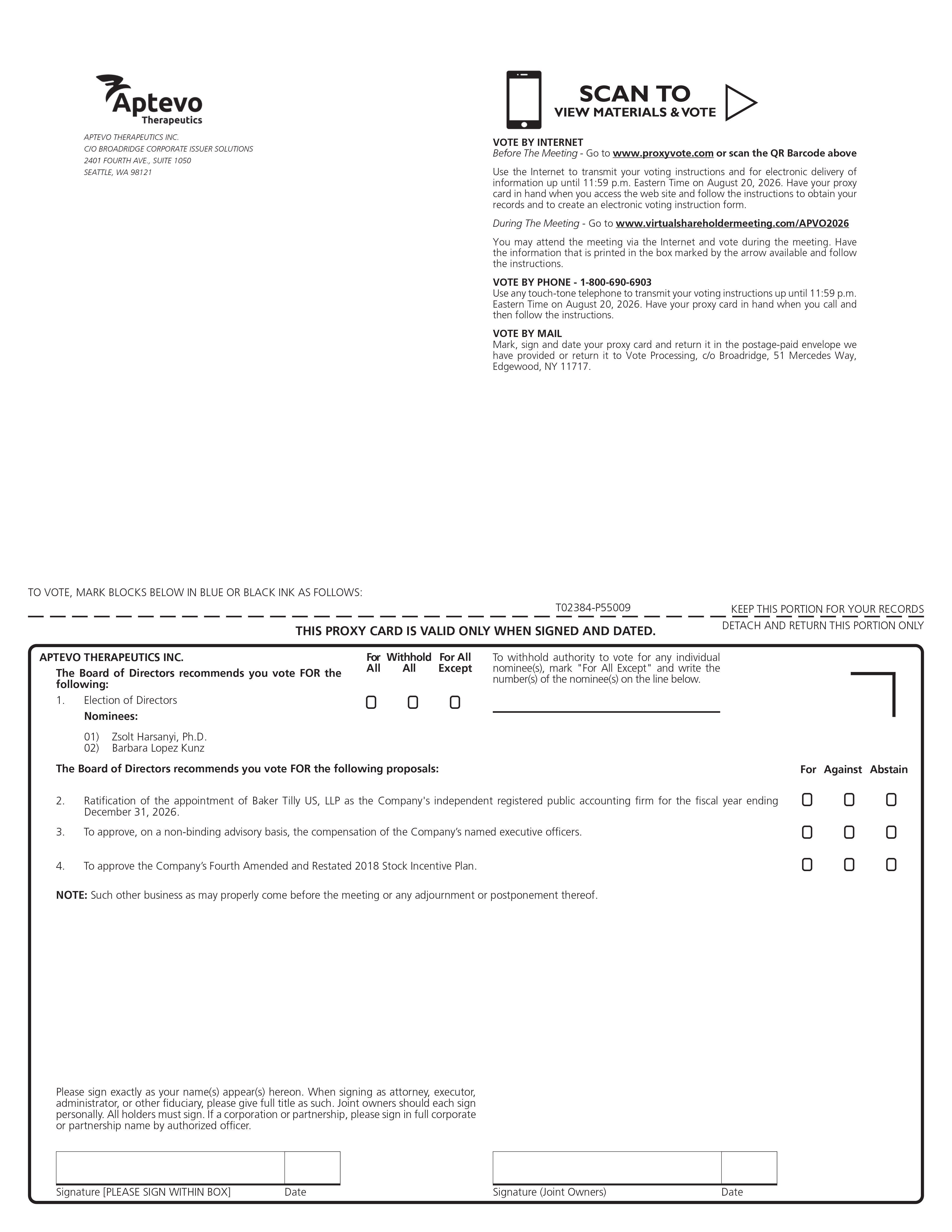
Aptevo Therapeutics APTEVO THERAPEUTICS INC. C/O BROADRIDGE CORPORATE ISSUER SOLUTIONS 2401 FOURTH AVE., SUITE 1050 SEATTLE, WA 98121 SCAN TO VIEW MATERIALS & VOTE VOTE BY INTERNET Before The Meeting - Go to www.proxyvote.com or scan the QR Barcode above Use the Internet to transmit your voting instructions and for electronic delivery of information up until 11:59 p.m. Eastern Time on August 20, 2026. Have your proxy card in hand when you access the web site and follow the instructions to obtain your records and to create an electronic voting instruction form. During The Meeting - Go to www.virtualshareholdermeeting.com/APVO2026 You may attend the meeting via the Internet and vote during the meeting. Have the information that is printed in the box marked by the arrow available and follow the instructions. VOTE BY PHONE - 1-800-690-6903 Use any touch-tone telephone to transmit your voting instructions up until 11:59 p.m. Eastern Time on August 20, 2026. Have your proxy card in hand when you call and then follow the instructions. VOTE BY MAIL Mark, sign and date your proxy card and return it in the postage-paid envelope we have provided or return it to Vote Processing, c/o Broadridge, 51 Mercedes Way, Edgewood, NY 11717. TO VOTE, MARK BLOCKS BELOW IN BLUE OR BLACK INK AS FOLLOWS: T02384-P55009 KEEP THIS PORTION FOR YOUR RECORDS THIS PROXY CARD IS VALID ONLY WHEN SIGNED AND DATED. DETACH AND RETURN THIS PORTION ONLY APTEVO THERAPEUTICS INC. The Board of Directors recommends you vote FOR the following: For All Withhold All For All Except To withhold authority to vote for any individual nominee(s), mark "For All Except" and write the number(s) of the nominee(s) on the line below. 1. Election of Directors Nominees: 01) Zsolt Harsanyi, Ph.D. 02) Barbara Lopez Kunz The Board of Directors recommends you vote FOR the following proposals: For Against Abstain 2. Ratification of the appointment of Baker Tilly US, LLP as the Company's independent registered public accounting firm for the fiscal year ending December 31, 2026. 3. To approve, on a non-binding advisory basis, the compensation of the Company’s named executive officers. 4. To approve the Company’s Fourth Amended and Restated 2018 Stock Incentive Plan. NOTE: Such other business as may properly come before the meeting or any adjournment or postponement thereof. Please sign exactly as your name(s) appear(s) hereon. When signing as attorney, executor, administrator, or other fiduciary, please give full title as such. Joint owners should each sign personally. All holders must sign. If a corporation or partnership, please sign in full corporate or partnership name by authorized officer. Signature [PLEASE SIGN WITHIN BOX] Date Signature (Joint Owners) Date
Important Notice Regarding the Availability of Proxy Materials for the Annual Meeting: The Proxy Statement and Annual Report on Form 10-K are available at www.proxyvote.com. T02385-P55009APTEVO THERAPEUTICS INC. THIS PROXY IS SOLICITED ON BEHALF OF THE BOARD OF DIRECTORS ANNUAL MEETING OF STOCKHOLDERS AUGUST 21, 2026 at 10:00 A.M., PACIFIC TIME The stockholder(s) hereby appoint(s) SoYoung Kwon and Daphne Taylor, or either of them, as proxies, each with the power to appoint her substitute, and hereby authorize(s) them to represent and to vote, as designated on the reverse side of this ballot, all of the shares of Common Stock of Aptevo Therapeutics Inc. that the stockholder(s) is/are entitled to vote at the virtual Annual Meeting of Stockholders to be held at 10:00 a.m., Pacific Time on Friday, August 21, 2026, and any adjournment or postponement thereof. THIS PROXY, WHEN PROPERLY EXECUTED, WILL BE VOTED AS DIRECTED BY THE STOCKHOLDER(S). IF NO SUCH DIRECTIONS ARE MADE, THIS PROXY WILL BE VOTED "FOR" THE ELECTION OF THE NOMINEES LISTED ON THE REVERSE SIDE FOR THE BOARD OF DIRECTORS, AND "FOR" PROPOSALS 2, 3, AND 4. PLEASE MARK, SIGN, DATE AND RETURN THIS PROXY CARD PROMPTLY USING THE ENCLOSED REPLY ENVELOPE. CONTINUED AND TO BE SIGNED ON REVERSE SIDE